
Trade
The workshop
Wood, iron, arrows, nails, wheels, and a knapped edge.
A workshop owned its tools and sold a finished thing. The factory and the firearm took the customer.
In this trade
8
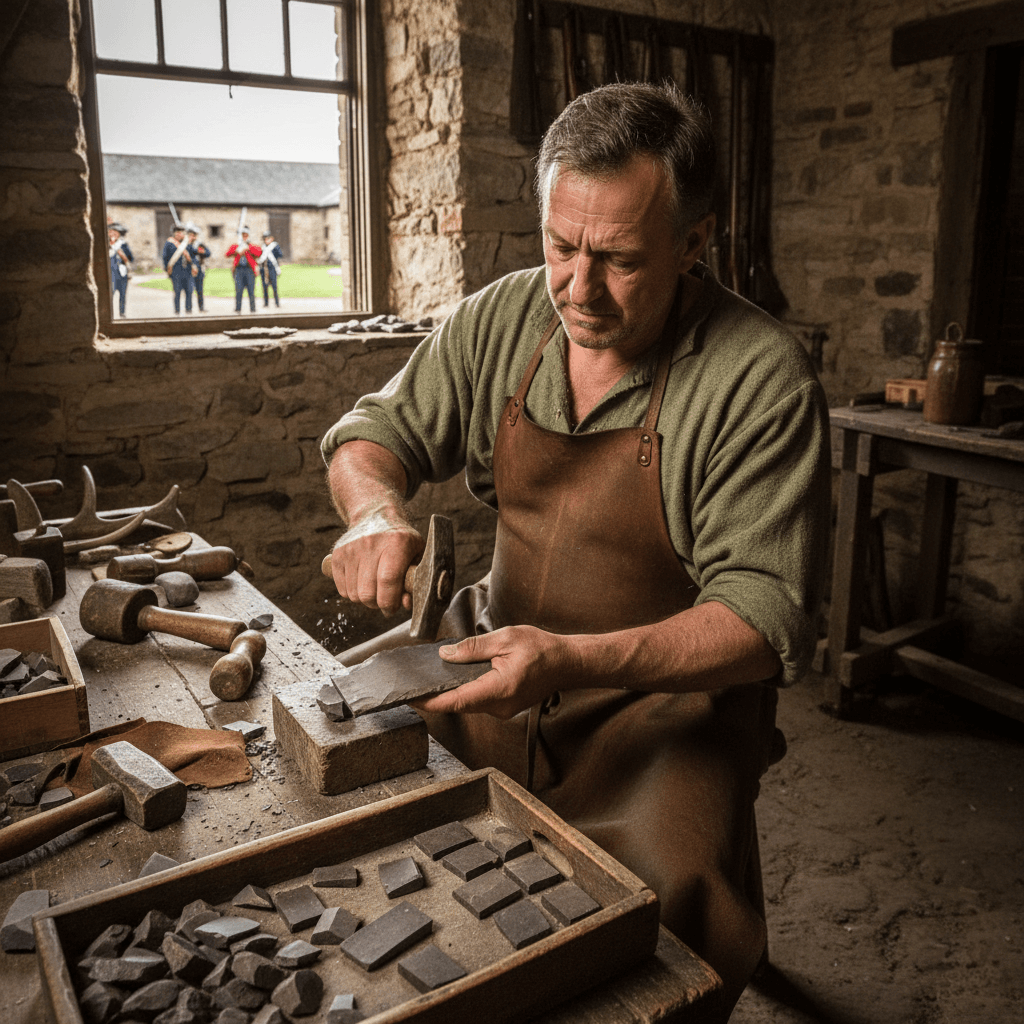
- Past · Prehistoric EraFlint KnapperThe flint knapper was a skilled artisan responsible for shaping flint and other stones into tools and weapons, a practice that dates back to the earliest human societies. This occupation was crucial for survival, as the tools created by flint knappers were essential for hunting, gathering, and daily tasks. Flint knapping involved a deep understanding of the material properties of stone, as well as the techniques required to create sharp edges and points. The flint knapper would carefully strike the stone with a hammerstone or another tool, removing flakes to create the desired shape. This process required not only physical skill but also an artistic eye, as the knapper had to envision the final product while working with the raw material. Flint knappers often worked in groups, sharing techniques and knowledge, which contributed to the development of regional styles and tool types. The tools produced ranged from simple hand axes to complex projectile points, each designed for specific tasks and environments. As societies evolved, so did their tool-making techniques, leading to the eventual decline of the flint knapper's role in favor of metalworking and other advanced technologies.
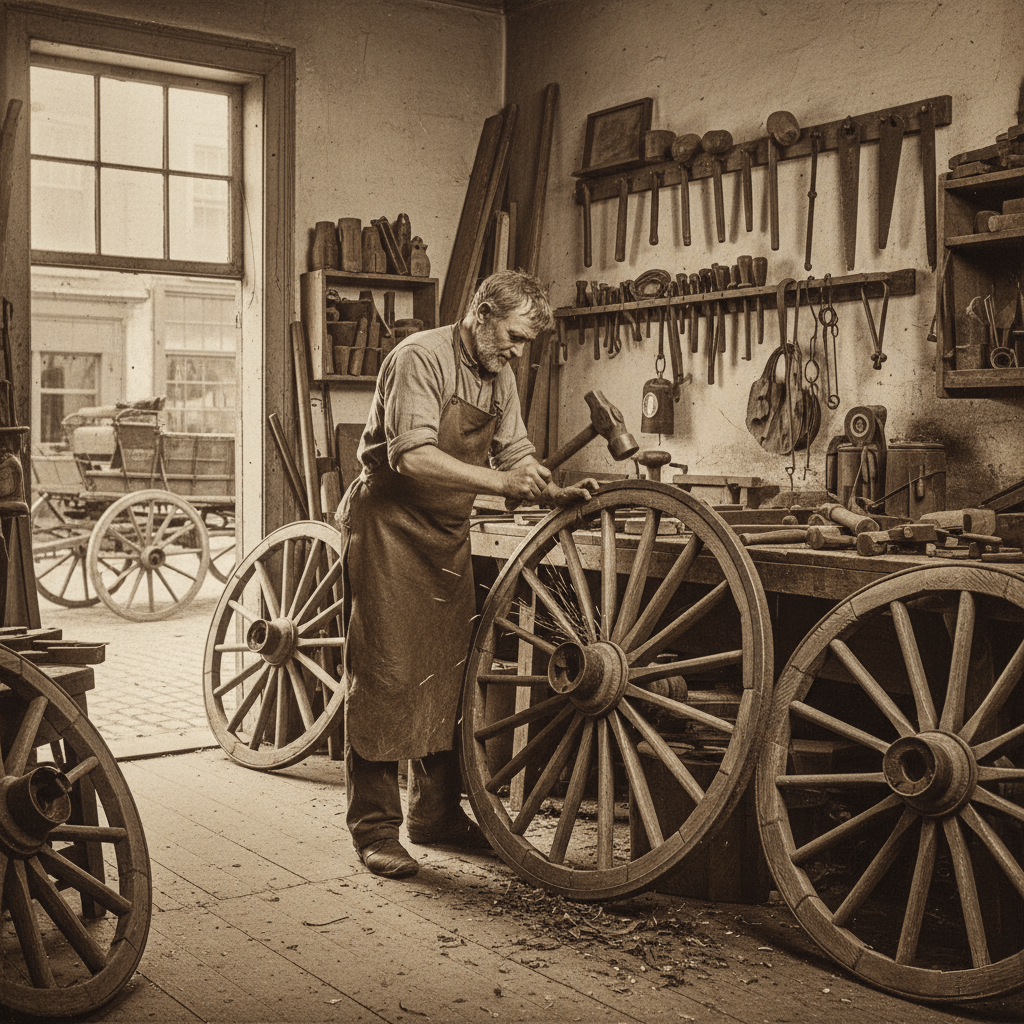 Past · Pre-Industrial EraWainwrightThe wainwright was a skilled craftsman responsible for the construction and repair of wagons and carts, essential vehicles for transportation before the advent of motorized vehicles. This occupation flourished in rural and urban settings, where the demand for sturdy, reliable transport was paramount for trade, agriculture, and daily life. Wainwrights utilized a variety of materials, primarily wood and iron, to create vehicles that could withstand the rigors of travel across uneven terrain. Their work was not only functional but also reflected the artistry of craftsmanship, with many wainwrights taking pride in the aesthetic details of their creations, such as decorative carvings and paintwork. The role of the wainwright was crucial in supporting the economy, as they provided the means for farmers to transport goods to market and for merchants to deliver products to consumers.
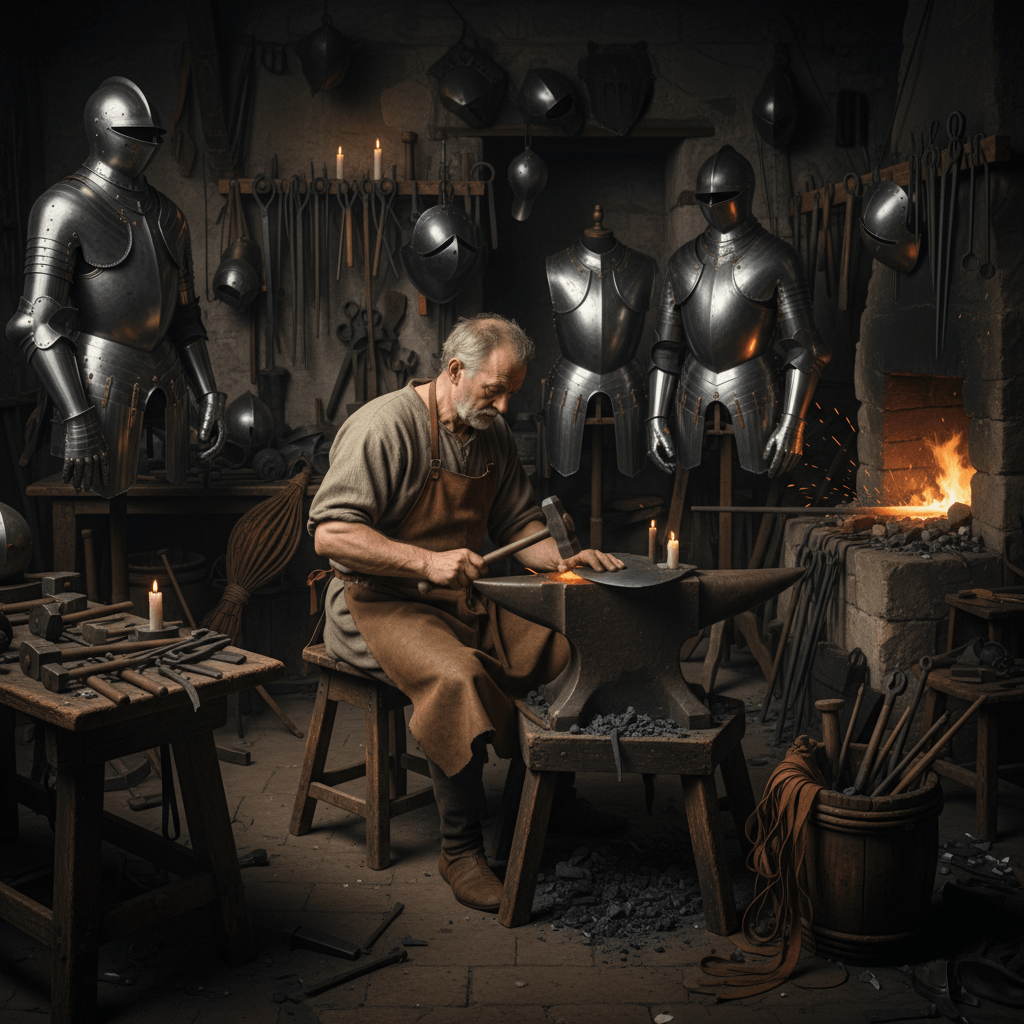 Past · Medieval PeriodArmourerThe role of the armourer was pivotal in the medieval period, a time when warfare and personal protection were paramount. Armourers were skilled craftsmen responsible for creating, repairing, and maintaining the protective gear worn by soldiers and knights. Their work encompassed a variety of tasks, including forging metal plates, shaping chainmail, and crafting helmets, shields, and other defensive equipment. The craftsmanship of an armourer was not only functional but also often artistic, with intricate designs and embellishments that reflected the status and wealth of the wearer. The armourer’s workshop was a hub of activity, filled with the sounds of hammering metal, the glow of the forge, and the smell of heated iron. Each piece of armour was custom-fitted to the individual, ensuring both protection and mobility in battle. As warfare evolved, so too did the demands on armourers, who had to adapt their techniques and designs to meet the changing needs of their clients.
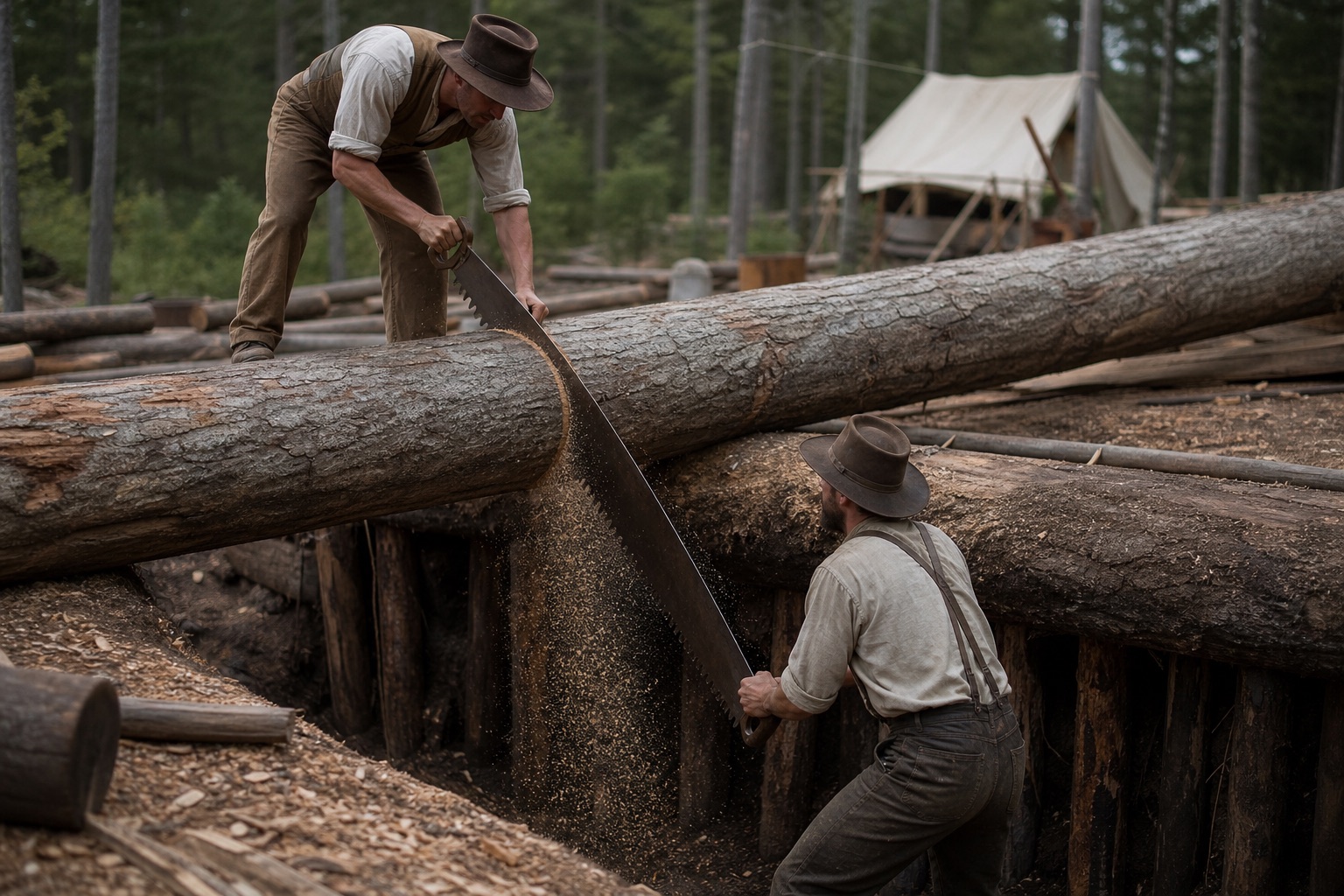 Past · Georgian EraPit-SawyerTwo men and one long saw turned a balk of timber into boards. The top-sawyer stood on the log, chalk line between his boots, and guided the blade. The pitman stood in the pit beneath, hauling the saw down through oak, elm, or deal while the dust settled on him. Iron dogs held the balk. Wooden wedges kept the kerf from pinching the plate. In a royal dockyard the pit might be a dug hole or a raised cradle; in a country yard it was often opened where the trees had been felled. A straight deal could come off in a morning. Compass timber for a shipwright, curved and stubborn, took the rest of the day and a higher price on the tally.
From the seventeenth century into the middle of the nineteenth this pair supplied house carpenters and shipyards in Britain, and the same pit was dug in colonial timber towns that had logs and no mill. Water-driven saws already existed in some districts, yet a pit could be set up wherever a merchant landed timber, and British yards were slow to give the work up. The top-sawyer's name even passed into ordinary speech for the person who stood first at a job. What ended the pit was the steam sawmill in the timber ports, which cut the same balk faster and sold the deals cheaper. The pits were not closed by proclamation. Builders bought mill-sawn stock, and the hundred-foot bargain stopped being offered.
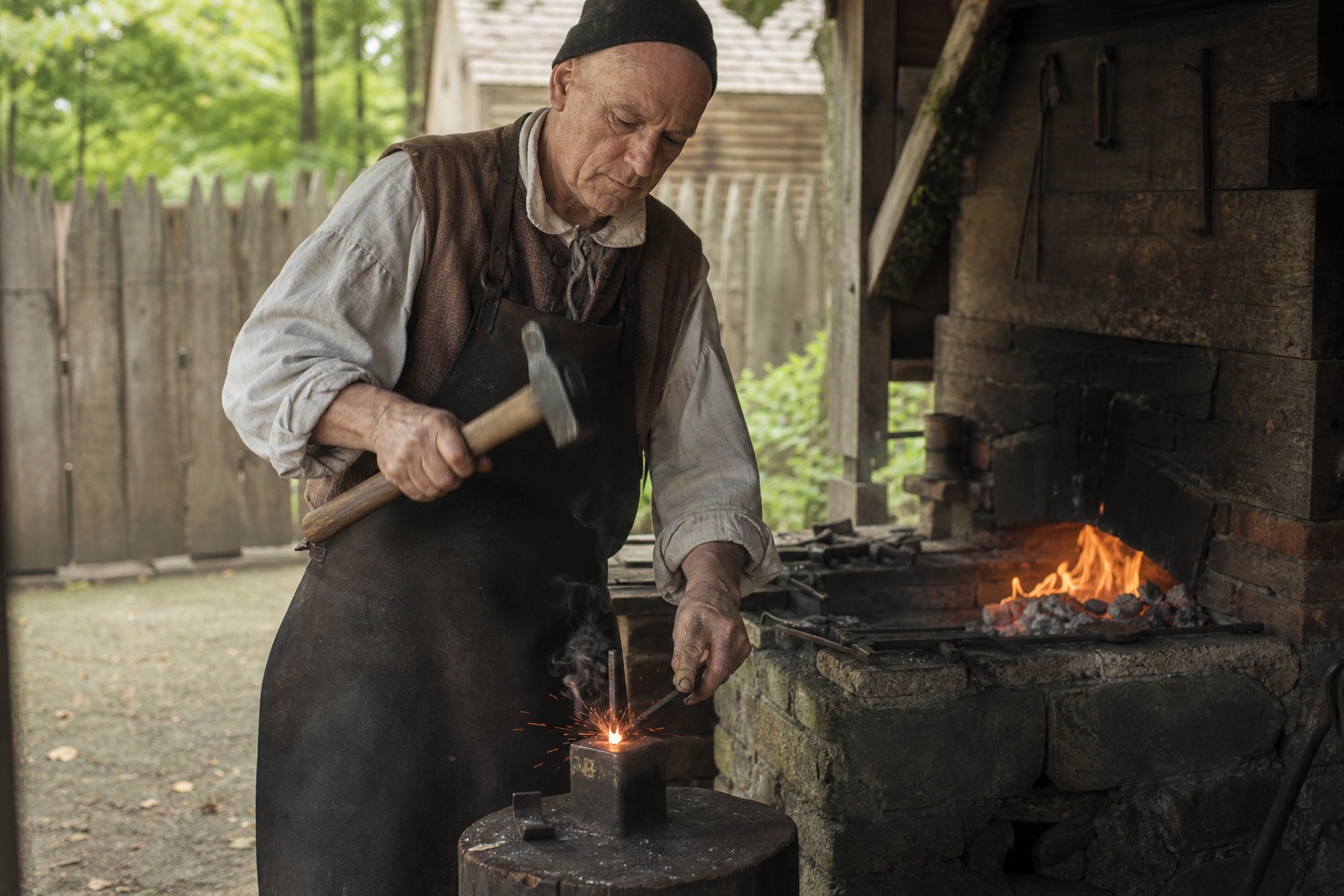 Past · Victorian EraNailerA nailer in the Black Country made nails one at a time at a hearth in the house. Rod iron, taken from a fogger, was heated, pointed, cut, and headed in a bore, often under an oliver, the foot-worked hammer that put a heavier blow behind a small hand. Dudley, Sedgley, Gornal, Lye, Halesowen, and the shops toward Bromsgrove were dense with these hearths. The count was the thousand. The fogger who had supplied the rod bought the nails back, and his prices on both sides of the bargain were deducted before the family saw cash. It was outwork, not a factory bell, and the workshop was the room where the household also lived.
Cut nails, sheared from sheet by machine from the early nineteenth century, undercut the common wrought nail. Wire nails, cheap in quantity by the 1880s and 1890s, destroyed what was left of the price. Reporters for the children's employment inquiries of the 1840s already found whole families at the block, children old enough to heat a rod or head a small nail working a long day inside a tally of a few shillings. The reports list hours and prices. Horse nails and a few special sorts lingered as hand work after general nails had gone. The nail in an ordinary carpenter's bag had become a machine nail, and the hearth could not sell against it.
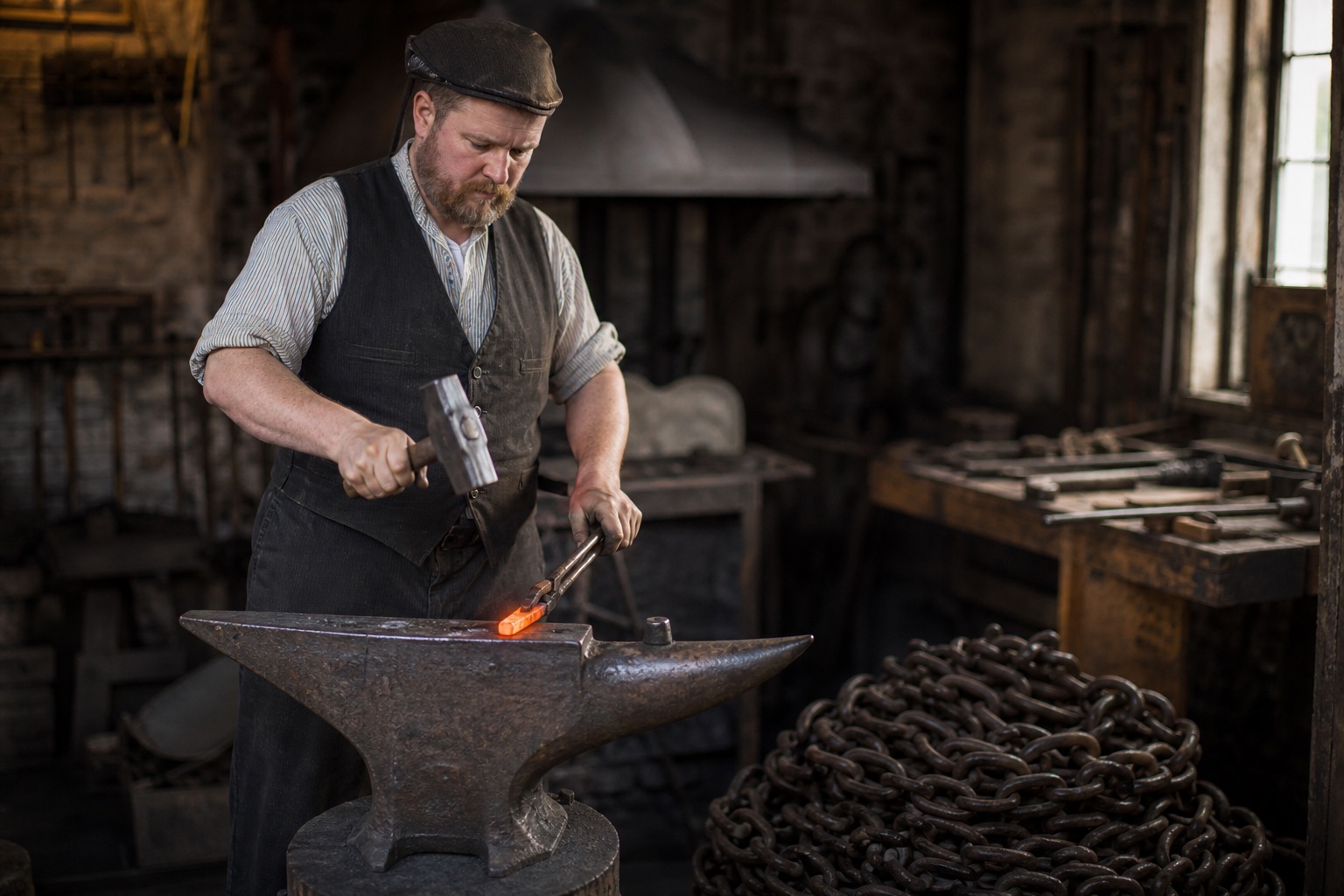 Past · Early Twentieth CenturyChainmakerAt Cradley Heath, and in the small-chain streets of Old Hill and the neighbouring towns, chain was hammered link by link. A woman scarfed a short iron rod, bent it through the previous link, and welded the join on a bick in a backyard shop, a dolly shop, paid by the hundredweight. This was the small work: common chain, dog chain, the lighter sizes. Heavy cable was men's work in larger shops. Before 1910 the backyard bargain was a sweated one. A woman could be at the hearth from morning into the evening and take home five or six shillings for the week, girls learning beside her at a still smaller share of that weight.
Mary Macarthur and the National Federation of Women Workers led the chainmakers' strike of 1910 so that employers would actually pay the minimum the Chain Trade Board had fixed under the Trade Boards Act of 1909, twopence-halfpenny an hour. The strike succeeded. It put a floor under the wage. It did not preserve the backyard hammer as the way ordinary chain would be made. Machine-made chain, and then welded chain from factories, supplied common links more cheaply than a legal hand rate could. The women had stopped the starvation price. Across the early twentieth century the market took the bulk orders to the factory, and the old domestic shops thinned away.
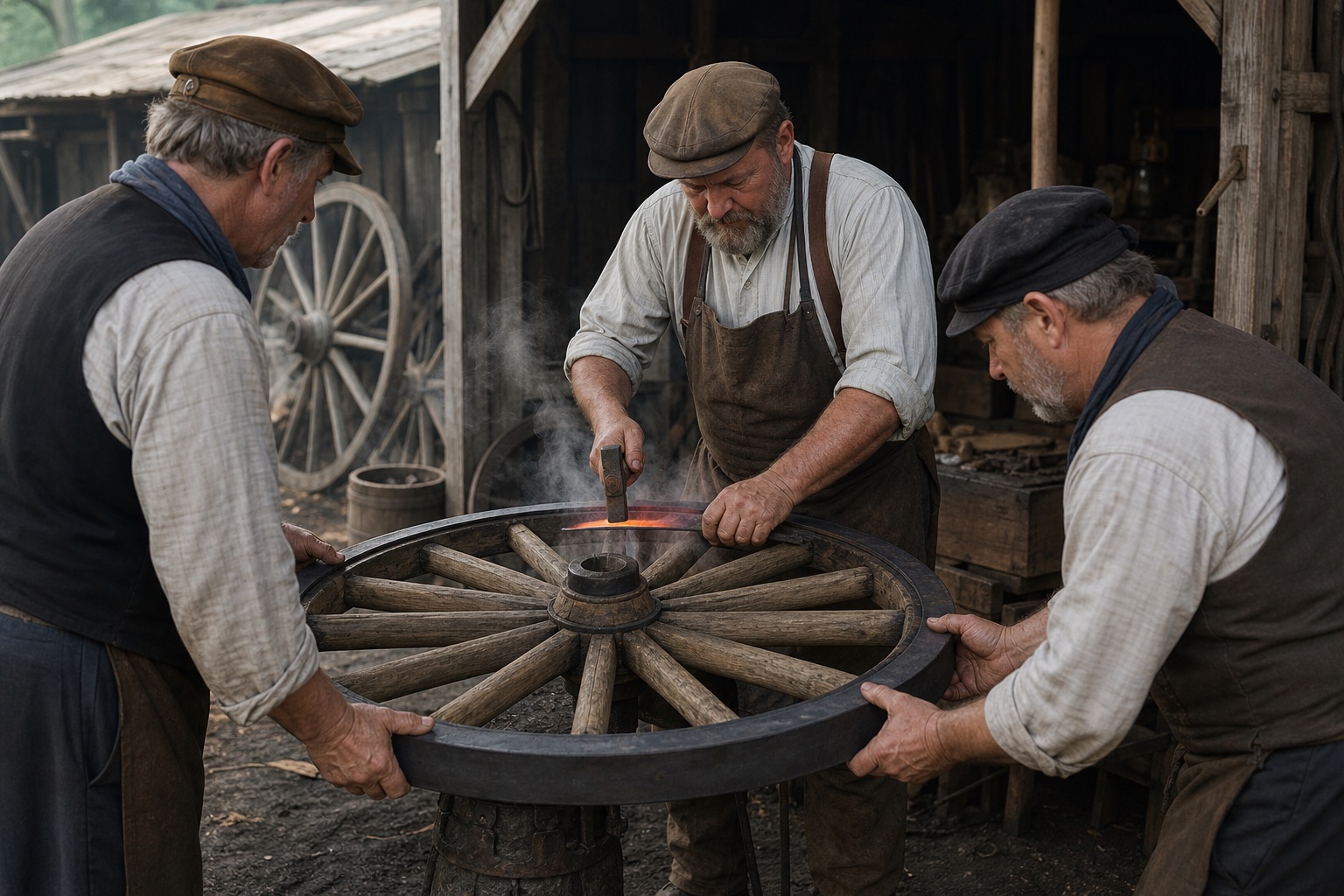 Past · Early Twentieth CenturyWheelwrightA wheelwright made the wooden wheel that carried a cart, a waggon, or a carriage, and he shod it with iron. The stock, or nave, was the hub, boxed with iron for the axle. Spokes were dressed and driven into mortises. Felloes, curved sections of ash or elm, made the rim and were dowelled into a circle. The wheel was dished, set as a shallow cone, so it stood plumb under the load when the cart moved. A hoop tyre was then heated on a circular fire, dropped over the rim, and quenched so the iron shrank tight and pulled the joints home. George Sturt, who ran his family shop at Farnham in Surrey from 1884 and published The Wheelwright's Shop in 1923, described this as a whole literacy in timber. Every country town had some version of that bench.
Rubber tyres, the motor trade, and factory wheels removed the reason for the bench. A pneumatic tyre does not sit on a craftsman-cut felloe in the old way. A motor van does not come to the wheelwright for a new stock. Factories supplied wooden wheels and then metal ones faster than a shop could spoke them, and cheaper. Farm repairs lingered where iron-shod carts still worked, into the 1920s and 1930s. The boy who in 1900 could still be offered seven years at the bench was, a generation on, looking at a trade that no longer bound apprentices.
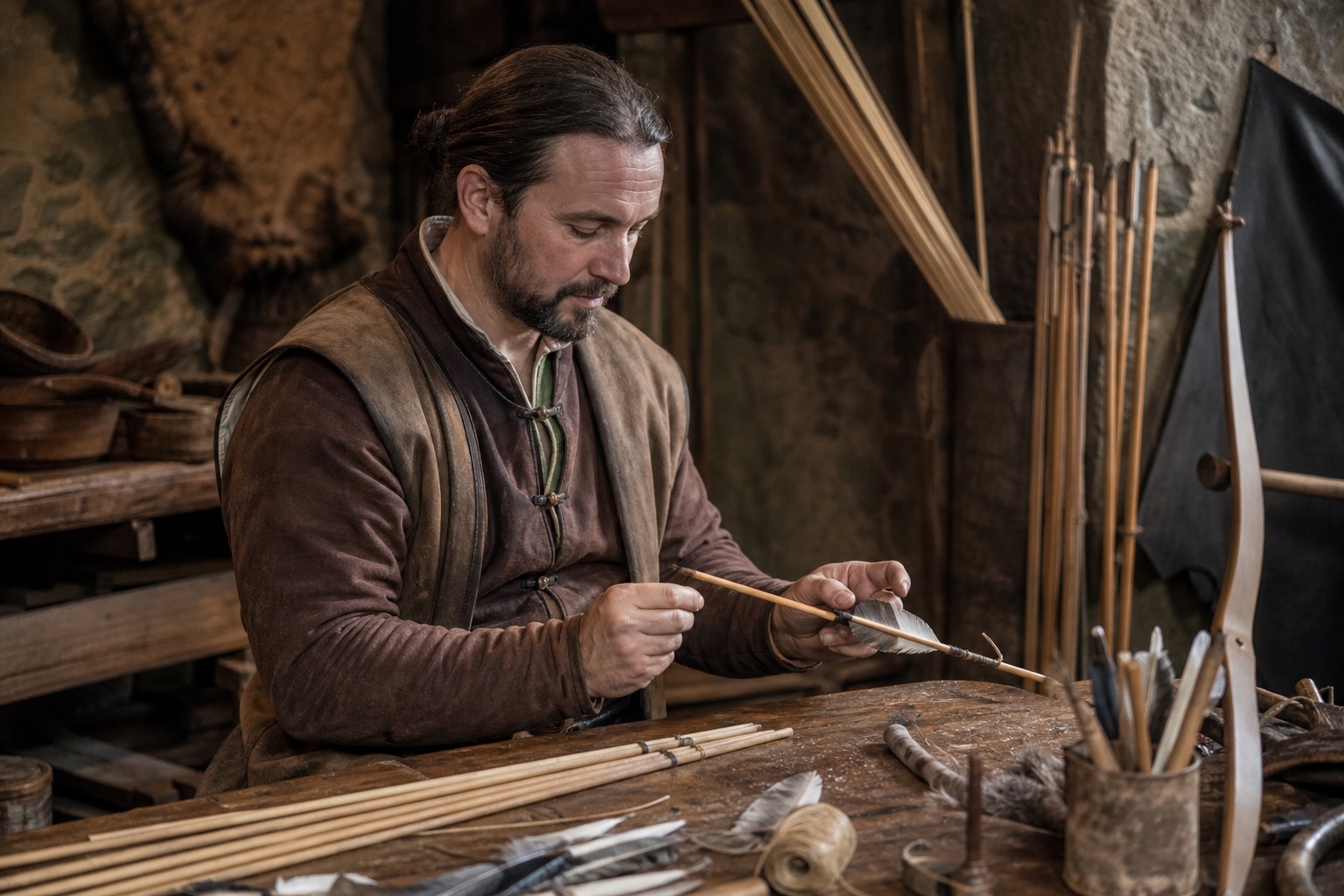 Past · Tudor EraFletcherA fletcher made arrows, and the trade was not the bowyer's. The bowyer made the bow. The fletcher planed and straightened the shaft, cut the nock that took the string, fitted the pile at the point, and glued and bound the feathers, usually from the goose, setting the cock feather so the arrow would leave the bow cleanly. Finished arrows were tied in a sheaf of four-and-twenty. In a medieval or Tudor town this was a guild craft. London fletchers worked under ordinances from the fourteenth century and kept themselves distinct from the bowyers. York, Chester, and other corporate towns had their own men. The customers were civic musters, ship stores, and householders obliged to practise at the butts.
Firearms ended the order slowly. Calivers and muskets spread through Tudor armies and then through the trained bands, and the statutes that told grown men to keep longbows and to shoot at the butts turned into a dead letter without one repealing morning. Sporting archery never employed a town full of fletchers. Some workshops drifted into other light woodwork. The London Company of Fletchers survived as a livery company. The making of war arrows did not. It thinned across the sixteenth century and was a remnant in the seventeenth, because the weapon the authorities issued had become the gun.