
Tudor Era
Fletcher
An extinct profession from Tudor Era that became obsolete due to technological advancement and societal change.
Media Gallery
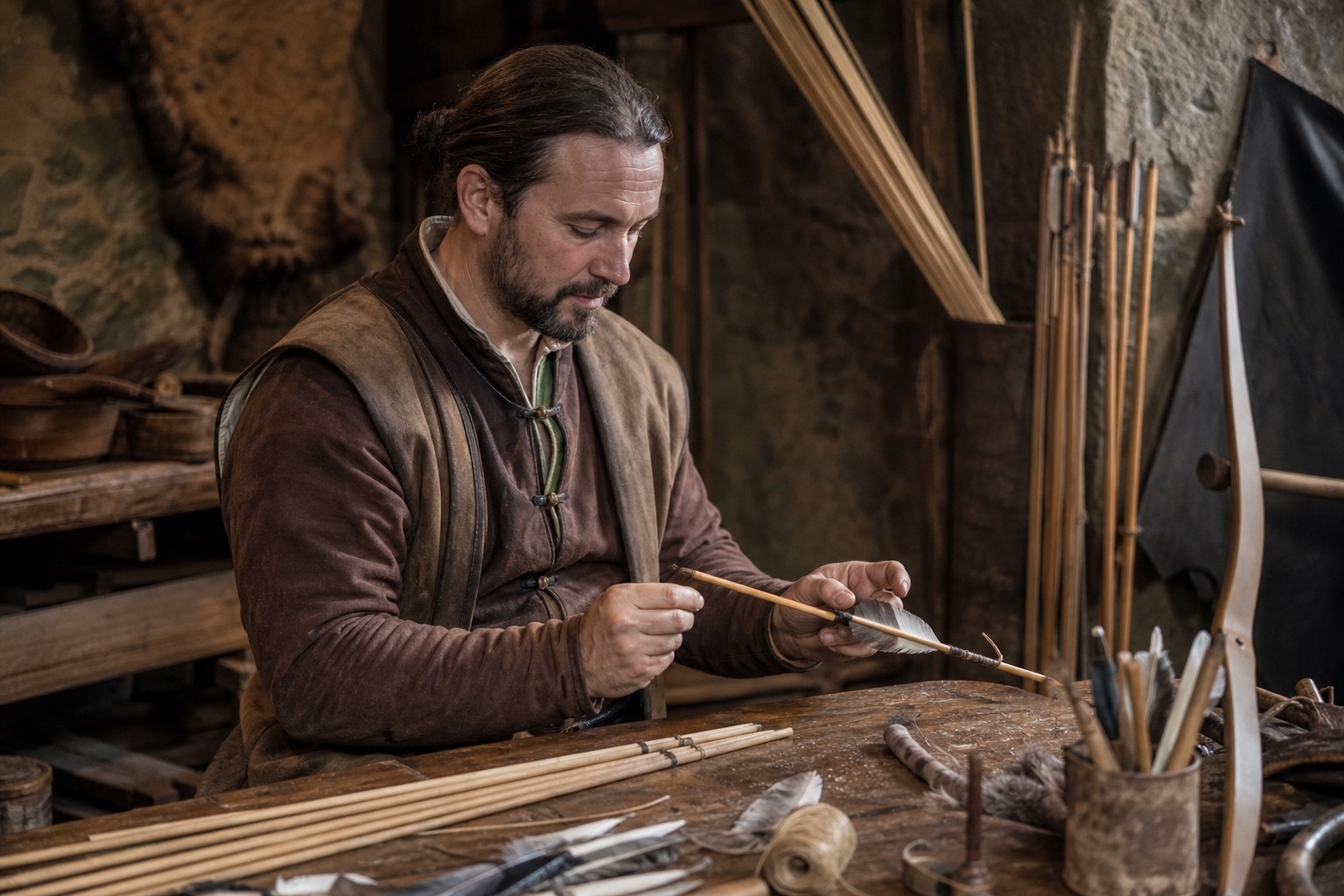
About the Fletcher profession
A fletcher made arrows, and the trade was not the bowyer's. The bowyer made the bow. The fletcher planed and straightened the shaft, cut the nock that took the string, fitted the pile at the point, and glued and bound the feathers, usually from the goose, setting the cock feather so the arrow would leave the bow cleanly. Finished arrows were tied in a sheaf of four-and-twenty. In a medieval or Tudor town this was a guild craft. London fletchers worked under ordinances from the fourteenth century and kept themselves distinct from the bowyers. York, Chester, and other corporate towns had their own men. The customers were civic musters, ship stores, and householders obliged to practise at the butts.
Firearms ended the order slowly. Calivers and muskets spread through Tudor armies and then through the trained bands, and the statutes that told grown men to keep longbows and to shoot at the butts turned into a dead letter without one repealing morning. Sporting archery never employed a town full of fletchers. Some workshops drifted into other light woodwork. The London Company of Fletchers survived as a livery company. The making of war arrows did not. It thinned across the sixteenth century and was a remnant in the seventeenth, because the weapon the authorities issued had become the gun.
Day in the Life of a Fletcher
Planing the shafts
The morning's work was shafts: seasoned wood selected for straightness, planed, scraped, and brought to a common length and weight so a sheaf would fly alike. A warped stave was set aside or corrected, not fletched in the hope the feathers would hide it. The guild's reputation sat on this sorting, and a mixed sheaf brought a complaint from the muster and a fine.
Nocks and piles
Each shaft was nocked at the heel to take the string, the cut even so the arrow would not split on the loose. The pile, the metal head, was fitted at the point, sometimes made by an arrowsmith and sometimes set by the fletcher himself from heads bought in. A loose pile or a crooked nock spoiled the shaft no matter how fine the feathers that came next.
Goose feathers
Feathers, typically goose, were pared, glued, and bound, three to a shaft, the cock feather distinguished so the archer could nock by touch. The glue had to set before the binding was trusted, and the trim had to leave each flight the same. This was the work that gave the trade its name, from the French word for an arrow's feather, and it was the slow part of a sheaf.
Binding the sheaf
Four-and-twenty finished arrows were matched and tied as a sheaf, the unit of sale and of civic order. The journeyman's day was counted in sheaves the shop could honestly offer, not in hours the ordinance would pay. A sheaf for the butts and a sheaf for a ship's chest left the same bench, and when those orders thinned the bench had no new unit to tie.
What came after
Arrows were a guild trade until firearms made the sheaf irrelevant to war and, slowly, to the hunt.
The succession pageRelated Exhibits
Agoranomos
The Agoranomos was a pivotal figure in the bustling marketplaces of ancient Greece, particularly in city-states like Athens. This role was akin to that of a modern-day market supervisor or inspector, responsible for overseeing the activities within the agora, the central public space where commerce, politics, and social interaction flourished. The Agoranomos ensured that trade was conducted fairly, that weights and measures were accurate, and that vendors adhered to the laws governing commerce. They played a crucial role in maintaining order and integrity in the marketplace, which was vital for the economic health of the city-state. In addition to regulatory duties, the Agoranomos also had the authority to impose fines on dishonest merchants and to confiscate goods that were sold under false pretenses. This position required a deep understanding of local laws and trade practices, as well as a keen sense of justice to protect both consumers and honest traders. The Agoranomos was often seen as a guardian of the public interest, ensuring that the agora remained a vibrant and trustworthy hub of activity.
Aircraft Listener
The role of an Aircraft Listener emerged in the mid-20th century, primarily during the Post-War Era, when aviation technology was rapidly advancing and air traffic was increasing significantly. Aircraft Listeners were tasked with monitoring and interpreting the sounds of aircraft engines, particularly in military contexts, where understanding the nuances of engine noise could indicate the type of aircraft, its operational status, and even potential mechanical issues. This job was crucial for military intelligence and air traffic control, as it provided valuable information about aircraft movements and capabilities without the need for visual confirmation. Listeners would often work in pairs or small teams, stationed at strategic locations such as airbases or observation posts. They utilized their acute hearing to distinguish between different aircraft types, noting variations in sound that could indicate changes in speed, altitude, or engine performance. This auditory skill was honed through extensive training and experience, as the ability to identify aircraft by sound alone was a rare and valuable talent. The job required not only a keen ear but also a deep understanding of aviation technology and the specific characteristics of various aircraft engines. Listeners would often keep detailed logs of their observations, contributing to intelligence reports and operational assessments. The role was a blend of art and science, requiring both technical knowledge and an intuitive grasp of sound dynamics.
Explore More Exhibits
Discover the full collection of past and future professions in The Jobs Museum.