
Georgian Era
Pit-Sawyer
An extinct profession from Georgian Era that became obsolete due to technological advancement and societal change.
Media Gallery
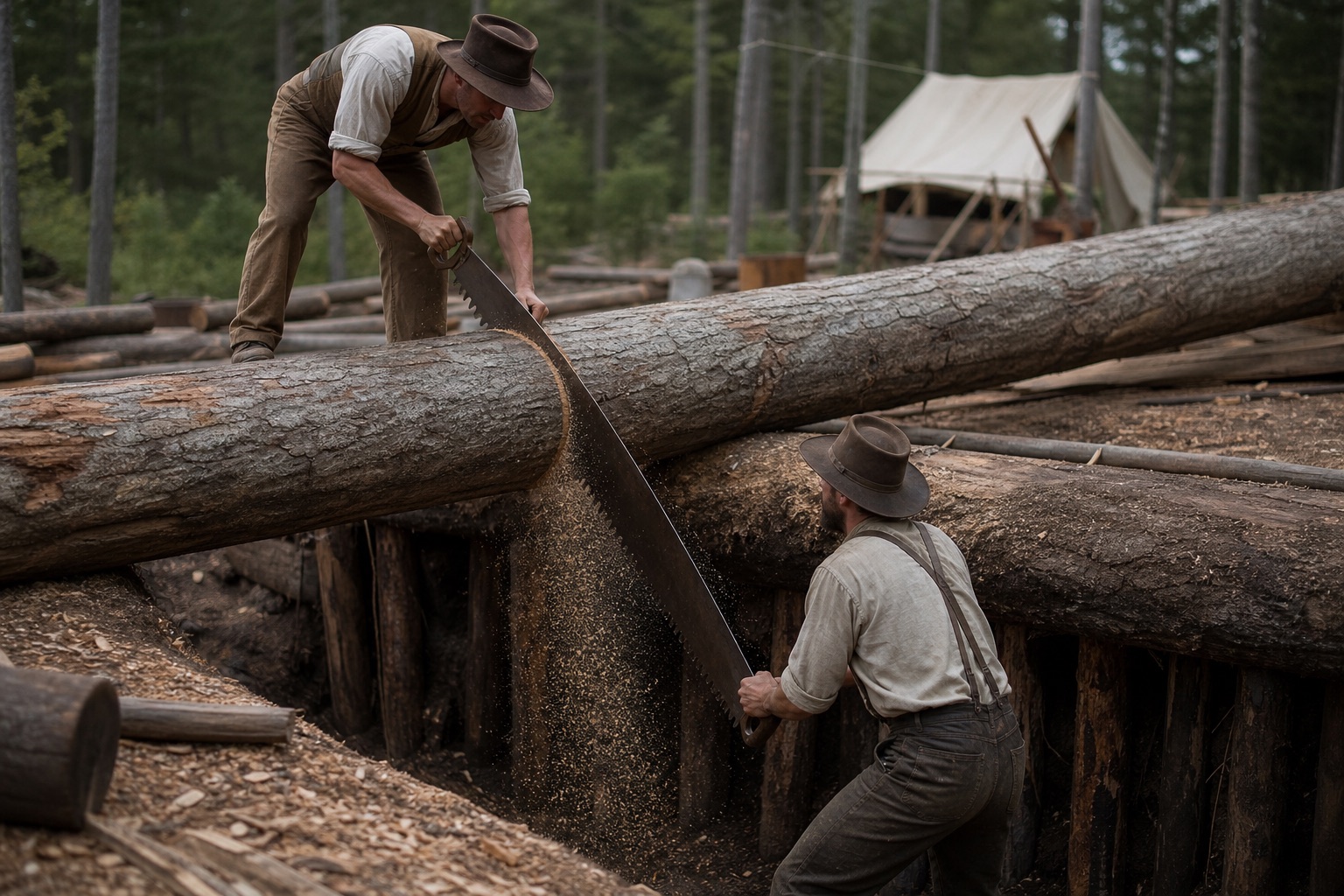
About the Pit-Sawyer profession
Two men and one long saw turned a balk of timber into boards. The top-sawyer stood on the log, chalk line between his boots, and guided the blade. The pitman stood in the pit beneath, hauling the saw down through oak, elm, or deal while the dust settled on him. Iron dogs held the balk. Wooden wedges kept the kerf from pinching the plate. In a royal dockyard the pit might be a dug hole or a raised cradle; in a country yard it was often opened where the trees had been felled. A straight deal could come off in a morning. Compass timber for a shipwright, curved and stubborn, took the rest of the day and a higher price on the tally.
From the seventeenth century into the middle of the nineteenth this pair supplied house carpenters and shipyards in Britain, and the same pit was dug in colonial timber towns that had logs and no mill. Water-driven saws already existed in some districts, yet a pit could be set up wherever a merchant landed timber, and British yards were slow to give the work up. The top-sawyer's name even passed into ordinary speech for the person who stood first at a job. What ended the pit was the steam sawmill in the timber ports, which cut the same balk faster and sold the deals cheaper. The pits were not closed by proclamation. Builders bought mill-sawn stock, and the hundred-foot bargain stopped being offered.
Day in the Life of a Pit-Sawyer
Dogging the balk
Before any sawing, the pair rolled the log over the pit on rollers and spiked it with iron dogs so it could not turn. The top-sawyer snapped a chalk line the length of the cut and sighted it from the butt for twist. Compass timber for a frame followed the shipwright's marks, not a straight edge, and a bad line would waste the whole balk.
Starting the kerf
The top-sawyer started the cut, lifting and guiding, while the pitman caught the rhythm of the long blade from below. They did not rush the first inches, because a wander at the end would run the deal off the line. Dust had to be kept from packing in the kerf, or the saw would bind and the man below would lose the stroke.
Holding the line
As the cut lengthened, one of them tapped wooden wedges into the kerf so the weight of the balk would not pinch the blade. The pitman worked in a steady fall of dust, timing his pull to the man above, whom he heard more clearly than he saw. On a long deal they stopped to reset the dogs and to brush the chalk clear before the saw wandered off the mark.
Stacking the deals
When the board dropped free they stacked it to season and marked the tally, because pay was by the hundred feet and not by the hours in the pit. The top-sawyer's larger share was settled before the next balk was rolled on. A slack week showed at once: no cut meant no shillings, and the pit was swept out for nothing.
What came after
A pit and a two-man saw lost to a mill powered by water and then by steam.
The succession pageRelated Exhibits
Agoranomos
The Agoranomos was a pivotal figure in the bustling marketplaces of ancient Greece, particularly in city-states like Athens. This role was akin to that of a modern-day market supervisor or inspector, responsible for overseeing the activities within the agora, the central public space where commerce, politics, and social interaction flourished. The Agoranomos ensured that trade was conducted fairly, that weights and measures were accurate, and that vendors adhered to the laws governing commerce. They played a crucial role in maintaining order and integrity in the marketplace, which was vital for the economic health of the city-state. In addition to regulatory duties, the Agoranomos also had the authority to impose fines on dishonest merchants and to confiscate goods that were sold under false pretenses. This position required a deep understanding of local laws and trade practices, as well as a keen sense of justice to protect both consumers and honest traders. The Agoranomos was often seen as a guardian of the public interest, ensuring that the agora remained a vibrant and trustworthy hub of activity.
Aircraft Listener
The role of an Aircraft Listener emerged in the mid-20th century, primarily during the Post-War Era, when aviation technology was rapidly advancing and air traffic was increasing significantly. Aircraft Listeners were tasked with monitoring and interpreting the sounds of aircraft engines, particularly in military contexts, where understanding the nuances of engine noise could indicate the type of aircraft, its operational status, and even potential mechanical issues. This job was crucial for military intelligence and air traffic control, as it provided valuable information about aircraft movements and capabilities without the need for visual confirmation. Listeners would often work in pairs or small teams, stationed at strategic locations such as airbases or observation posts. They utilized their acute hearing to distinguish between different aircraft types, noting variations in sound that could indicate changes in speed, altitude, or engine performance. This auditory skill was honed through extensive training and experience, as the ability to identify aircraft by sound alone was a rare and valuable talent. The job required not only a keen ear but also a deep understanding of aviation technology and the specific characteristics of various aircraft engines. Listeners would often keep detailed logs of their observations, contributing to intelligence reports and operational assessments. The role was a blend of art and science, requiring both technical knowledge and an intuitive grasp of sound dynamics.
Explore More Exhibits
Discover the full collection of past and future professions in The Jobs Museum.