
Early Twentieth Century
Chainmaker
An extinct profession from Early Twentieth Century that became obsolete due to technological advancement and societal change.
Media Gallery
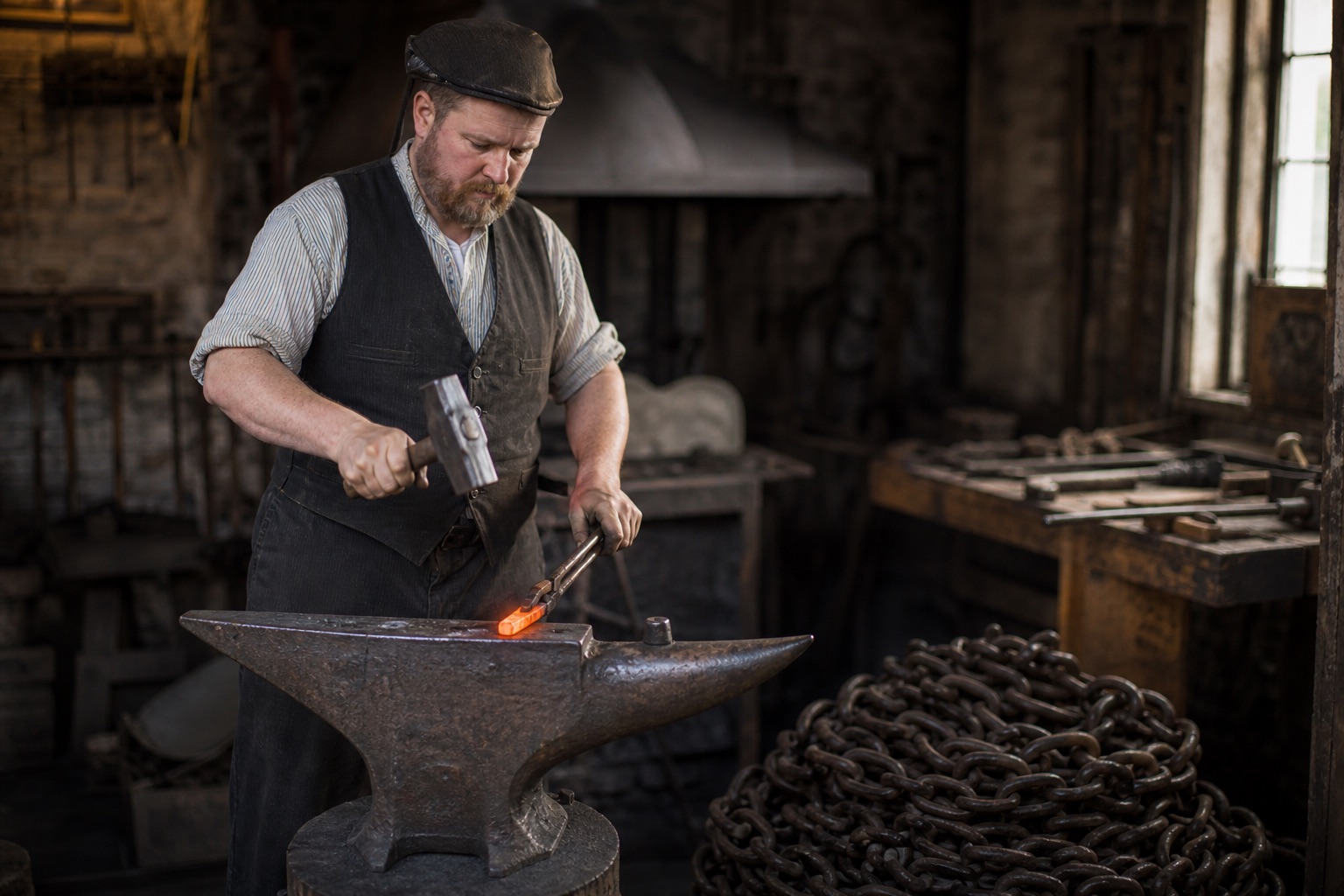
About the Chainmaker profession
At Cradley Heath, and in the small-chain streets of Old Hill and the neighbouring towns, chain was hammered link by link. A woman scarfed a short iron rod, bent it through the previous link, and welded the join on a bick in a backyard shop, a dolly shop, paid by the hundredweight. This was the small work: common chain, dog chain, the lighter sizes. Heavy cable was men's work in larger shops. Before 1910 the backyard bargain was a sweated one. A woman could be at the hearth from morning into the evening and take home five or six shillings for the week, girls learning beside her at a still smaller share of that weight.
Mary Macarthur and the National Federation of Women Workers led the chainmakers' strike of 1910 so that employers would actually pay the minimum the Chain Trade Board had fixed under the Trade Boards Act of 1909, twopence-halfpenny an hour. The strike succeeded. It put a floor under the wage. It did not preserve the backyard hammer as the way ordinary chain would be made. Machine-made chain, and then welded chain from factories, supplied common links more cheaply than a legal hand rate could. The women had stopped the starvation price. Across the early twentieth century the market took the bulk orders to the factory, and the old domestic shops thinned away.
Day in the Life of a Chainmaker
Cutting the rod
The morning's iron was cut to the length of one link for the size of chain in hand, small sizes for the women and girls in the backyard shops. Ends were scarfed, thinned so the weld would have something to take, before any link was closed. A wrong length was a wrong size, and a bundle of mixed sizes was paid as the cheaper sort, if it was paid at all.
Welding the link
Each scarf was bent through the last finished link, closed, and welded on the bick with a light hammer, the join brought to heat in the small hearth. The dolly and the tongs kept the hot end where the blow had to fall. Speed mattered because the pay, before the 1910 rate, was by the hundredweight, so a slow morning was a lighter bundle at the end of the week.
The chain growing
The chain lengthened on the shop floor, link by link, and someone checked the size as it grew so the buyer would not reject the hundredweight. Girls on the smallest work kept the same hours as the women, a long day, for a smaller share of the money. There was no factory hooter, and the shop stopped when the iron was used or the light and the hearth gave out.
Weighing the bundle
Finished chain was bundled and weighed, because the old price was per hundredweight and even the later hourly rate did not stop the employer counting what had been made. Before 1910 that weight often represented five or six shillings for a week of long days. After the strike, a woman who actually received twopence-halfpenny an hour could see something over ten shillings, which was the whole point of leaving the hearth to stand on the picket.
What came after
Small chain forged by women at Cradley Heath was replaced by machine-made chain. The 1910 strike won a minimum rate on the way out.
The succession pageRelated Exhibits
Bal-maiden
A bal-maiden broke and sorted copper ore, and sometimes tin, on the surface dressing floor of a Cornish or West Devon mine. She was not underground. The word bal is the mine itself. On a paved or boarded floor open to the weather she used a bucking hammer, a short-handled flat-faced tool, to crush ore small enough to be washed, and a heavier cobbing hammer on the larger stones. Waste rock was picked out by eye. Dressed ore went on to buddles and the rest of the surface plant, where water separated the heavier mineral. The trade runs from the eighteenth century, when these copper mines expanded, into the early twentieth, when the same mines closed and mechanical stamps, crushers, and later flotation did the breaking. The Mines and Collieries Act 1842 cleared women from underground work. It did not clear the dressing floor, and bal-maidens remained a normal part of the surface payroll long after that Act. Census returns use the title in Cornwall and around Tavistock. Devon Great Consols was among the large employers. The label is this hand floor, not a romantic pit woman and not a child-haulage job.
Comptometer Operator
A comptometer operator ran a Felt comptometer, the key-driven adding machine Dorr E. Felt brought out in 1887. Unlike a crank adder, it let several keys in a column go down together, so a trained hand could enter a number in one stroke. Banks, billing offices, railroads, and insurance rooms hired people, mostly women, to add and extend figures for hours at that keyboard. Operator schools taught the touch and certified speed. The product was a total the bookkeeper could trust, not a printed page of prose. The machine's long life makes the job look Victorian at the start, and the honest center of the exhibit is the twentieth-century office, ending when electronic calculators and computers took the columns in the 1960s and 1970s. A comptometer bureau might sell the labor by the batch. An in-house operator sat beside the ledgers she fed. Either way the skill was in the hands, and it did not survive the cheap electronic key.
Explore More Exhibits
Discover the full collection of past and future professions in The Jobs Museum.