
Mid Twentieth Century
Comptometer Operator
An extinct profession from Mid Twentieth Century that became obsolete due to technological advancement and societal change.
Media Gallery
About the Comptometer Operator profession
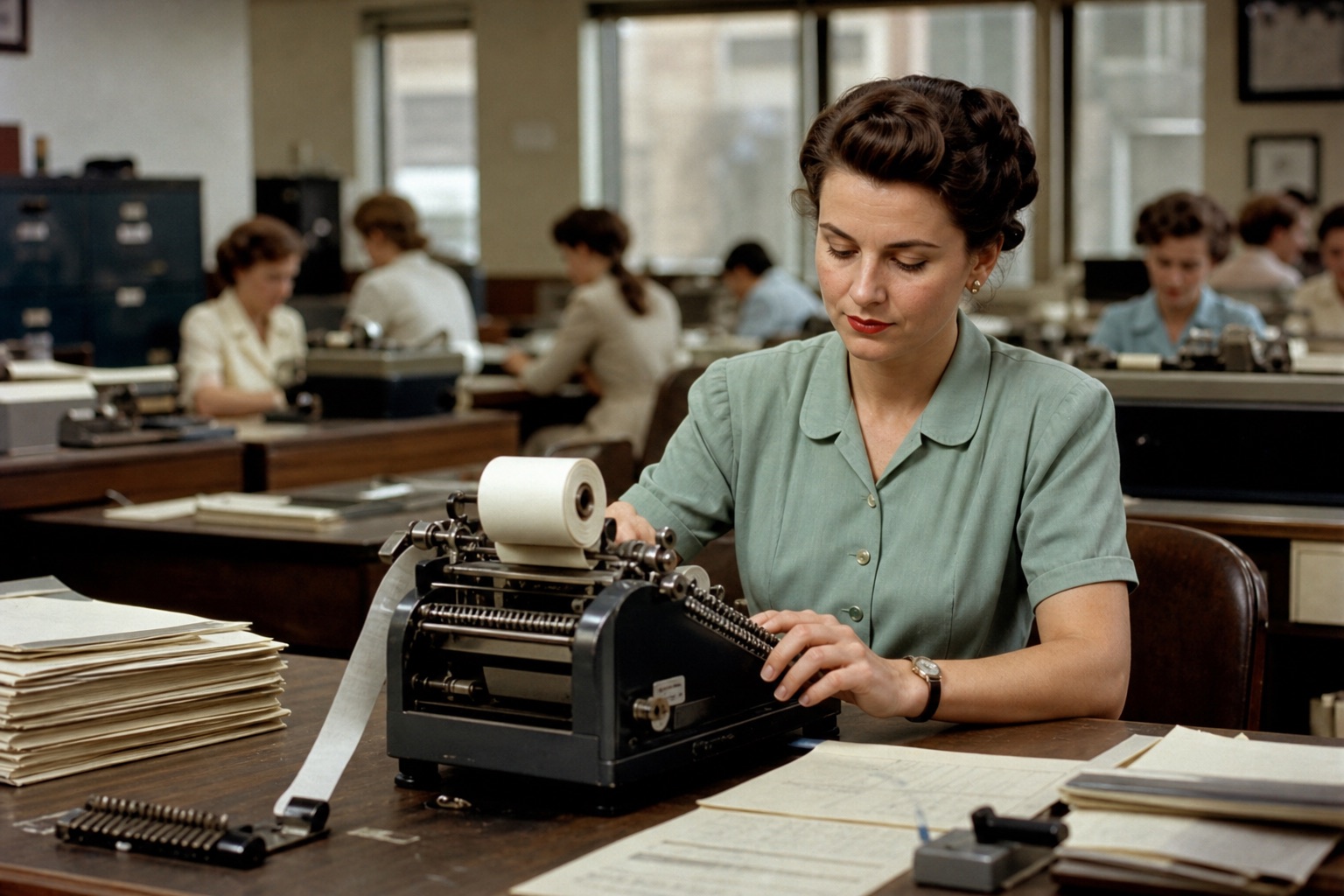
A comptometer operator ran a Felt comptometer, the key-driven adding machine Dorr E. Felt brought out in 1887. Unlike a crank adder, it let several keys in a column go down together, so a trained hand could enter a number in one stroke. Banks, billing offices, railroads, and insurance rooms hired people, mostly women, to add and extend figures for hours at that keyboard. Operator schools taught the touch and certified speed. The product was a total the bookkeeper could trust, not a printed page of prose.
The machine's long life makes the job look Victorian at the start, and the honest center of the exhibit is the twentieth-century office, ending when electronic calculators and computers took the columns in the 1960s and 1970s. A comptometer bureau might sell the labor by the batch. An in-house operator sat beside the ledgers she fed. Either way the skill was in the hands, and it did not survive the cheap electronic key.
Day in the Life of a Comptometer Operator
The batch
The morning started with tickets, bills, or ledger pages and a cleared machine. She set the paper or the pencil where the totals would be written down. Speed was already assumed; the first column showed whether the day would hold it.
The stroke
Numbers went in by touch, several keys at once in a column, the way the school had drilled. A mis-stroke had to be felt at once, because many comptometers did not print a tape to confess it later. The rhythm was the work.
The proof
Batches were proved against a control total, and a difference meant doing the stretch again rather than arguing with the ledger. Another operator might rekey the same tickets. Agreement, not opinion, released the batch.
Clearing
At the end of the day the machine was cleared, the totals handed on, and the count of work noted if the office paid attention to volume. The next morning's paper would look the same. Nothing in the day was a conversation with a customer.
What came after
Felt's key-driven adder, and the schools that taught it, ended when electronic calculators and computers took the sums.
The succession pageRelated Exhibits
Keypunch Operator
A keypunch operator turned source documents into Hollerith and later IBM cards by striking a punch, one character to a column, until a deck existed that a machine room could read. The mid-century room was often a floor of the same gray machines, program drums skipping fields the operator should not retype, hoppers of blank cards on one side and finished decks on the other. A second person at a verifier rekeyed to catch errors. The work flourished when payrolls, policies, censuses, and bills all had to become cards before a computer would accept them. The operators were mostly women, and the job is a mid-twentieth-century mass occupation rather than a nineteenth-century curiosity. It thinned when key-to-disk machines, terminals, and direct data entry in the 1970s and 1980s let the same facts go into a system without a card. The exhibit is that punch room: the sheet, the keyboard, the deck, and the sound.
Bal-maiden
A bal-maiden broke and sorted copper ore, and sometimes tin, on the surface dressing floor of a Cornish or West Devon mine. She was not underground. The word bal is the mine itself. On a paved or boarded floor open to the weather she used a bucking hammer, a short-handled flat-faced tool, to crush ore small enough to be washed, and a heavier cobbing hammer on the larger stones. Waste rock was picked out by eye. Dressed ore went on to buddles and the rest of the surface plant, where water separated the heavier mineral. The trade runs from the eighteenth century, when these copper mines expanded, into the early twentieth, when the same mines closed and mechanical stamps, crushers, and later flotation did the breaking. The Mines and Collieries Act 1842 cleared women from underground work. It did not clear the dressing floor, and bal-maidens remained a normal part of the surface payroll long after that Act. Census returns use the title in Cornwall and around Tavistock. Devon Great Consols was among the large employers. The label is this hand floor, not a romantic pit woman and not a child-haulage job.
Explore More Exhibits
Discover the full collection of past and future professions in The Jobs Museum.