
Early Twentieth Century
Wheelwright
An extinct profession from Early Twentieth Century that became obsolete due to technological advancement and societal change.
Media Gallery
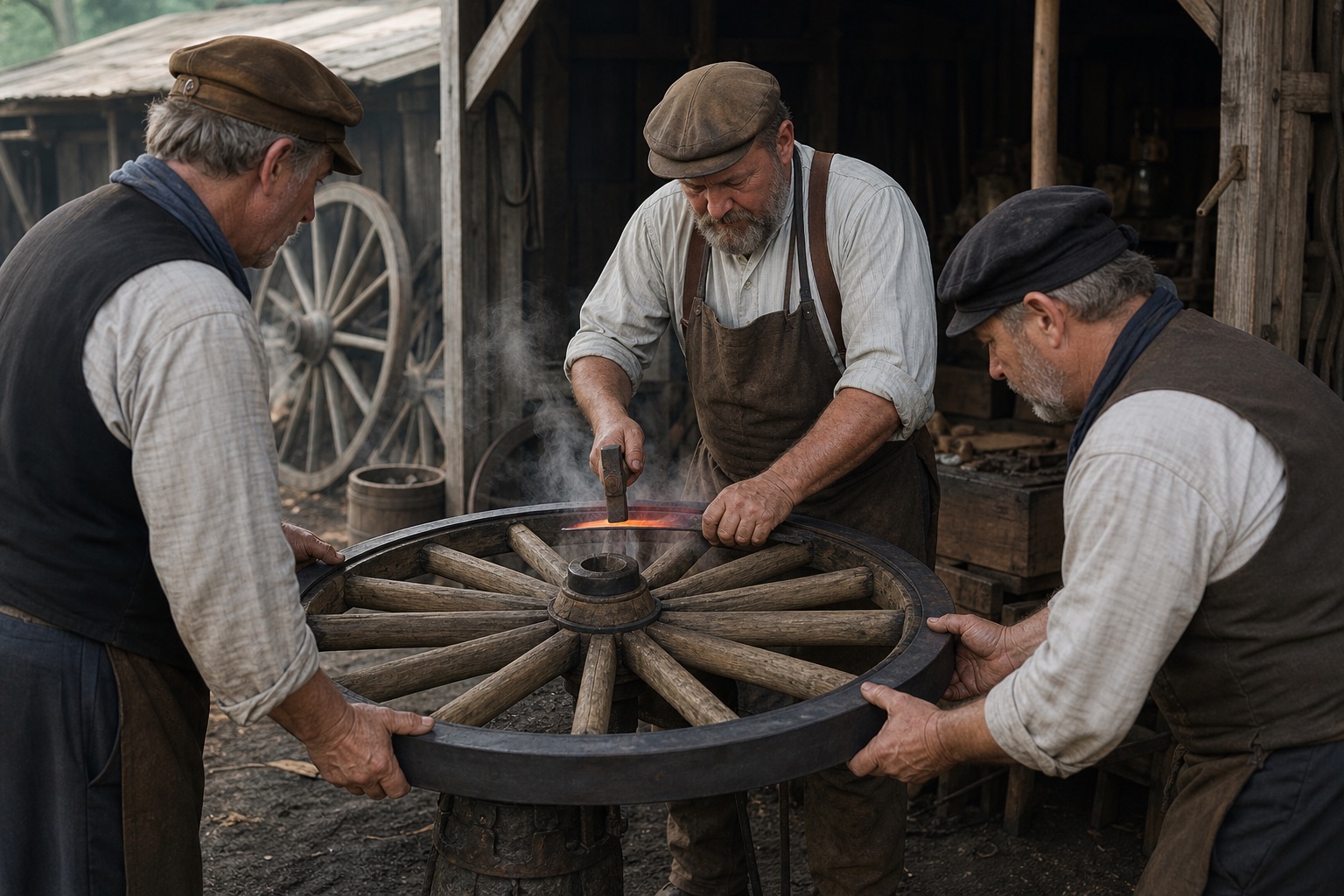
About the Wheelwright profession
A wheelwright made the wooden wheel that carried a cart, a waggon, or a carriage, and he shod it with iron. The stock, or nave, was the hub, boxed with iron for the axle. Spokes were dressed and driven into mortises. Felloes, curved sections of ash or elm, made the rim and were dowelled into a circle. The wheel was dished, set as a shallow cone, so it stood plumb under the load when the cart moved. A hoop tyre was then heated on a circular fire, dropped over the rim, and quenched so the iron shrank tight and pulled the joints home. George Sturt, who ran his family shop at Farnham in Surrey from 1884 and published The Wheelwright's Shop in 1923, described this as a whole literacy in timber. Every country town had some version of that bench.
Rubber tyres, the motor trade, and factory wheels removed the reason for the bench. A pneumatic tyre does not sit on a craftsman-cut felloe in the old way. A motor van does not come to the wheelwright for a new stock. Factories supplied wooden wheels and then metal ones faster than a shop could spoke them, and cheaper. Farm repairs lingered where iron-shod carts still worked, into the 1920s and 1930s. The boy who in 1900 could still be offered seven years at the bench was, a generation on, looking at a trade that no longer bound apprentices.
Day in the Life of a Wheelwright
The stock
The day's serious work often began at the stock, the nave, already seasoned and now bored, boxed, and mortised for the number of spokes the wheel required. A mortise out of line would throw every spoke, so the wheelwright checked the circle before any tenon was driven. Elm was the usual timber for stocks, and he rejected a piece with a shake rather than discover the fault after the wheel was shod.
Spokes and felloes
Spokes of oak were dressed with the drawknife and the spoke-shave, tenoned, and driven into the stock, then the outer tenons were marked for the felloes. Felloes were sawn to the curve, jointed, and knocked on so the rim closed. The dish, the slight cone of the wheel, was proved as the spokes went in, not corrected as an afterthought once the tyre was tight.
The tyre fire
The iron tyre, a hoop made to a calculated size, was laid on a circular fire of shavings and chips until it would just pass over the wooden rim. It was lifted, dropped, levered home, and quenched before it could char too far, shrinking as it cooled and pulling the joints up. Neighbours knew this hour, the visible end of a wheel that had taken days of quieter bench work.
Hanging the wheel
Once cool, the wheel was tried, the dish checked again, and the tyre fastened with the usual clips or rivets so it could not creep. It was then hung on the axle or leaned for the farmer to collect, the bill naming timber, iron, and labour separately. A repair day was the same craft on a smaller scale: one felloe, a spoke, or a tyre reset, which is the work that outlived the new waggon.
What came after
A wooden wheel, built and tired in a yard, left the road when vehicles came from a factory on rubber.
The succession pageRelated Exhibits
Agoranomos
The Agoranomos was a pivotal figure in the bustling marketplaces of ancient Greece, particularly in city-states like Athens. This role was akin to that of a modern-day market supervisor or inspector, responsible for overseeing the activities within the agora, the central public space where commerce, politics, and social interaction flourished. The Agoranomos ensured that trade was conducted fairly, that weights and measures were accurate, and that vendors adhered to the laws governing commerce. They played a crucial role in maintaining order and integrity in the marketplace, which was vital for the economic health of the city-state. In addition to regulatory duties, the Agoranomos also had the authority to impose fines on dishonest merchants and to confiscate goods that were sold under false pretenses. This position required a deep understanding of local laws and trade practices, as well as a keen sense of justice to protect both consumers and honest traders. The Agoranomos was often seen as a guardian of the public interest, ensuring that the agora remained a vibrant and trustworthy hub of activity.
Aircraft Listener
The role of an Aircraft Listener emerged in the mid-20th century, primarily during the Post-War Era, when aviation technology was rapidly advancing and air traffic was increasing significantly. Aircraft Listeners were tasked with monitoring and interpreting the sounds of aircraft engines, particularly in military contexts, where understanding the nuances of engine noise could indicate the type of aircraft, its operational status, and even potential mechanical issues. This job was crucial for military intelligence and air traffic control, as it provided valuable information about aircraft movements and capabilities without the need for visual confirmation. Listeners would often work in pairs or small teams, stationed at strategic locations such as airbases or observation posts. They utilized their acute hearing to distinguish between different aircraft types, noting variations in sound that could indicate changes in speed, altitude, or engine performance. This auditory skill was honed through extensive training and experience, as the ability to identify aircraft by sound alone was a rare and valuable talent. The job required not only a keen ear but also a deep understanding of aviation technology and the specific characteristics of various aircraft engines. Listeners would often keep detailed logs of their observations, contributing to intelligence reports and operational assessments. The role was a blend of art and science, requiring both technical knowledge and an intuitive grasp of sound dynamics.
Explore More Exhibits
Discover the full collection of past and future professions in The Jobs Museum.