
Victorian Era
Nailer
An extinct profession from Victorian Era that became obsolete due to technological advancement and societal change.
Media Gallery
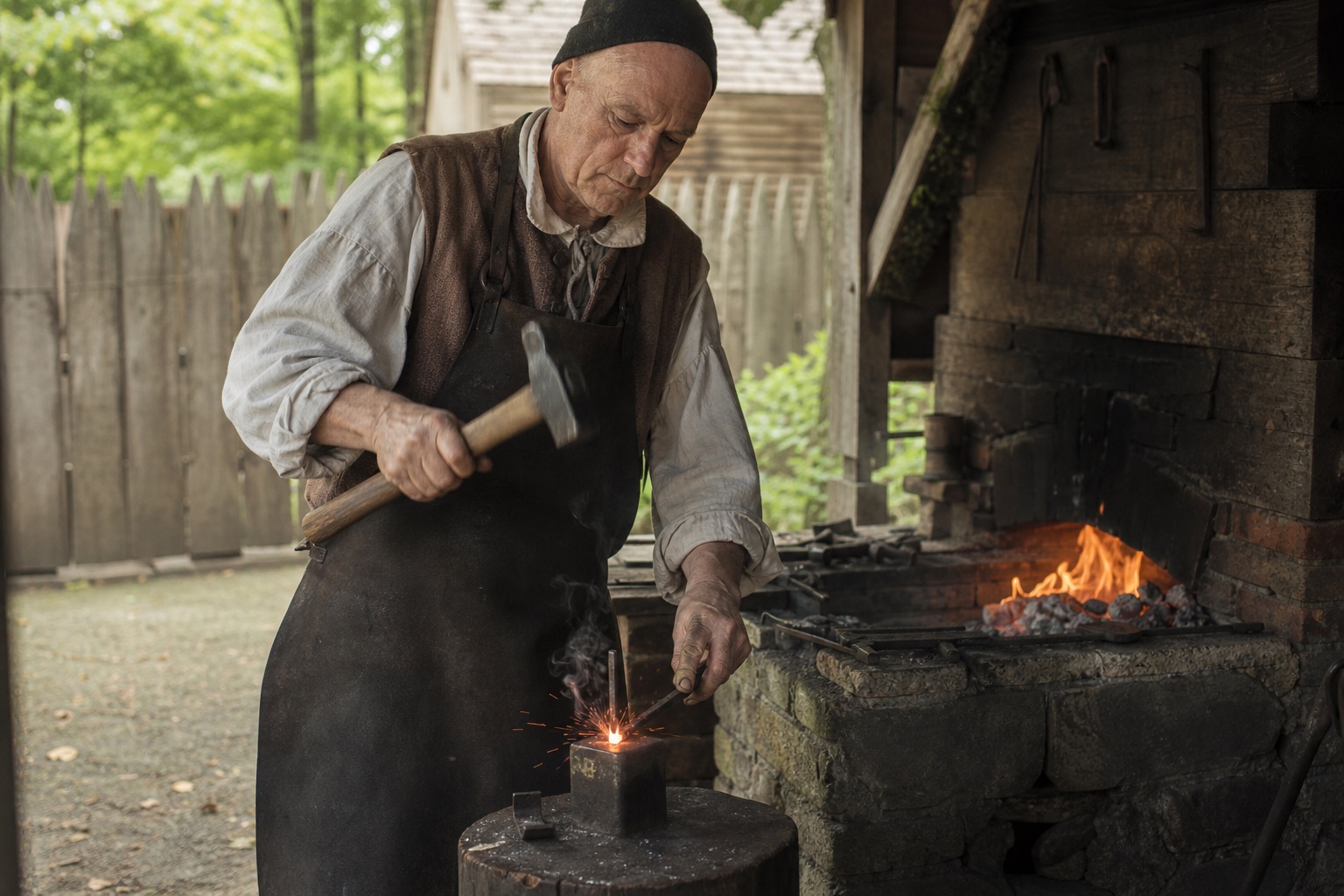
About the Nailer profession
A nailer in the Black Country made nails one at a time at a hearth in the house. Rod iron, taken from a fogger, was heated, pointed, cut, and headed in a bore, often under an oliver, the foot-worked hammer that put a heavier blow behind a small hand. Dudley, Sedgley, Gornal, Lye, Halesowen, and the shops toward Bromsgrove were dense with these hearths. The count was the thousand. The fogger who had supplied the rod bought the nails back, and his prices on both sides of the bargain were deducted before the family saw cash. It was outwork, not a factory bell, and the workshop was the room where the household also lived.
Cut nails, sheared from sheet by machine from the early nineteenth century, undercut the common wrought nail. Wire nails, cheap in quantity by the 1880s and 1890s, destroyed what was left of the price. Reporters for the children's employment inquiries of the 1840s already found whole families at the block, children old enough to heat a rod or head a small nail working a long day inside a tally of a few shillings. The reports list hours and prices. Horse nails and a few special sorts lingered as hand work after general nails had gone. The nail in an ordinary carpenter's bag had become a machine nail, and the hearth could not sell against it.
Day in the Life of a Nailer
Rod from the fogger
The week started with rod iron, fetched from the fogger who would also buy the nails, and the price of that rod was already a debt against the count not yet made. The family sorted what they had to make: common nails, or a size the fogger said he would still take. Without rod there was no work, and without the fogger there was often no rod, which is how the house stayed tied to his prices.
At the hearth
The hearth was blown up and the rod heated a few inches at a time, one worker pointing and cutting the blank while the same hands, or another pair, turned to the bore to make the head. The oliver, struck with the foot, saved a little of the arm-work on the heavier blows. Children who were old enough heated rods or headed the smallest sizes, and their hours were the family's hours, morning into the afternoon and beyond.
The thousand
Nails were tallied as they cooled, because pay was by the thousand and a miscount was the fogger's chance to dock the bundle. Different sizes were kept apart, a mix being a spoiled delivery. The work had no natural end in the afternoon, and it stopped when the rod was used or the hearth could not be kept up.
Back to the fogger
Bundles were carried back and weighed against the rod that had gone out, and the fogger's price, minus the iron, was what the house received. In the mid-Victorian decades that remainder was often only a few shillings for the family's week. If he said a size was unsaleable, those nails earned little or nothing, though the rod and the hours had already been spent.
What came after
Hand-wrought nails, made at a domestic hearth, could not meet the price of nails cut or drawn by machine.
The succession pageRelated Exhibits
Chainmaker
At Cradley Heath, and in the small-chain streets of Old Hill and the neighbouring towns, chain was hammered link by link. A woman scarfed a short iron rod, bent it through the previous link, and welded the join on a bick in a backyard shop, a dolly shop, paid by the hundredweight. This was the small work: common chain, dog chain, the lighter sizes. Heavy cable was men's work in larger shops. Before 1910 the backyard bargain was a sweated one. A woman could be at the hearth from morning into the evening and take home five or six shillings for the week, girls learning beside her at a still smaller share of that weight. Mary Macarthur and the National Federation of Women Workers led the chainmakers' strike of 1910 so that employers would actually pay the minimum the Chain Trade Board had fixed under the Trade Boards Act of 1909, twopence-halfpenny an hour. The strike succeeded. It put a floor under the wage. It did not preserve the backyard hammer as the way ordinary chain would be made. Machine-made chain, and then welded chain from factories, supplied common links more cheaply than a legal hand rate could. The women had stopped the starvation price. Across the early twentieth century the market took the bulk orders to the factory, and the old domestic shops thinned away.
Handloom Weaver
A handloom weaver worked at home. The loom stood in a cottage room, often kept damp so that cotton ends would not snap, and the weaver threw the shuttle and beat the weft a few inches an hour. Yarn came from a spinning mill or a woolstapler through a putter-out. The finished length went back to a warehouse to be measured, examined, and paid by the piece. Lancashire cotton villages were the centre of this work in the boom of the 1790s. Woollen weavers in the West Country, around Frome and Trowbridge, and in the West Riding lived by the same bargain: the loom and the room were the family's, and the cloth belonged to the merchant who had put out the yarn. The ruin was a collapse of the piece rate, not a cartoon of men who hated machines. A cotton weaver earning close to a pound a week in the late 1790s was, in the parliamentary returns of the 1830s, often down to a few shillings for a longer week at the same loom. Power looms, patented in crude form by Edmund Cartwright in the 1780s and practical in Lancashire from the 1810s, were widespread in ordinary cottons by the 1840s, and woollen mills followed. Some crowds broke looms. Most weavers did not. They worked longer hours, asked Parliament for a legal minimum, were refused, and lost the trade when the warehouse cut the price below a living.
Explore More Exhibits
Discover the full collection of past and future professions in The Jobs Museum.