
Industrial Revolution
Handloom Weaver
An extinct profession from Industrial Revolution that became obsolete due to technological advancement and societal change.
Media Gallery
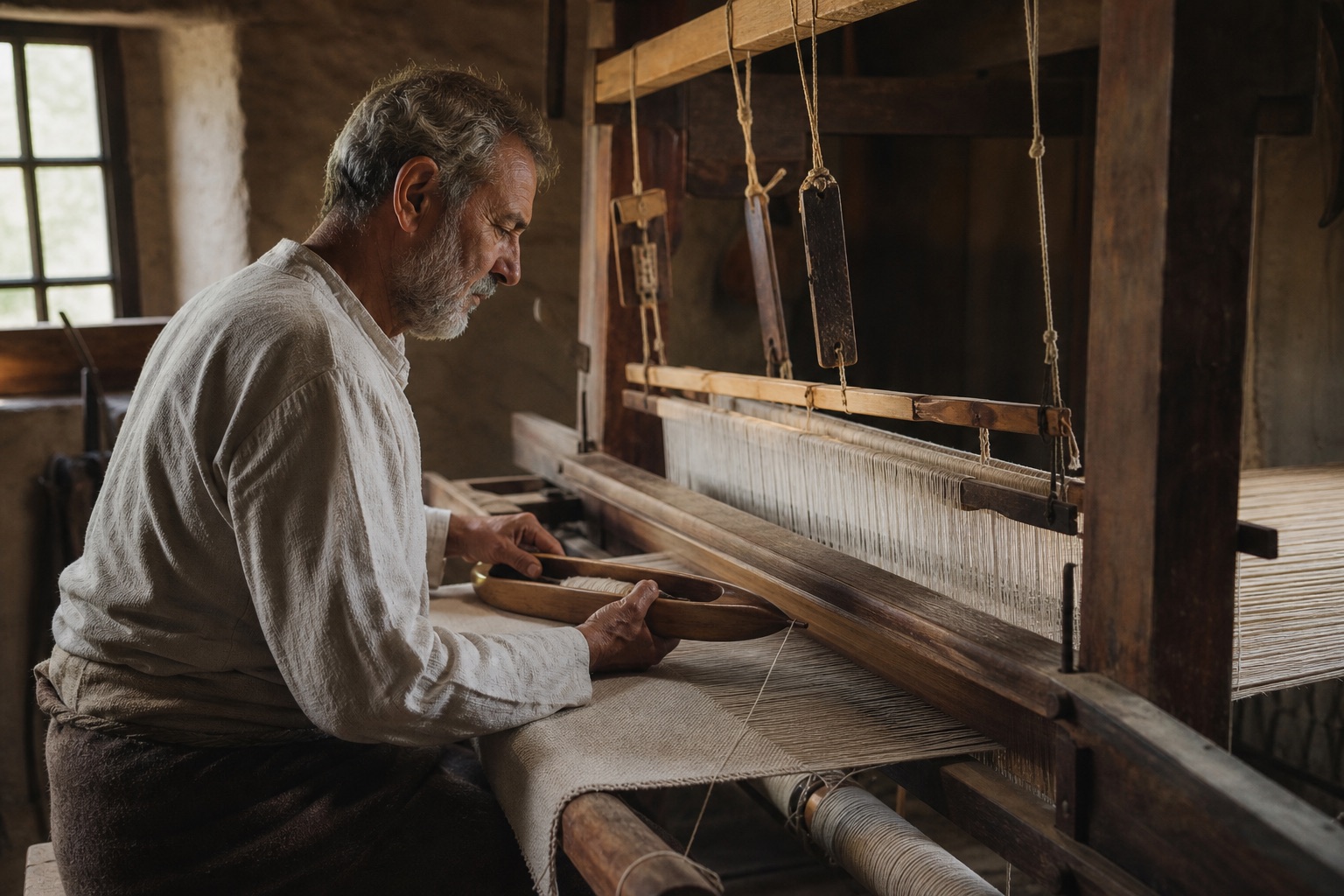
About the Handloom Weaver profession
A handloom weaver worked at home. The loom stood in a cottage room, often kept damp so that cotton ends would not snap, and the weaver threw the shuttle and beat the weft a few inches an hour. Yarn came from a spinning mill or a woolstapler through a putter-out. The finished length went back to a warehouse to be measured, examined, and paid by the piece. Lancashire cotton villages were the centre of this work in the boom of the 1790s. Woollen weavers in the West Country, around Frome and Trowbridge, and in the West Riding lived by the same bargain: the loom and the room were the family's, and the cloth belonged to the merchant who had put out the yarn.
The ruin was a collapse of the piece rate, not a cartoon of men who hated machines. A cotton weaver earning close to a pound a week in the late 1790s was, in the parliamentary returns of the 1830s, often down to a few shillings for a longer week at the same loom. Power looms, patented in crude form by Edmund Cartwright in the 1780s and practical in Lancashire from the 1810s, were widespread in ordinary cottons by the 1840s, and woollen mills followed. Some crowds broke looms. Most weavers did not. They worked longer hours, asked Parliament for a legal minimum, were refused, and lost the trade when the warehouse cut the price below a living.
Day in the Life of a Handloom Weaver
Beaming the warp
The morning of a new piece began with the warp: lease taken, ends tied onto the old heading or onto the beam, and the reed threaded where a fresh count was wanted. A few trial picks were thrown and pulled out again if the selvedge came up foul. Cotton houses kept the room damp on purpose, because a dry warp snapped and every snapped end was time the piece rate would not pay for.
The day's weaving
Once the web was truly started the work was a rhythm of shuttle and batten, hour after hour, watching for a slack thread or a skipped pick. A plain calico grew faster than a fine reed or a check, which is why the warehouse price was supposed to differ and, in the bad years, often did not differ enough. Children wound bobbins beside the loom so the weaver did not have to leave the seat.
Faults and length
Broken ends were mended as they happened, not left for a row of faults the warehouse would abate. The weaver measured on, because payment was for the ordered length and a short piece was a quarrel at the counter. In the 1830s that length, however clean, might still be worth only a few shillings for the week it had taken.
Into the warehouse
The finished piece was cut off, folded, and carried in, often on foot, to the putter-out's warehouse to be weighed, measured, and examined. Abatements for faults came off the price before any money was handed over, and the next warp was taken home on the same visit if the house was to keep working. A weaver who argued the rate still went home with yarn, because there was nowhere else to sell one cottage piece.
What came after
The domestic loom was undercut by the power loom in a mill, and the weaver's price fell with it.
The succession pageRelated Exhibits
Nailer
A nailer in the Black Country made nails one at a time at a hearth in the house. Rod iron, taken from a fogger, was heated, pointed, cut, and headed in a bore, often under an oliver, the foot-worked hammer that put a heavier blow behind a small hand. Dudley, Sedgley, Gornal, Lye, Halesowen, and the shops toward Bromsgrove were dense with these hearths. The count was the thousand. The fogger who had supplied the rod bought the nails back, and his prices on both sides of the bargain were deducted before the family saw cash. It was outwork, not a factory bell, and the workshop was the room where the household also lived. Cut nails, sheared from sheet by machine from the early nineteenth century, undercut the common wrought nail. Wire nails, cheap in quantity by the 1880s and 1890s, destroyed what was left of the price. Reporters for the children's employment inquiries of the 1840s already found whole families at the block, children old enough to heat a rod or head a small nail working a long day inside a tally of a few shillings. The reports list hours and prices. Horse nails and a few special sorts lingered as hand work after general nails had gone. The nail in an ordinary carpenter's bag had become a machine nail, and the hearth could not sell against it.
Agoranomos
The Agoranomos was a pivotal figure in the bustling marketplaces of ancient Greece, particularly in city-states like Athens. This role was akin to that of a modern-day market supervisor or inspector, responsible for overseeing the activities within the agora, the central public space where commerce, politics, and social interaction flourished. The Agoranomos ensured that trade was conducted fairly, that weights and measures were accurate, and that vendors adhered to the laws governing commerce. They played a crucial role in maintaining order and integrity in the marketplace, which was vital for the economic health of the city-state. In addition to regulatory duties, the Agoranomos also had the authority to impose fines on dishonest merchants and to confiscate goods that were sold under false pretenses. This position required a deep understanding of local laws and trade practices, as well as a keen sense of justice to protect both consumers and honest traders. The Agoranomos was often seen as a guardian of the public interest, ensuring that the agora remained a vibrant and trustworthy hub of activity.
Explore More Exhibits
Discover the full collection of past and future professions in The Jobs Museum.