
Spacefaring Era
Space Traffic Controller
A speculative career prediction for Spacefaring Era based on technological trends and societal evolution.
Media Gallery
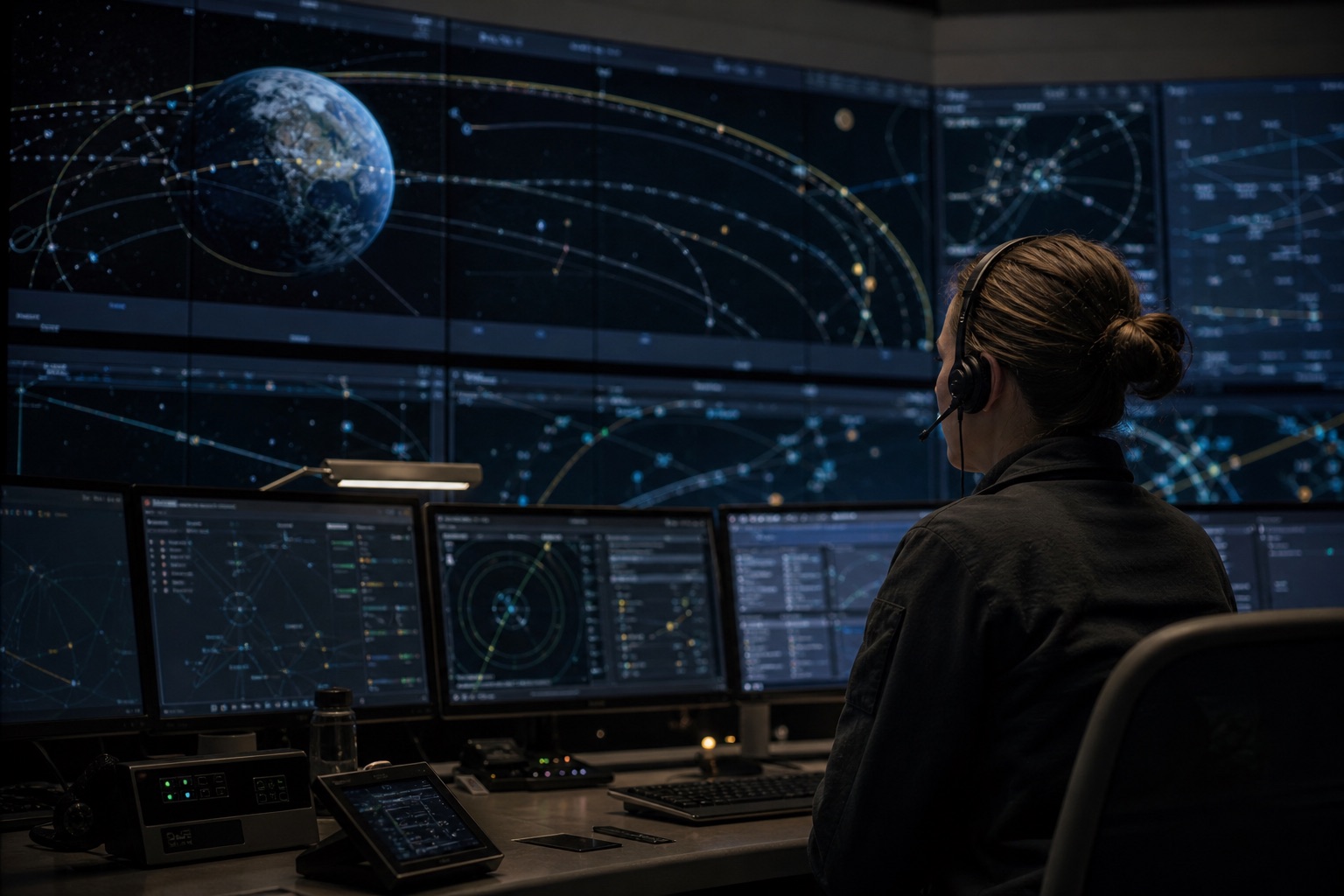
About the Space Traffic Controller career
The space traffic controller watches crowded orbits for conjunctions and coordinates the maneuvers that keep two objects from trying to occupy the same place at the same time. The kinship with air traffic control is real, and the physics is different. There is no cab in a tower and no pair of binoculars on a console. Closing speeds are kilometers per second, the useful warning is often hours or days, and the remedy is a burn that spends a satellite's propellant and disturbs its schedule.
The controller usually does not fly the spacecraft. An owner-operator does. The controller screens the messages, decides which approaches matter, and gets the parties to agree on who moves. Large constellations have made this a daily screen rather than an occasional memo. Some objects are poorly tracked and some are only partly shared. The work is judgment under an incomplete catalog, written so the next shift can see what was risked and what was spent.
Day in the Life of a Space Traffic Controller
Screening
The controller opens the day's conjunction messages and sorts them by time of closest approach and by the quality of the orbits. Many are routine and are marked as such. A few have a small miss distance and a covariance that still leaves a real chance of contact.
Calling the operators
Those few trigger a message to the owner-operators, with the same numbers in front of both. The controller asks who can maneuver, what the burn costs in propellant, and whether a burn already planned makes the miss worse. Silence from one party is written down as silence.
Choosing the move
If both objects can maneuver, the controller presses for one clear action rather than two half-measures that cross each other. If only one object can move, that limit is stated without decoration. The decision and the remaining uncertainty are both entered in the log.
After the window
Once the time of closest approach has passed, the outcome is recorded, including maneuvers that were refused. The catalog is checked for new debris if the miss was very small. The next shift inherits the open items in writing, not as a verbal shrug at the door.
What it grew from
It grows out of the air traffic controller and the telegraph dispatcher. The physics and the hours are different.
Related Exhibits
Orbital Debris Retrieval Technician
The orbital-debris retrieval technician operates or supports a mission that meets a dead satellite or a fragment and takes it out of the way. Most of the occupation sits in a ground control room: relative navigation, a slow approach after the orbits are matched, a capture mechanism, and an abort call if the corridor goes bad. A few specialists may work on orbit. The present edge is uncrewed and flown from the ground, already rehearsed by inspection missions and by small demonstration captures. The hazard is making more debris while trying to remove some. A poorly chosen capture, a botched grapple, or a push in the wrong direction turns one tracked object into many. The object may still have an owner, and a clean video is not a license. The technician's standard is ordinary and strict: the target was identified, the approach stayed inside its limits, the capture held, and the catalog was updated with whatever remains in the sky.
AI-Powered Eldercare Companion Designer
In the not-so-distant future, as the global population ages and the demand for personalized care increases, the role of the AI-Powered Eldercare Companion Designer emerges as a vital profession. This innovative job combines the fields of artificial intelligence, healthcare, and human-centered design to create intelligent companions that assist the elderly in their daily lives. These companions, equipped with advanced AI algorithms, are designed to provide emotional support, monitor health conditions, and facilitate social interactions, all while adapting to the unique needs and preferences of each individual. The designer's role is not only to develop the technology but also to ensure that these companions foster meaningful connections, enhance quality of life, and promote independence among seniors. As society grapples with the challenges of an aging population, this profession stands at the intersection of compassion and technology, paving the way for a more inclusive future.
Explore More Exhibits
Discover the full collection of past and future professions in The Jobs Museum.