
Organization
ActiveNASA
Washington, D.C. · Since 1958
Still the United States' civilian space agency, and still a large technical employer and a customer of private contractors.
A later timeline chapter projects a role for this organization. That chapter is a projection. This page is about the institution as it exists, or as it existed.
The National Aeronautics and Space Administration opened in 1958, built from the earlier National Advisory Committee for Aeronautics and given the civilian space program after Sputnik. It is an agency, not a company. It employs scientists, engineers, astronauts, and a much larger number of civil servants and contractors who never leave the ground.
NASA's labor history is a history of contracts. The centers, at Houston, Huntsville, the Cape, and Pasadena, direct work that private firms carry out. The agency is the customer and the standard. The factory is often someone else's.
Who is on the badge
A NASA center mixes civil servants with contractors who sit in the same building and cannot be paid the same way. That split is the occupation: the government engineer who writes the requirement, and the company engineer who meets it. Astronauts are a tiny fraction of the headcount. Technicians who stack a vehicle, and the safety staff who can stop a countdown, are the work. Any chapter about a space economy that counts only the people in orbit has missed the building.
Still the customer
NASA is still funded, still hiring, and still buying launches from companies such as SpaceX. The 2045 and 2070 chapters project a larger commercial sector in which the agency remains the standard-setter. Those chapters are projections. The agency is not. It has been a public employer since 1958.
The work it organized
- Flight controller
- Contractor engineer
- Technician
- Safety officer
In the exhibits
Jobs associated with this organization.
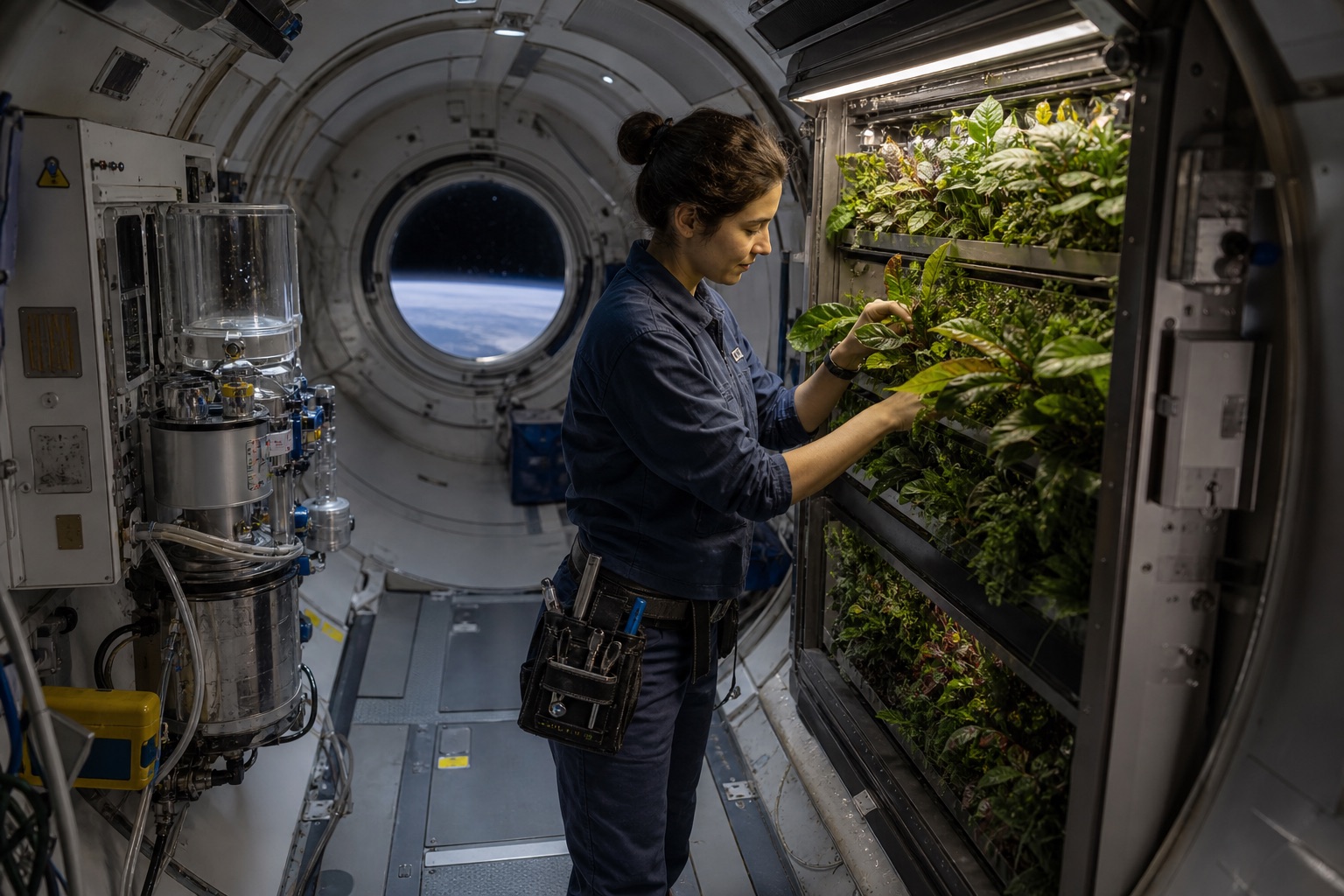 Projected · Spacefaring EraHabitat TechnicianThe habitat technician keeps people alive in a sealed volume: a station, a lunar habitat, or an analog on Earth that is closed on purpose. Air, water, waste, and pressure are one loop. Carbon dioxide has to leave the air, oxygen has to be made or supplied, and water is recovered from wash water and from urine. Filters load up. Sensors drift. The alarms are the job. Drills are practice. The alarm that is not a drill sets the rest of the day.
Present work sits mostly on the station already in orbit and in sealed analogs, where crews know that a closed system will look healthy on a tired sensor. A lunar habitat, where it is more than a drawing and a field trial, will inherit these habits. The technician trusts a round of the panels and a sample of the water more than a green summary. When the loop fails, it fails on a clock that ignores the mission timeline posted on the door. The oxygen drop inside Biosphere 2 remains the cautionary case: a sealed experiment can fail in the air while the public story still sounds intact.
 Projected · Spacefaring EraSpace Traffic ControllerThe space traffic controller watches crowded orbits for conjunctions and coordinates the maneuvers that keep two objects from trying to occupy the same place at the same time. The kinship with air traffic control is real, and the physics is different. There is no cab in a tower and no pair of binoculars on a console. Closing speeds are kilometers per second, the useful warning is often hours or days, and the remedy is a burn that spends a satellite's propellant and disturbs its schedule.
The controller usually does not fly the spacecraft. An owner-operator does. The controller screens the messages, decides which approaches matter, and gets the parties to agree on who moves. Large constellations have made this a daily screen rather than an occasional memo. Some objects are poorly tracked and some are only partly shared. The work is judgment under an incomplete catalog, written so the next shift can see what was risked and what was spent.
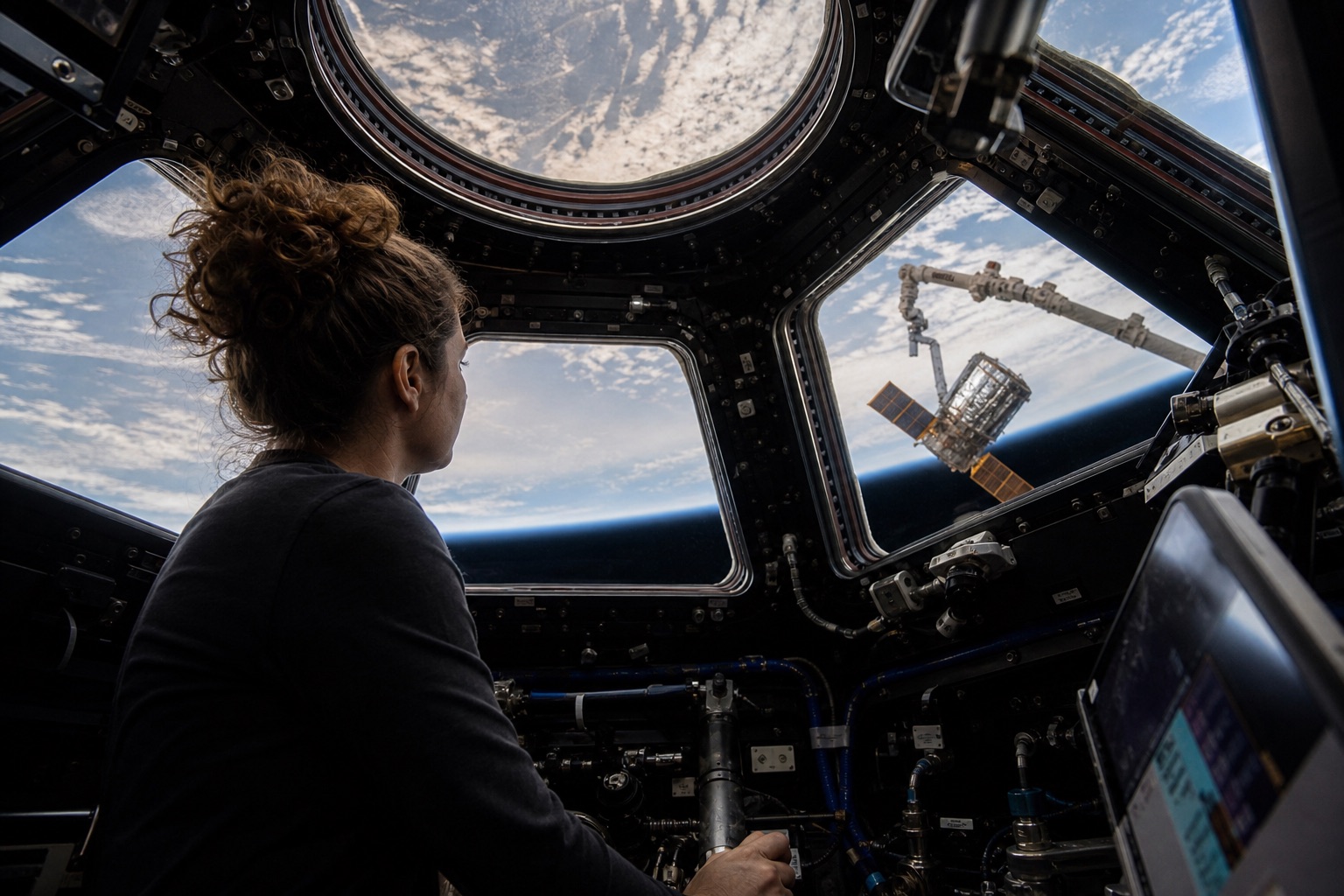 Projected · Spacefaring EraOrbital Debris Retrieval TechnicianThe orbital-debris retrieval technician operates or supports a mission that meets a dead satellite or a fragment and takes it out of the way. Most of the occupation sits in a ground control room: relative navigation, a slow approach after the orbits are matched, a capture mechanism, and an abort call if the corridor goes bad. A few specialists may work on orbit. The present edge is uncrewed and flown from the ground, already rehearsed by inspection missions and by small demonstration captures.
The hazard is making more debris while trying to remove some. A poorly chosen capture, a botched grapple, or a push in the wrong direction turns one tracked object into many. The object may still have an owner, and a clean video is not a license. The technician's standard is ordinary and strict: the target was identified, the approach stayed inside its limits, the capture held, and the catalog was updated with whatever remains in the sky.
On the timeline
Related
- The European Space AgencyActive
- SpaceXActive
- Lockheed MartinActive