
Company
ActiveSpaceX
Hawthorne, California · Since 2002
Still private. Reusable orbital launch is its existing business. Settlement of another planet is not.
A later timeline chapter projects a role for this organization. That chapter is a projection. This page is about the institution as it exists, or as it existed.
Elon Musk founded Space Exploration Technologies in 2002 to lower the cost of reaching orbit, with the stated longer aim of making life multiplanetary. The part that is already an industry is the first half. Falcon 9 flies, lands, and flies again. Customers pay for the ride.
The workforce that makes this true is mostly on the ground, in Hawthorne, at the Cape, and in Texas. Welders, propulsion engineers, and the technicians who turn a booster around between flights are the occupation. A settlement on Mars is not on the payroll.
Reuse as a shift
An expendable rocket employs a factory once per flight. A reusable one employs a factory and a launch crew that must make the same vehicle ready again. That is a maintenance culture closer to an airline than to a munitions plant, and it is the job the 2045 chapter is pointing at when it talks about turning vehicles around. SpaceX also builds satellites and a capsule. It is a private company, large, and unusual in how much it integrates under one roof.
Do not staff the brochure
The 2045 and 2070 chapters are projections. They start from SpaceX because any forecast that ignores the company that actually reflies boosters is pretending. They are not a claim that the company will own a city on another planet, or that it will still be independent. This page is about the launch business that exists.
The work it organized
- Propulsion engineer
- Launch technician
- Welder
- Flight-software engineer
In the exhibits
Jobs associated with this organization.
 Projected · Spacefaring EraSpace Tourism GuideAs humanity ventures beyond the confines of Earth, the role of the Space Tourism Guide emerges as a pivotal profession in the burgeoning industry of space travel. These guides are not merely tour leaders; they are educators, safety officers, and cultural ambassadors, tasked with ensuring that the experience of space travel is both exhilarating and safe for the adventurous tourists who dare to leave the planet.
Imagine a world where individuals from all walks of life can book a trip to the edge of space, experiencing the breathtaking view of Earth from above, the sensation of weightlessness, and the thrill of traveling at incredible speeds. The Space Tourism Guide is there to facilitate this journey, providing insights into the science of space travel, the history of human exploration, and the environmental considerations of our ventures into the cosmos.
Guides will be equipped with advanced training in astrophysics, emergency protocols, and customer service, ensuring that every traveler feels informed and secure. They will also play a crucial role in promoting sustainable practices in space tourism, advocating for responsible exploration that respects the delicate balance of our universe.
As the industry grows, so too will the responsibilities of the Space Tourism Guide, who will need to adapt to new technologies and evolving safety standards, all while fostering a sense of wonder and respect for the cosmos among their clients.
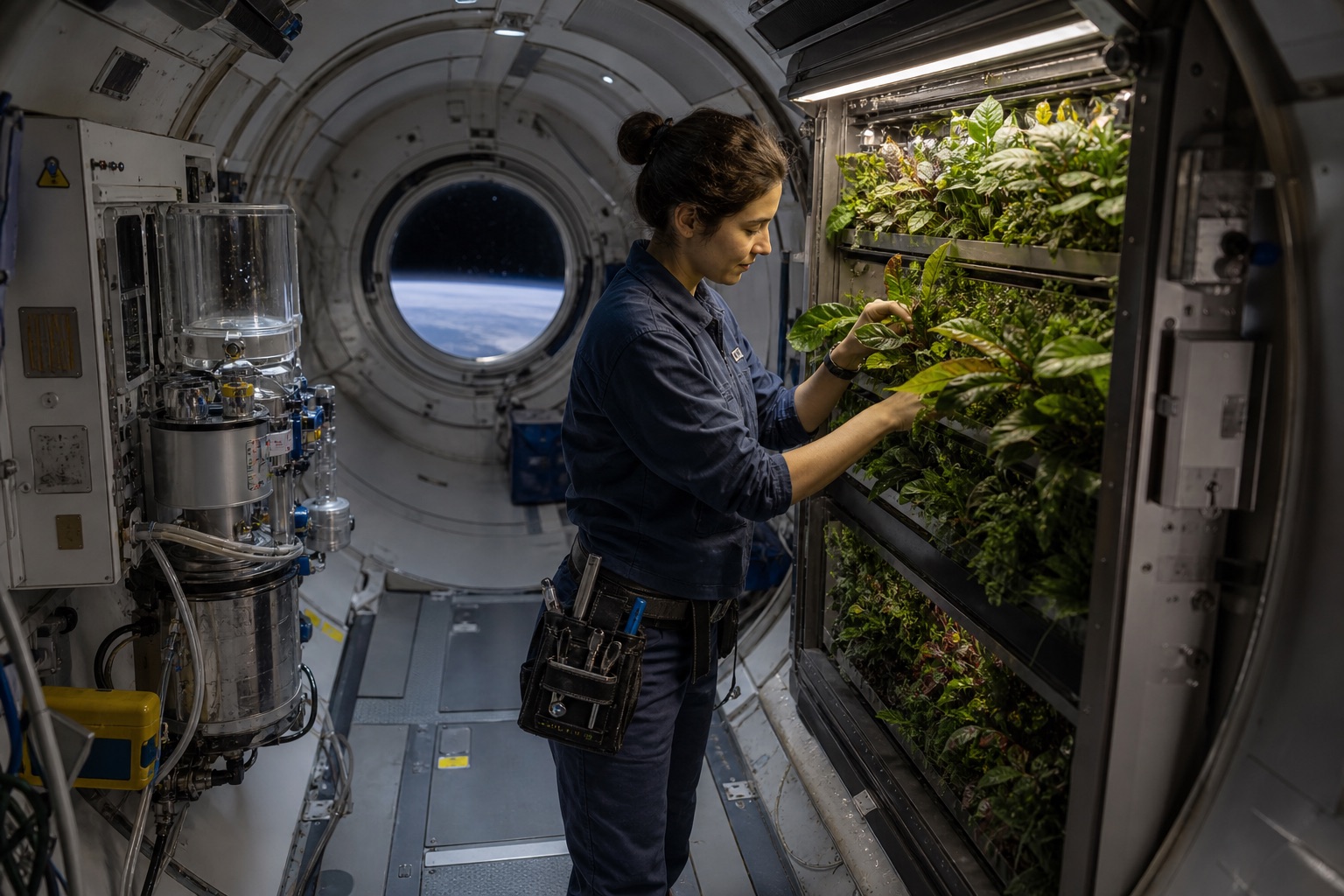 Projected · Spacefaring EraHabitat TechnicianThe habitat technician keeps people alive in a sealed volume: a station, a lunar habitat, or an analog on Earth that is closed on purpose. Air, water, waste, and pressure are one loop. Carbon dioxide has to leave the air, oxygen has to be made or supplied, and water is recovered from wash water and from urine. Filters load up. Sensors drift. The alarms are the job. Drills are practice. The alarm that is not a drill sets the rest of the day.
Present work sits mostly on the station already in orbit and in sealed analogs, where crews know that a closed system will look healthy on a tired sensor. A lunar habitat, where it is more than a drawing and a field trial, will inherit these habits. The technician trusts a round of the panels and a sample of the water more than a green summary. When the loop fails, it fails on a clock that ignores the mission timeline posted on the door. The oxygen drop inside Biosphere 2 remains the cautionary case: a sealed experiment can fail in the air while the public story still sounds intact.
On the timeline
Related
- NASAActive
- Rocket LabActive