
Spacefaring Era
Habitat Technician
A speculative career prediction for Spacefaring Era based on technological trends and societal evolution.
Media Gallery
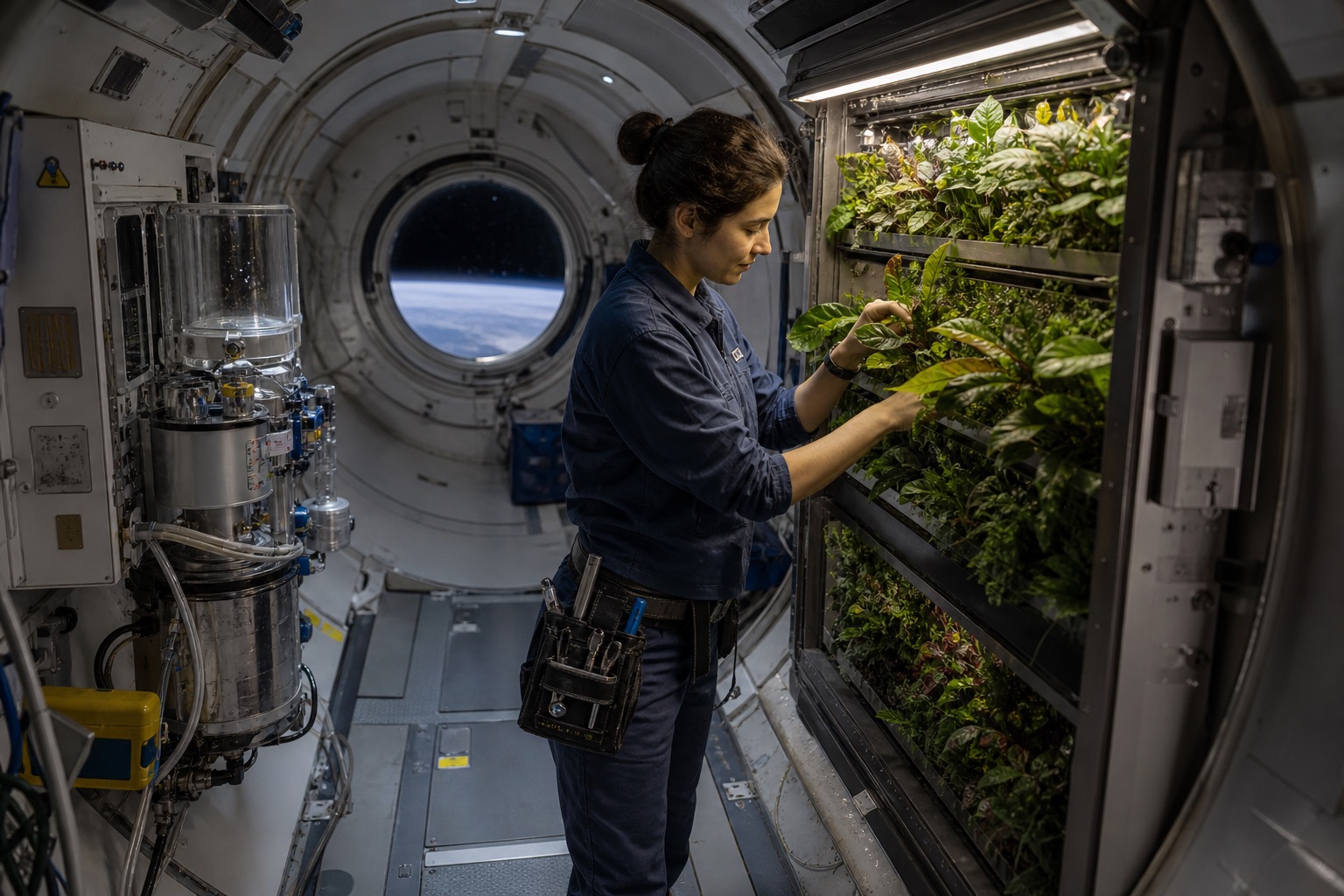
About the Habitat Technician career
The habitat technician keeps people alive in a sealed volume: a station, a lunar habitat, or an analog on Earth that is closed on purpose. Air, water, waste, and pressure are one loop. Carbon dioxide has to leave the air, oxygen has to be made or supplied, and water is recovered from wash water and from urine. Filters load up. Sensors drift. The alarms are the job. Drills are practice. The alarm that is not a drill sets the rest of the day.
Present work sits mostly on the station already in orbit and in sealed analogs, where crews know that a closed system will look healthy on a tired sensor. A lunar habitat, where it is more than a drawing and a field trial, will inherit these habits. The technician trusts a round of the panels and a sample of the water more than a green summary. When the loop fails, it fails on a clock that ignores the mission timeline posted on the door. The oxygen drop inside Biosphere 2 remains the cautionary case: a sealed experiment can fail in the air while the public story still sounds intact.
Day in the Life of a Habitat Technician
Atmosphere round
The technician starts with carbon dioxide, oxygen, pressure, and the trace-contaminant readings, then looks at the machines behind those numbers. A comfortable summary screen is not the round. Filters, fans, and the last alarm acknowledgements are.
Water and waste
Water recovery is checked next, because a stoppage there becomes a supply problem on a short clock. Tanks, temperatures, and the unglamorous parts of the loop get the same attention as the oxygen generator. Waste that is backing up is treated as a life-support fault.
An alarm
When an alarm sounds, the response card is followed before anyone explains it away. The technician finds out whether the sensor, the machine, or the cabin is telling the truth. Drills end in a reset, and a real alarm ends in a repair, a time-limited workaround, or a call that wakes the next person.
Watch handover
The incoming technician gets the trends, the open faults, and the samples still waiting on the bench. Verbal color is useless without the numbers beside it. The log is written so it can stand alone if the voice link fails during the handover.
What it grew from
It grows out of the ship engineer and the building superintendent, inside a volume that must stay sealed.
Related Exhibits
Direct Air Capture Technician
The direct-air-capture technician keeps a plant that pulls carbon dioxide from open air in working order. The day is fan walls, contactor vessels, sorbent or solvent, process heat, water, and the meters that show whether the energy spent was honest against the gas caught. Humidity, frost, and a loaded filter change the capture rate before a dashboard admits it. The technician walks the fans, listens for a bearing, samples the sorbent, and logs the steam or electricity that regeneration actually used. The captured gas still has to go somewhere. It is dried, compressed, and either mineralized in rock, injected into a permitted reservoir, or sold into a use that may return it to the air. A plant that reports tons while burning a dirtier fuel for heat is putting on a display, and the technician is often the first person who can see that in the shift log. The exhibit asks visitors to leave with the machine as it is: already built in a few places, still small beside a power station, and still judged by storage, water, and the power bill.
AI-Powered Eldercare Companion Designer
In the not-so-distant future, as the global population ages and the demand for personalized care increases, the role of the AI-Powered Eldercare Companion Designer emerges as a vital profession. This innovative job combines the fields of artificial intelligence, healthcare, and human-centered design to create intelligent companions that assist the elderly in their daily lives. These companions, equipped with advanced AI algorithms, are designed to provide emotional support, monitor health conditions, and facilitate social interactions, all while adapting to the unique needs and preferences of each individual. The designer's role is not only to develop the technology but also to ensure that these companions foster meaningful connections, enhance quality of life, and promote independence among seniors. As society grapples with the challenges of an aging population, this profession stands at the intersection of compassion and technology, paving the way for a more inclusive future.
Explore More Exhibits
Discover the full collection of past and future professions in The Jobs Museum.