
Late Twentieth Century
Typewriter Repairman
An extinct profession from Late Twentieth Century that became obsolete due to technological advancement and societal change.
Media Gallery
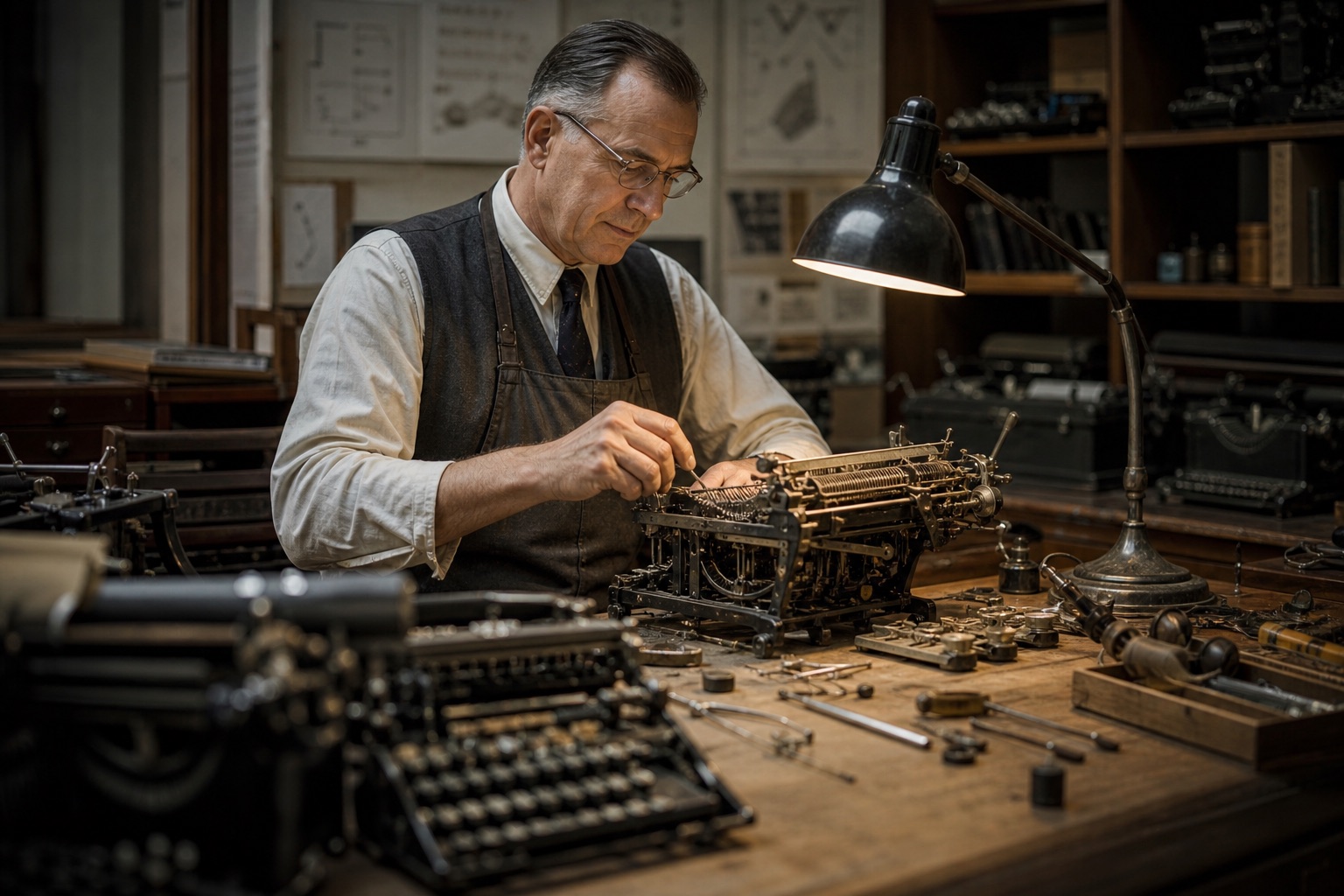
About the Typewriter Repairman profession
A typewriter repairman was the traveling or shop mechanic who kept office typewriters writing. He arrived with a case, cleaned a segment packed with eraser crumbs, replaced a broken drawband, aligned type that no longer struck in a straight line, and recovered or replaced a platen that had gone hard. Underwood, Remington, Royal, and the rest each had their own screws. The IBM Selectric, from 1961, added a golf-ball element and a different set of failures, and he learned those too if the route included them.
The job is a twentieth-century service trade that ends in the 1980s, when word processors and personal computers took the desks. A shop might still oil a machine for a loyal customer after that. The ordinary call, an office full of typewriters that had to be back before the mail, belongs to the decades when the typewriter was the instrument of the office and not a curiosity kept for show.
Day in the Life of a Typewriter Repairman
The route
The morning was a list of offices that had telephoned, or a loop of contracts he already knew. The case went into the car or onto the streetcar, heavier for a shop day of major overhauls than for a round of cleanings. He judged which calls were a screw and which were a machine to haul away.
On the desk
At the desk he ran a sheet, listened to the escapement, and cleaned the segment before promising anything. A slipped drawband or a dead carriage return was a familiar job he could finish while the typist waited. Alignment took longer and was done with the type in front of him, not by guess.
The Selectric call
Where the route had golf-ball machines, the element, the tilt, and the rotate mechanism replaced the old typebar troubles. He carried those parts only if the offices had already bought the machines. A standard portable and a Selectric were not the same visit.
Back at the shop
Machines too sick for the desk came to the bench for a platen, a new basket of parts, or a full clean. The invoice listed labor and parts separately. Tomorrow's list was whoever had called while he was out.
What came after
Word processors and personal computers replaced the typebar machine and the route that serviced it.
The succession pageRelated Exhibits
Comptometer Operator
A comptometer operator ran a Felt comptometer, the key-driven adding machine Dorr E. Felt brought out in 1887. Unlike a crank adder, it let several keys in a column go down together, so a trained hand could enter a number in one stroke. Banks, billing offices, railroads, and insurance rooms hired people, mostly women, to add and extend figures for hours at that keyboard. Operator schools taught the touch and certified speed. The product was a total the bookkeeper could trust, not a printed page of prose. The machine's long life makes the job look Victorian at the start, and the honest center of the exhibit is the twentieth-century office, ending when electronic calculators and computers took the columns in the 1960s and 1970s. A comptometer bureau might sell the labor by the batch. An in-house operator sat beside the ledgers she fed. Either way the skill was in the hands, and it did not survive the cheap electronic key.
Keypunch Operator
A keypunch operator turned source documents into Hollerith and later IBM cards by striking a punch, one character to a column, until a deck existed that a machine room could read. The mid-century room was often a floor of the same gray machines, program drums skipping fields the operator should not retype, hoppers of blank cards on one side and finished decks on the other. A second person at a verifier rekeyed to catch errors. The work flourished when payrolls, policies, censuses, and bills all had to become cards before a computer would accept them. The operators were mostly women, and the job is a mid-twentieth-century mass occupation rather than a nineteenth-century curiosity. It thinned when key-to-disk machines, terminals, and direct data entry in the 1970s and 1980s let the same facts go into a system without a card. The exhibit is that punch room: the sheet, the keyboard, the deck, and the sound.
Explore More Exhibits
Discover the full collection of past and future professions in The Jobs Museum.