
Company
DissolvedE. Remington and Sons
Ilion, New York · 1816 – 1886
The firm went bankrupt in 1886. The typewriter business was sold and continued under other owners.
E. Remington and Sons of Ilion, New York, made rifles. After the Civil War the rifle business slumped, and in 1873 the firm agreed to manufacture a machine Christopher Latham Sholes and others had been tinkering with: a typewriter.
The Remington No. 1 reached the market in 1874. It was heavy, expensive, and wrote in capital letters only. It was also the first typewriter a buyer could order from a company that knew how to build machines in quantity. The typist, as a paid occupation, begins with this object.
A factory teaching an office
Remington had to invent the customers. It hired demonstrators, often women, to show the machine in offices that had always used male clerks and a pen. The QWERTY layout, inherited from Sholes, was there to keep the typebars from colliding, and it became the thing every later typist had to learn. Mechanics in Ilion built the machines. The new job was somewhere else, in the office that bought one.
Bankruptcy and a sold name
The company overextended and went bankrupt in 1886. The typewriter business was sold and continued as the Remington Typewriter Company, a different firm. The armory returned to firearms under other owners. Ilion kept making guns, under Remington Arms, until that company's own later bankruptcies. The 1816 firm that first shipped a commercial typewriter did not survive the decade in which the machine succeeded.
The work it organized
- Armorer
- Typewriter assembler
- Demonstrator
- Sales agent
In the exhibits
Jobs associated with this organization.
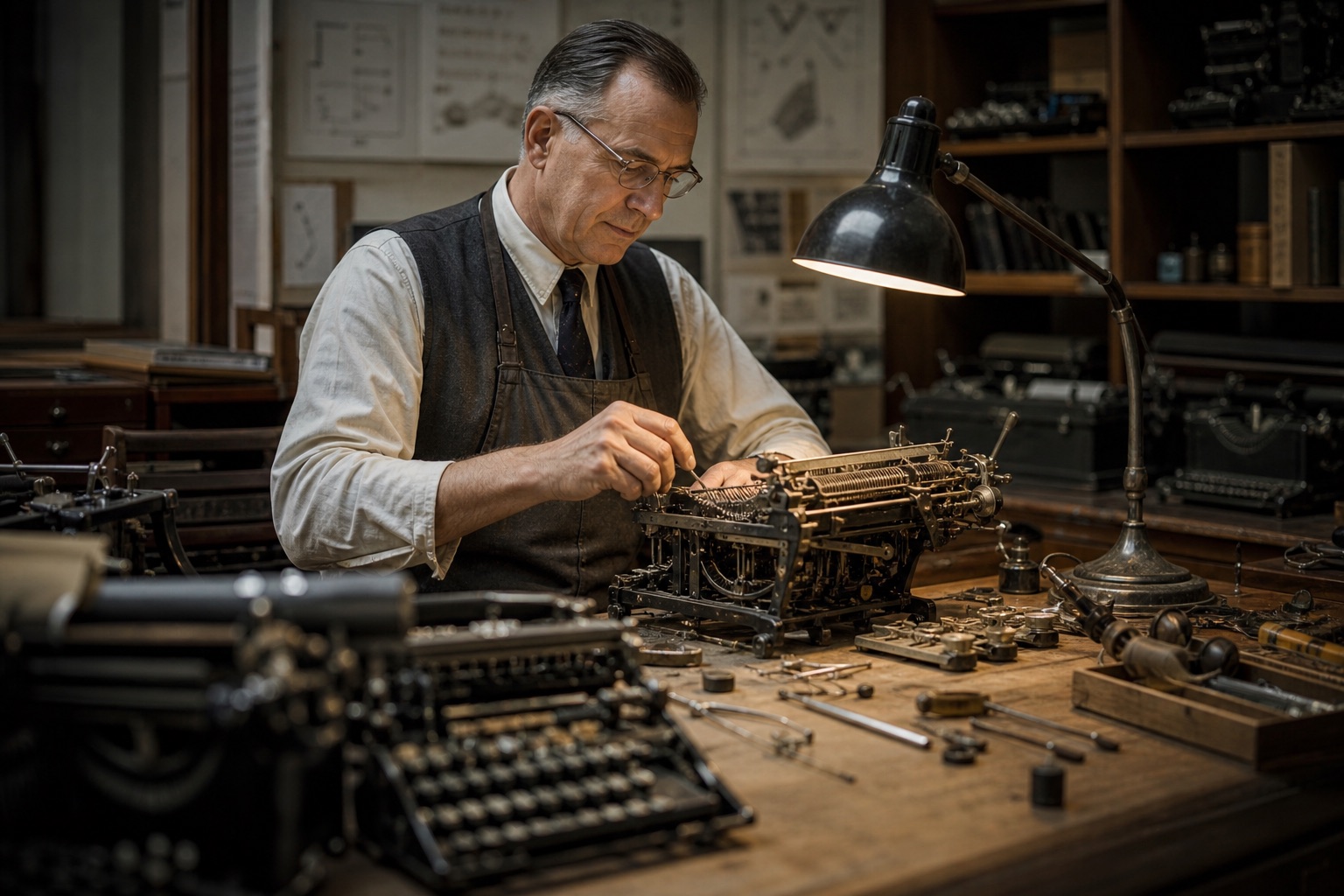 Past · Late Twentieth CenturyTypewriter RepairmanA typewriter repairman was the traveling or shop mechanic who kept office typewriters writing. He arrived with a case, cleaned a segment packed with eraser crumbs, replaced a broken drawband, aligned type that no longer struck in a straight line, and recovered or replaced a platen that had gone hard. Underwood, Remington, Royal, and the rest each had their own screws. The IBM Selectric, from 1961, added a golf-ball element and a different set of failures, and he learned those too if the route included them.
The job is a twentieth-century service trade that ends in the 1980s, when word processors and personal computers took the desks. A shop might still oil a machine for a loyal customer after that. The ordinary call, an office full of typewriters that had to be back before the mail, belongs to the decades when the typewriter was the instrument of the office and not a curiosity kept for show.
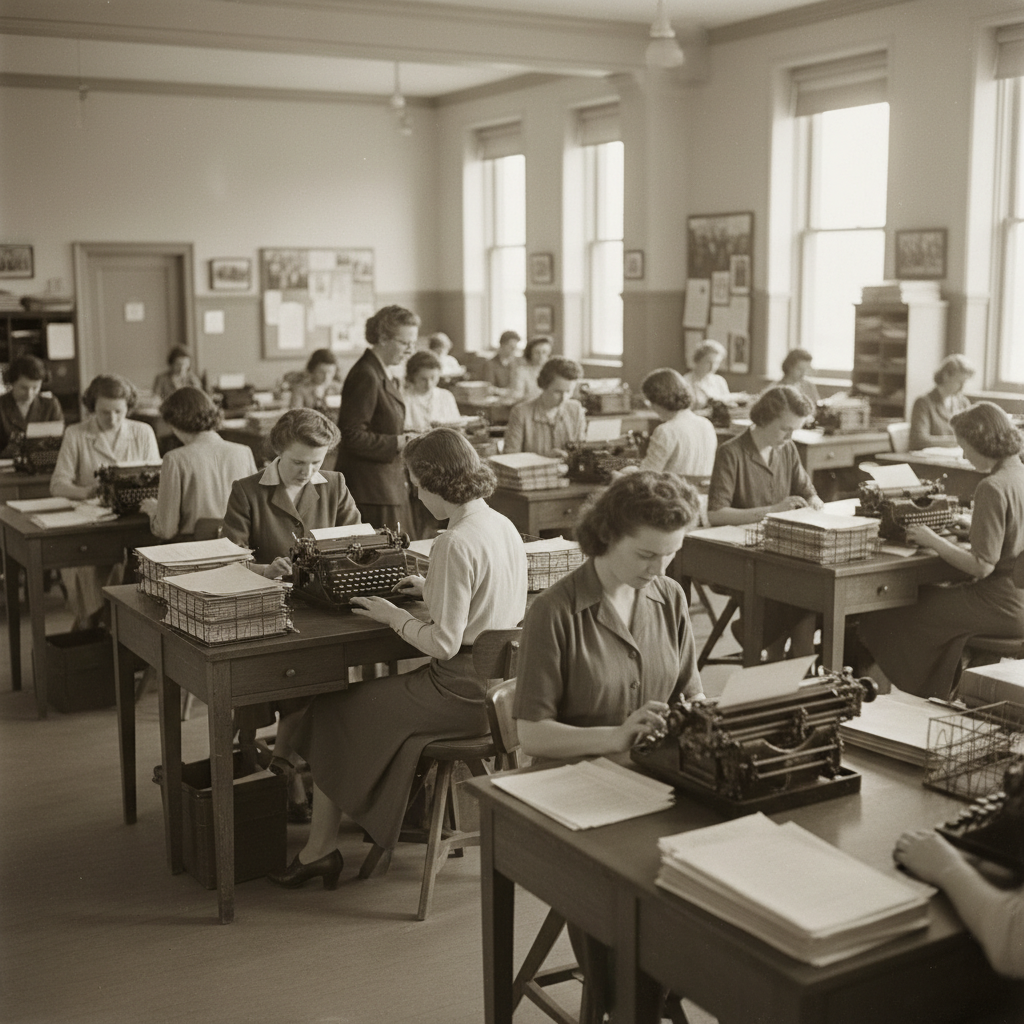 Past · Post-War EraTypist Pool WorkerThe Typist Pool Worker was a vital cog in the machinery of mid-20th century office life, particularly in the bustling corporate environments of the Post-War Era, from the late 1940s to the early 1980s. These skilled individuals were responsible for producing typed documents, correspondence, and reports, often under tight deadlines. They worked in a shared office space known as a 'typist pool,' where multiple typists would be stationed at rows of typewriters, each contributing to the efficiency of the office. The typist pool was a reflection of the era's burgeoning corporate culture, where the demand for clerical work surged as businesses expanded in the post-war economic boom.
The role required not only speed and accuracy in typing but also a keen understanding of office protocols and etiquette. Typist Pool Workers were often the first point of contact for incoming correspondence, and their ability to produce clear, professional documents was crucial for maintaining the image of the organization. They utilized carbon paper for duplicating documents and were adept at using various typewriter models, each with its own quirks and features. The job was often seen as a stepping stone for women entering the workforce, providing them with financial independence and a foothold in the corporate world.
On the timeline
Related
- Remington RandAbsorbed