
Mid Twentieth Century
Television Repairman
An extinct profession from Mid Twentieth Century that became obsolete due to technological advancement and societal change.
Media Gallery
About the Television Repairman profession
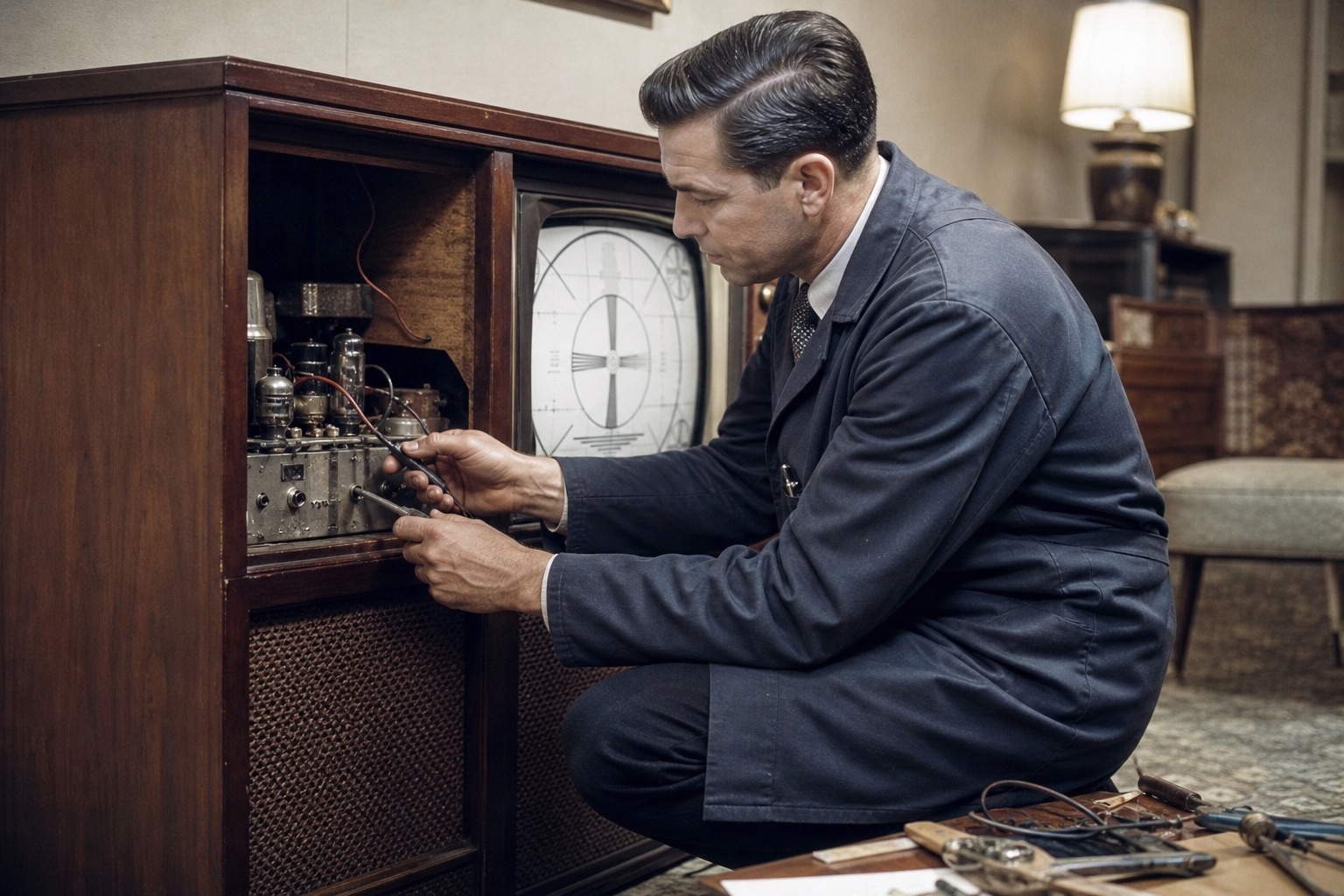
A television repairman made house calls on vacuum-tube sets in the years when a receiver was expensive enough to mend. He arrived with a caddy of common tubes, pulled the back, and tested the likely suspects, sometimes after the owner had already tried a drugstore tube checker and failed. Schematics, the Photofact kind above all, told him the chassis. If the fault was not a tube, the set might go to the shop. If it was, he replaced it in the living room and adjusted the picture before he left.
The exhibit is that mid-century visit, not every later person who swaps a board. Solid-state chassis, modular construction, and sets cheap enough to replace rather than repair ended the call. High voltage at the picture tube was a real property of the work and is named here calmly. The man with the caddy is the subject, and the glowing set is the thing he was hired to keep in the house each evening.
Day in the Life of a Television Repairman
The call
A neighbor telephoned the shop, and he drove with the caddy and the schematics for the brands he saw most. The living room was the bench. He asked what the picture had done, because a dark screen and a rolling picture were different faults.
The back off
He unplugged the set, pulled the back, and tested tubes, respecting the charge a picture tube can still hold. A bad tube from the caddy finished many visits. A fault that was not a tube meant notes, or a trip of the whole set to the shop.
The picture
When the repair worked, he adjusted height, width, and hold until the picture sat in the mask. The owner watched the test pattern or the station. He did not leave a set that had sound and no raster if the call had promised a picture.
The invoice
The bill was the call plus the tubes or parts, written on the spot or at the shop if the set had come in. Evening calls were common because households watched at night. The next morning's list was whoever had telephoned after supper.
What came after
Vacuum-tube house calls ended when sets were solid-state, modular, and cheap enough to replace.
The succession pageRelated Exhibits
Radio Repairman
The Radio Repairman was a vital figure in the mid-20th century, particularly in the post-World War II era when radio became a staple of American households. As the popularity of radio surged, so did the need for skilled technicians who could diagnose and fix the myriad of issues that could arise in these complex devices. Radio Repairmen were often found in small shops, bustling with the sounds of static and the hum of electronic equipment, as they worked diligently to restore the voices of news anchors, music, and entertainment to life. Their expertise was not only technical but also deeply rooted in an understanding of the evolving technology of the time, as they navigated the transition from vacuum tubes to transistors, and later to integrated circuits. In their workshops, Radio Repairmen would often encounter a variety of problems, from broken speakers to faulty wiring. They were adept at using a range of diagnostic tools, including multimeters and oscilloscopes, to troubleshoot issues. The job required a keen eye for detail and a methodical approach to problem-solving, as well as a solid understanding of electrical engineering principles. The Radio Repairman was not just a technician; he was a community figure, often providing advice on the best radio models and helping customers understand the technology that was rapidly changing their lives. As the 1960s progressed, the landscape of audio technology began to shift dramatically. The advent of television, along with the rise of portable music devices, led to a decline in radio's dominance. Additionally, the increasing complexity of radio technology, coupled with the introduction of disposable consumer electronics, made repairs less common. By the late 1970s, the role of the Radio Repairman began to fade, as many consumers opted to replace rather than repair their devices, marking the end of an era for this once-essential profession.
Typewriter Repairman
A typewriter repairman was the traveling or shop mechanic who kept office typewriters writing. He arrived with a case, cleaned a segment packed with eraser crumbs, replaced a broken drawband, aligned type that no longer struck in a straight line, and recovered or replaced a platen that had gone hard. Underwood, Remington, Royal, and the rest each had their own screws. The IBM Selectric, from 1961, added a golf-ball element and a different set of failures, and he learned those too if the route included them. The job is a twentieth-century service trade that ends in the 1980s, when word processors and personal computers took the desks. A shop might still oil a machine for a loyal customer after that. The ordinary call, an office full of typewriters that had to be back before the mail, belongs to the decades when the typewriter was the instrument of the office and not a curiosity kept for show.
Explore More Exhibits
Discover the full collection of past and future professions in The Jobs Museum.