
Georgian Era
Linkboy
An extinct profession from Georgian Era that became obsolete due to technological advancement and societal change.
Media Gallery
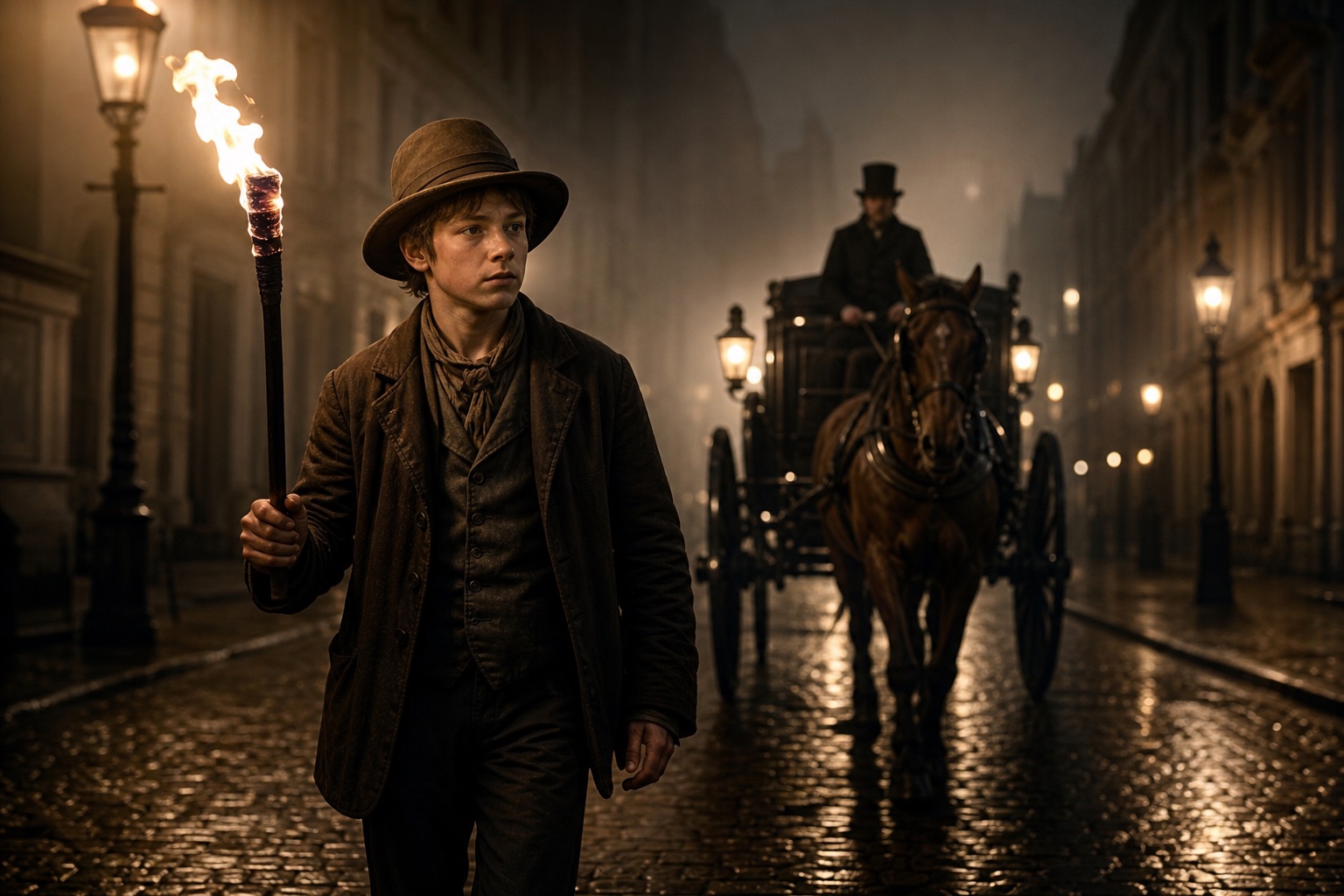
About the Linkboy profession
A linkboy carried fire through a city that had not yet been given street lamps. In London, from the later seventeenth century into the early nineteenth, anyone who left a playhouse, a tavern, or a private house after dark had to cross streets that were muddy, uneven, and often deliberately dark. The link was a torch of rope, pitch, or resin on a pole. The boy, or sometimes a grown man in the same trade, walked ahead of the fare and sold the light by the journey.
The work sat in a bad reputation as well as a useful one. An honest linkboy was a piece of street infrastructure. A dishonest one could lead a drunk customer into a court where companions were waiting. Parish officers and satirists treated the whole trade as a nuisance, which did not stop theater crowds from shouting for a light when the doors opened. The job lasted as long as the darkness did.
Day in the Life of a Linkboy
Dusk at the playhouse door
The evening starts where the crowd will be. A linkboy claims a place outside a theater, a coffeehouse, or a gentleman's door and gets the link smoldering before the performance ends. Wind is the first enemy. A flame that dies halfway down a street does not get paid.
The hire
Someone calls for a light. The fare is named before the walk begins, a few pence for a nearby street and more if the house is across an unlit parish. The boy goes ahead, not beside, so the customer can see the holes, the kennel, and whoever is standing in a doorway.
The crossing
Alleys are the dangerous part of the round. A linkboy who knows the neighborhood avoids courts with a second exit and does not stop when a stranger offers to take the fare the rest of the way. The torch throws a short circle. Outside it, the street is still night.
The last door
Payment comes at the customer's step, sometimes with an argument. Then the boy walks back toward the lights he can already see, saves what is left of the link, and waits for another party. On a dry night the work is a series of short fares. On a wet one it is a soak for the same money.
Related Exhibits
Sedan Chairman
A sedan chair was a box with a seat, a roof, and a door, hung on two poles. It needed no horse and almost no street. Two chairmen carried it, one in front and one behind, through lanes where a coach could not turn and into halls where a coach could not be brought. In seventeenth- and eighteenth-century London, Bath, and Edinburgh, the chair was how people of means crossed a filthy street without putting a shoe in it. The men who carried it were called chairmen, and the front man was often the one who spoke for the pair. The work looked simple and was not. An unbalanced step on a stair, or a pole set down at different moments, threw the passenger forward. The trade belonged to the city before it was paved for wheels. When the streets were improved for carriages, the chair lost the only advantage it had.
Coal Whipper
Coal reached London in colliers and left them in baskets. A coal whipper stood in a gang and hoisted those baskets out of the hold with a whip, a rope through a pulley, worked by the men's weight as they jumped down from a staging. It was the standard way of unloading a coal ship in the port before hydraulic cranes and tips. The gang was hired by the ship, paid by the ton, and often controlled by a publican who took his cut before the men saw theirs. Parliament noticed. The Coal Whippers Act of 1843 set up a register office so that gangs were called in turn and the publican's hold on the work was broken. The act did not save the trade. Steam cranes, and then the hydraulic coal tips that emptied a wagon straight into a barge, did the jumping for them.
Explore More Exhibits
Discover the full collection of past and future professions in The Jobs Museum.