
Georgian Era
Sedan Chairman
An extinct profession from Georgian Era that became obsolete due to technological advancement and societal change.
Media Gallery
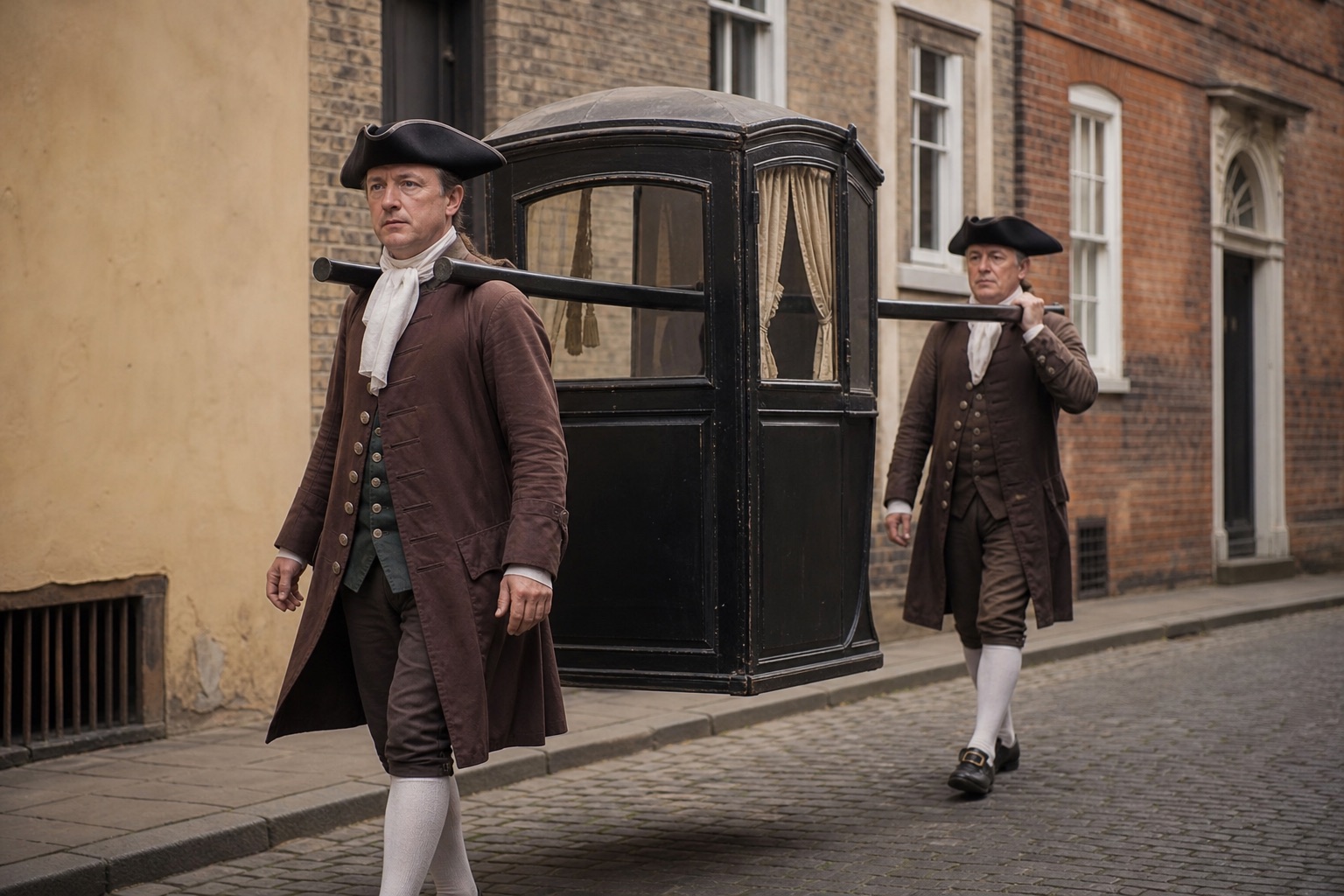
About the Sedan Chairman profession
A sedan chair was a box with a seat, a roof, and a door, hung on two poles. It needed no horse and almost no street. Two chairmen carried it, one in front and one behind, through lanes where a coach could not turn and into halls where a coach could not be brought. In seventeenth- and eighteenth-century London, Bath, and Edinburgh, the chair was how people of means crossed a filthy street without putting a shoe in it.
The men who carried it were called chairmen, and the front man was often the one who spoke for the pair. The work looked simple and was not. An unbalanced step on a stair, or a pole set down at different moments, threw the passenger forward. The trade belonged to the city before it was paved for wheels. When the streets were improved for carriages, the chair lost the only advantage it had.
Day in the Life of a Sedan Chairman
The stand
A public pair takes a stand near a pump room, a theater, or a coffeehouse and keeps the chair under cover. The poles are wiped. The straps are looked at. A wet pole slips, and a slip is how passengers get hurt.
The lift
They lift together, on a word. The front man watches the street and the back man watches the front man's shoulders. Through a lane they turn the chair on its own length, which a coach cannot do.
The visit
At the house they set the poles down level, open the door, and wait. A private pair may carry their employer on to a second call. A hired pair is paid to wait or dismissed and told to return.
The walk back
Empty, the chair is lighter and more awkward, because there is no weight to settle it. They take it back to the stand or the mews, dry the straps, and argue, if they must, over the split of the fare.
What came after
A chair carried on poles could not compete with a wheeled cab once streets were paved enough to take one.
The succession pageRelated Exhibits
Ice Delivery Man
The Ice Delivery Man was a vital figure in the late 19th and early 20th centuries, responsible for transporting large blocks of ice from ice houses to homes and businesses. Before the advent of modern refrigeration, ice was essential for preserving food, cooling drinks, and providing comfort during the sweltering summer months. Ice delivery men would often rise before dawn, preparing for a long day of labor that involved hauling heavy blocks of ice, sometimes weighing up to 300 pounds, using specialized tools and horse-drawn wagons. They navigated through city streets, delivering ice to households, restaurants, and markets, often shouting 'Ice!' to announce their arrival. The job required not only physical strength but also knowledge of customer preferences, as many clients had specific requests for the size and quantity of ice needed. The ice delivery man was a familiar sight in urban areas, contributing to the daily rhythm of life and commerce.
Linkboy
A linkboy carried fire through a city that had not yet been given street lamps. In London, from the later seventeenth century into the early nineteenth, anyone who left a playhouse, a tavern, or a private house after dark had to cross streets that were muddy, uneven, and often deliberately dark. The link was a torch of rope, pitch, or resin on a pole. The boy, or sometimes a grown man in the same trade, walked ahead of the fare and sold the light by the journey. The work sat in a bad reputation as well as a useful one. An honest linkboy was a piece of street infrastructure. A dishonest one could lead a drunk customer into a court where companions were waiting. Parish officers and satirists treated the whole trade as a nuisance, which did not stop theater crowds from shouting for a light when the doors opened. The job lasted as long as the darkness did.
Explore More Exhibits
Discover the full collection of past and future professions in The Jobs Museum.