
Victorian Era
Coal Whipper
An extinct profession from Victorian Era that became obsolete due to technological advancement and societal change.
Media Gallery
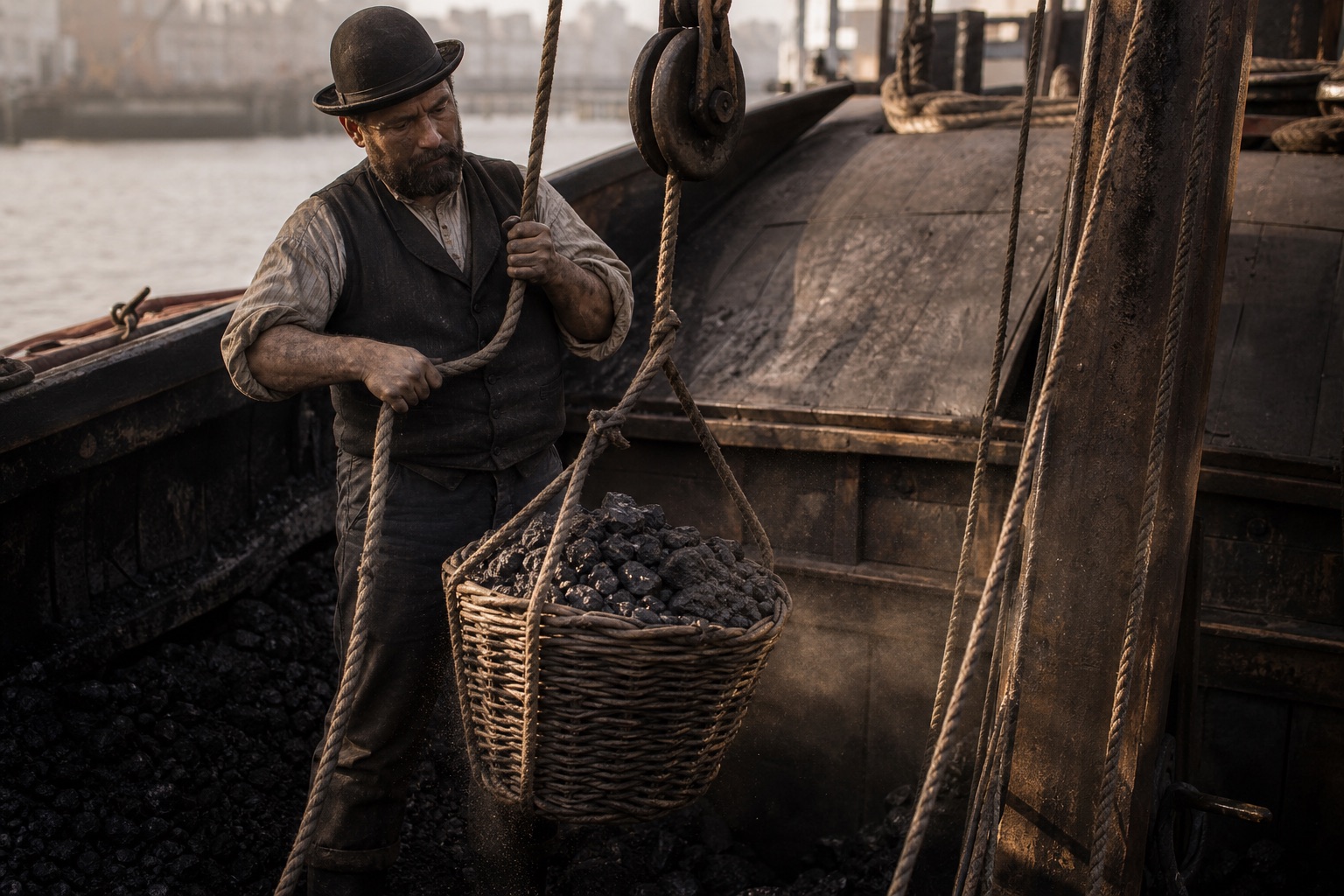
About the Coal Whipper profession
Coal reached London in colliers and left them in baskets. A coal whipper stood in a gang and hoisted those baskets out of the hold with a whip, a rope through a pulley, worked by the men's weight as they jumped down from a staging. It was the standard way of unloading a coal ship in the port before hydraulic cranes and tips. The gang was hired by the ship, paid by the ton, and often controlled by a publican who took his cut before the men saw theirs.
Parliament noticed. The Coal Whippers Act of 1843 set up a register office so that gangs were called in turn and the publican's hold on the work was broken. The act did not save the trade. Steam cranes, and then the hydraulic coal tips that emptied a wagon straight into a barge, did the jumping for them.
Day in the Life of a Coal Whipper
The call
Under the register, a gang waited to be called in turn. Before 1843 they waited on a publican, who decided who worked and who drank on the slate. Either way the morning was a wait, and then a ship.
Rigging
They set the staging and the pulley over the hatch. The men who will jump test the rope. A bad whip is how someone goes into the hold.
The hoist
One part of the gang fills baskets below. The others whip them up, using their weight on the rope, and land the coal into a barge or a sack. The tallyman counts. The pace is the wage.
The clearance
A ship is finished or the tide says stop. They coil the gear, argue the tons, and go back to the office or the public house. The next call may be the same day or not at all.
What came after
Whipping baskets out of a collier ended when coal dropped from a spout or rose in a grab.
The succession pageRelated Exhibits
Hansom Cab Driver
Joseph Hansom patented his low, two-wheeled cab in 1834, and the driver who sat it became one of the distinctive figures of Victorian streets. He did not sit in front, as a coachman did. He sat high at the back, above the roof, and drove with reins that ran over the top of the passenger compartment. The passengers sat low, between the large wheels, with a good view and almost no conversation with the man who was driving them. The cab was fast, tippy, and cheap enough to threaten the older hackney coach. Drivers hired the vehicle and often the horse from a proprietor and lived on the difference between the legal fare and the day's costs. The trade was loud, competitive, and thickly regulated. A driver who did not know the tariff, or who took the long way, was the villain of a thousand newspaper paragraphs.
Keelman
A keel was a blunt, heavy barge, and a keelman was one of the crew that took coal down the Tyne from the upriver staiths to the colliers waiting in deeper water. The boat was too clumsy for a sail in that crowded river. The men drove it with a long sweep, a great oar worked over the side, and they lived in the Sandgate when they were not on it. The keelmen were a closed community with their own society, their own hospital, and a habit of striking when the coal owners tried to cut the load or bypass them. The strike of 1819 is the famous one. It did not stop the staiths, the spouts, and the railways from eventually dropping coal straight into the ships. When the river no longer needed a barge in the middle, the keel went with it.
Explore More Exhibits
Discover the full collection of past and future professions in The Jobs Museum.