
Victorian Era
Hansom Cab Driver
An extinct profession from Victorian Era that became obsolete due to technological advancement and societal change.
Media Gallery
About the Hansom Cab Driver profession
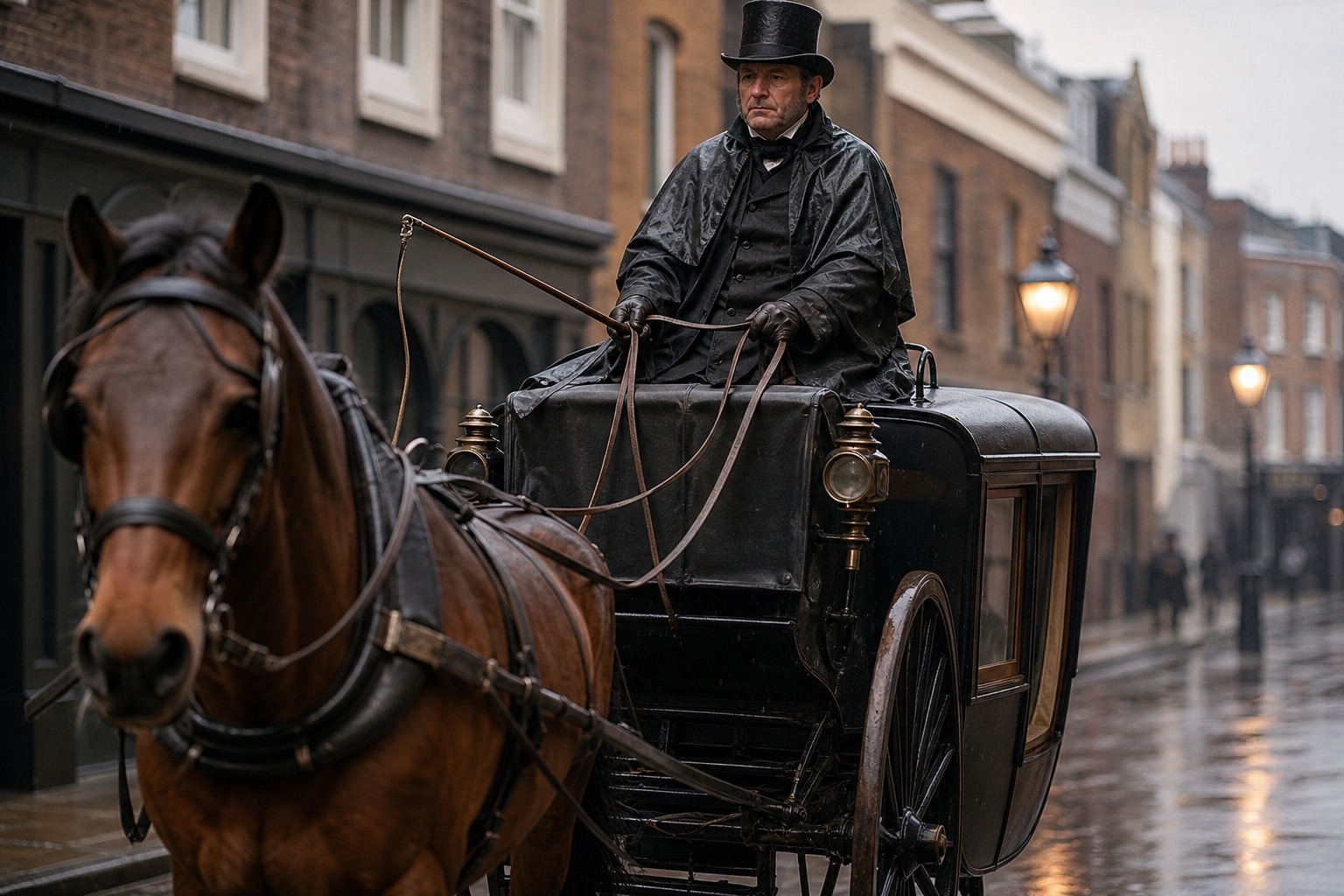
Joseph Hansom patented his low, two-wheeled cab in 1834, and the driver who sat it became one of the distinctive figures of Victorian streets. He did not sit in front, as a coachman did. He sat high at the back, above the roof, and drove with reins that ran over the top of the passenger compartment. The passengers sat low, between the large wheels, with a good view and almost no conversation with the man who was driving them.
The cab was fast, tippy, and cheap enough to threaten the older hackney coach. Drivers hired the vehicle and often the horse from a proprietor and lived on the difference between the legal fare and the day's costs. The trade was loud, competitive, and thickly regulated. A driver who did not know the tariff, or who took the long way, was the villain of a thousand newspaper paragraphs.
Day in the Life of a Hansom Cab Driver
Before the rank
The day starts in a yard. The driver checks shoes, harness, and the two big wheels, because a loose tire on a hansom is not a small repair. He feeds the horse and takes the cab to a rank near a station, a hotel, or a theater.
On the stand
Ranks are queued and argued over. Railway stations are the prize. He waits his turn, names the fare when a passenger asks, and refuses a journey that the tariff will not pay for once the horse is tired.
The drive
From the high seat he can see over other traffic and cannot hear much of what the passengers say. The reins come back over the roof. Corners are taken with care. A hansom is fast and it will spill if he shows off.
Back to the yard
At the end of the turn he waters the horse before he counts the day. The proprietor's hire comes off the top. What remains is the wage, and some days it is less than the horse has eaten.
What came after
The two-wheel hansom was replaced by the petrol cab, which kept a driver and lost the horse.
The succession pageRelated Exhibits
Coal Whipper
Coal reached London in colliers and left them in baskets. A coal whipper stood in a gang and hoisted those baskets out of the hold with a whip, a rope through a pulley, worked by the men's weight as they jumped down from a staging. It was the standard way of unloading a coal ship in the port before hydraulic cranes and tips. The gang was hired by the ship, paid by the ton, and often controlled by a publican who took his cut before the men saw theirs. Parliament noticed. The Coal Whippers Act of 1843 set up a register office so that gangs were called in turn and the publican's hold on the work was broken. The act did not save the trade. Steam cranes, and then the hydraulic coal tips that emptied a wagon straight into a barge, did the jumping for them.
Wherryman
Before London built enough bridges, the Thames was the street. A wherry was a light rowing boat, sharp at both ends, and the wherryman who hired it out was how a person crossed from one stair to another. The Watermen's Company licensed him. He waited at the stairs, called for custom, and rowed the fare into whatever the tide was doing that hour. The work was older than the company and outlived the first bridges, because a bridge with a toll and a climb was not always better than a boat. Steamers and more bridges finished it. The men who remained became watermen in a thinner trade, ferrying where a tunnel or a pier had not yet made them unnecessary.
Explore More Exhibits
Discover the full collection of past and future professions in The Jobs Museum.