
Industrial Revolution
Hurrier
An extinct profession from Industrial Revolution that became obsolete due to technological advancement and societal change.
Media Gallery
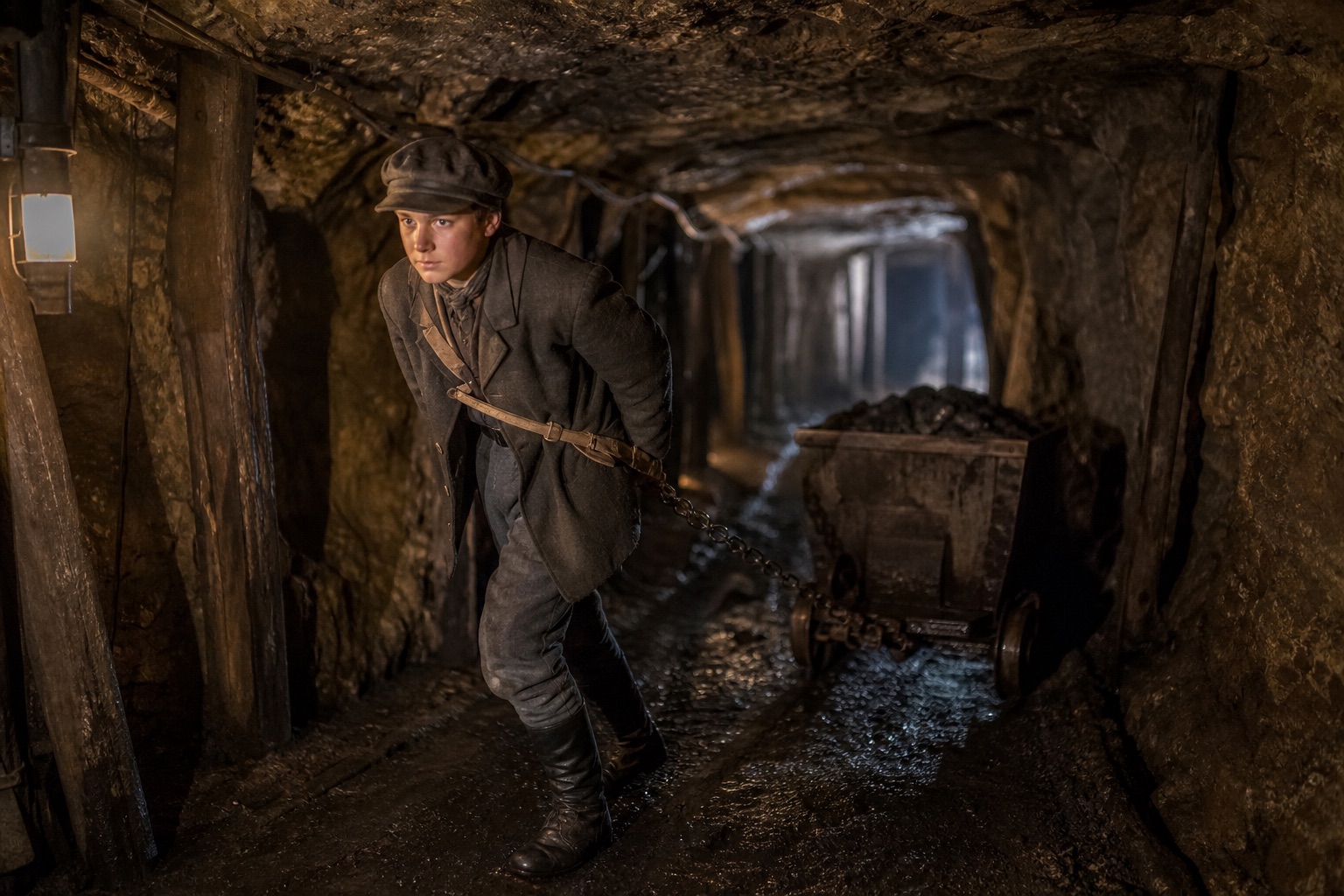
About the Hurrier profession
A hurrier moved coal along the low underground road between the face and the next stage of haulage. In thin British seams of the early nineteenth century that road was often too low for a pony, so a leather girdle was buckled at the waist and a chain ran back to a corve or a wooden tub. The hewer filled the box. The hurrier drew it, bent or on hands and feet, then returned for the next. In some pits a second child, the thruster, pushed from behind. Scottish coal bearers, usually women with creels, did a related but different carry, and this label stays with the chain and the tub.
Girls and boys both hurried, and adult women hauled underground in some districts, until the Mines and Collieries Act 1842. That Act barred every woman and girl from underground work and barred boys under ten. Lord Ashley's bill followed the Children's Employment Commission, whose sub-commissioners had gone into the pits and published the harness, the hours, and the ages. This exhibit is that pre-1842 haul. The wording stays on the road, the girdle, the tub, and the statute. It does not describe injuries. Parliament's answer was an age line, a sex line, and inspectors, which is the fact the label is built to carry.
Day in the Life of a Hurrier
The low road
The hurrier's ground was the mine road from the stall to the rolleyway, the pony road, or the shaft siding. In thin seams the roof left too little height for a horse, so the tub moved with the child. Props, water, and a brow at a turn were the ordinary features of that road.
Chain and corve
A leather girdle took the pull, and a chain or strap coupled it to a corve or a wheeled tub sized to the seam. The hurrier hooked on when the hewer had filled the box, drew it to the meeting point, and unhooked. The empty walk back was the other half of the same round.
Who hurried
Boys and girls both appear in the 1842 evidence, often hired by a parent who was the hewer, and often working beside a sibling. Ages in that evidence run from about five or six into the early teens. Trappers, who opened doors, were a neighboring child job and not the same haul.
The 1842 line
The Mines and Collieries Act 1842 took all females out of underground work and set ten as the youngest age for a boy in the pit. The commission's report is the document that fixed the hurrier in the public record. This label stops at that Act and does not carry the story past it into injury or plea.
What came after
The Mines Act of 1842 ended the child with a girdle and a chain. Older boys and ponies took the tubs, and machines took them after that.
The succession pageRelated Exhibits
Banksman
The banksman was the man at the pithead who controlled the cage and signaled the winding engineman. He stood on the bank, the surface mouth of the shaft, in the decades when British collieries wound coal and men by a steam engine, a rope, and a cage. A code of bell raps, later pushed toward a standard code by the mines acts, told the engineman to raise, lower, or stop. The banksman opened the gates, saw that keps or chairs were set or clear, and decided when the cage was free to move. He did not drive the engine. The onsetter, down the shaft, was his counterpart at the pit bottom. This exhibit is that cage-and-bell job of the steam-winding era, roughly from the spread of cages in the mid-nineteenth century through the years when many pits still wound that way. The word banksman did not die with those pits. It remains in use for the person who directs a crane or a hoist, and mining law kept a banksman's duties wherever a shaft was wound by hand signals. What thinned was this particular post: the appointed man on an open bank, ringing a bell to a steam engineman, as collieries closed and winding was enclosed, automated, and run from a control room.
Billy Boy
The term 'Billy Boy' refers to a young boy employed in the Victorian era, primarily in the coal mining industry, to assist with various tasks that were essential for the operation of the mines. These boys, often starting work as young as six or seven, played a crucial role in the mining process, particularly in the transportation of coal and the management of ventilation within the mines. Their small stature allowed them to navigate the narrow tunnels and shafts where adults could not fit, making them invaluable to the mining operations of the time. Billy Boys were responsible for a variety of tasks, including pushing carts filled with coal, opening and closing ventilation doors, and sometimes even acting as lookouts for supervisors. Their work was physically demanding and often dangerous, exposing them to the perils of mining, such as cave-ins and poor air quality. Despite the harsh conditions, these boys contributed significantly to the coal industry, which was a cornerstone of the Victorian economy, fueling the Industrial Revolution and the rapid urbanization of Britain. The life of a Billy Boy was marked by long hours, typically starting before dawn and ending after sunset, with little regard for their well-being. They were often paid meager wages, reflecting the exploitative labor practices of the time, and many faced health issues due to the hazardous environment in which they worked.
Explore More Exhibits
Discover the full collection of past and future professions in The Jobs Museum.