
Victorian Era
Banksman
An extinct profession from Victorian Era that became obsolete due to technological advancement and societal change.
Media Gallery
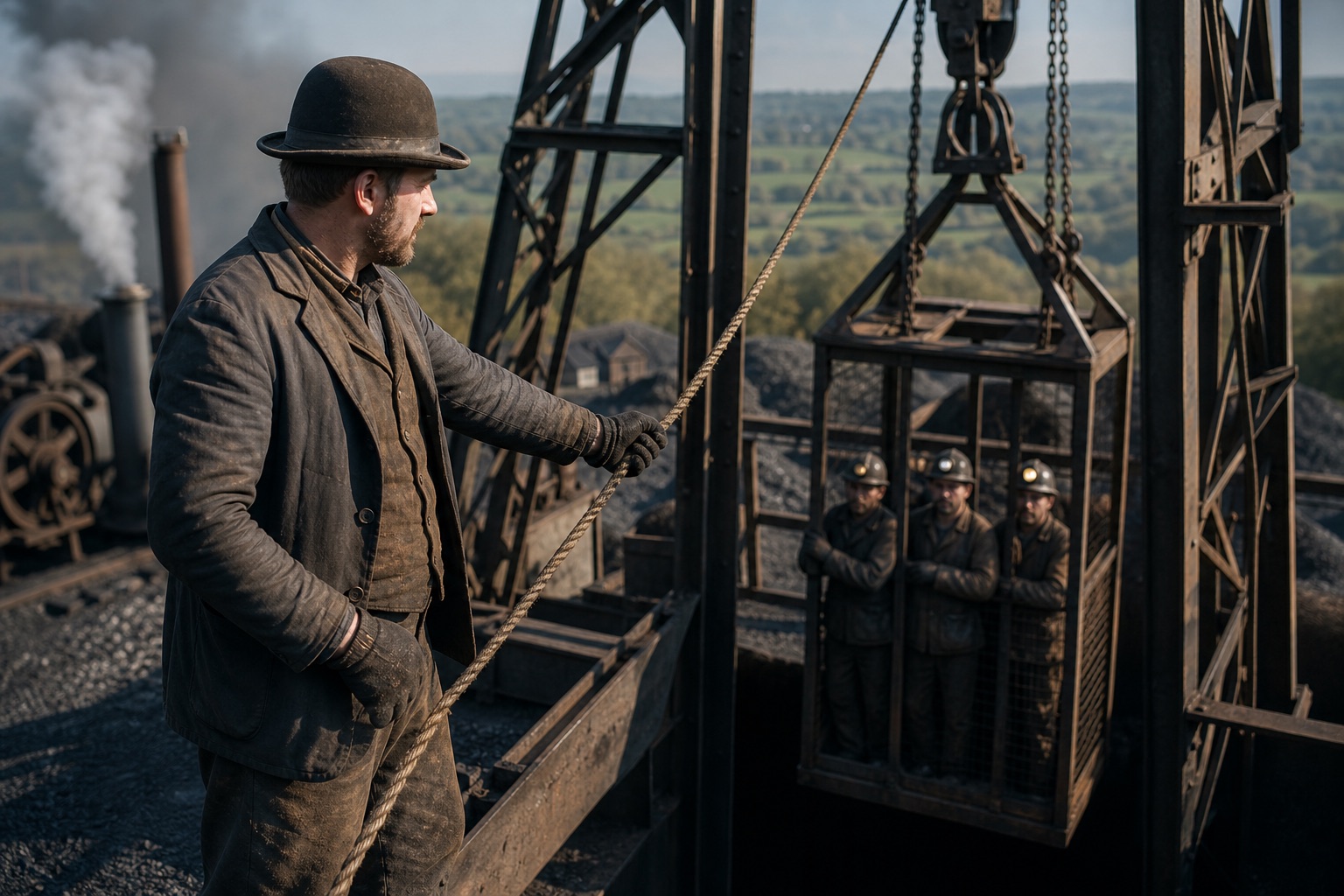
About the Banksman profession
The banksman was the man at the pithead who controlled the cage and signaled the winding engineman. He stood on the bank, the surface mouth of the shaft, in the decades when British collieries wound coal and men by a steam engine, a rope, and a cage. A code of bell raps, later pushed toward a standard code by the mines acts, told the engineman to raise, lower, or stop. The banksman opened the gates, saw that keps or chairs were set or clear, and decided when the cage was free to move. He did not drive the engine. The onsetter, down the shaft, was his counterpart at the pit bottom.
This exhibit is that cage-and-bell job of the steam-winding era, roughly from the spread of cages in the mid-nineteenth century through the years when many pits still wound that way. The word banksman did not die with those pits. It remains in use for the person who directs a crane or a hoist, and mining law kept a banksman's duties wherever a shaft was wound by hand signals. What thinned was this particular post: the appointed man on an open bank, ringing a bell to a steam engineman, as collieries closed and winding was enclosed, automated, and run from a control room.
Day in the Life of a Banksman
The pit bank
The bank was the surface landing at the shaft, with the heapstead over it and the winding-engine house a short walk away. Tubs came off the cage and went toward the screens. Men rode at the hours the pit allowed, and the banksman was the one person whose job was to keep that landing under control.
Bells to the engine
Signals went by bell or rapper, a local code of raps for raise, lower, and stop, later pressed into a more standard code by regulation. The banksman sent the surface signals, and the onsetter sent them from the bottom. The engineman moved the cage on the rap he was entitled to obey, not on a shout.
An appointed post
Colliery rules and the mines acts required a competent person at the bank whenever the cage was winding men or coal. The manager appointed him. He was an adult with pit experience, not a boy given the bell, and leaving the post unmanned while the rope was running was a breach, because the shaft had no second pair of eyes.
The word afterward
When a pit closed, its banksman went with it, and when winding was enclosed and automated the open-bank bell ringer ceased to be how the shaft was run. The word itself stayed. A banksman in construction still directs a crane, and this label does not call the word dead.
What came after
The man at the open shaft mouth was absorbed by interlocks, electric winders, and pit closures. The word survived the open-bank job.
The succession pageRelated Exhibits
Coal Stoker
The coal stoker was a vital role during the Industrial Revolution, responsible for feeding coal into steam boilers that powered locomotives, ships, and factories. These workers were the unsung heroes of the industrial age, ensuring that the engines of progress ran smoothly. The job required physical strength and endurance, as stokers often worked in hot, cramped, and dark conditions, shoveling coal into the fireboxes of boilers to maintain the necessary temperature for steam production. The stoker's work was crucial for the operation of steam engines, which were the backbone of industrial transportation and manufacturing during this period. The job was labor-intensive and often dangerous, with workers exposed to high temperatures, coal dust, and the risk of burns or injuries from heavy equipment. Stokers were typically employed in coal-fired power plants, on ships, and in factories, where they played a key role in the efficiency of steam-powered machinery. As the Industrial Revolution progressed, the demand for coal stokers grew, but so did the mechanization of the industry, leading to significant changes in the workforce.
Coal Whipper
Coal reached London in colliers and left them in baskets. A coal whipper stood in a gang and hoisted those baskets out of the hold with a whip, a rope through a pulley, worked by the men's weight as they jumped down from a staging. It was the standard way of unloading a coal ship in the port before hydraulic cranes and tips. The gang was hired by the ship, paid by the ton, and often controlled by a publican who took his cut before the men saw theirs. Parliament noticed. The Coal Whippers Act of 1843 set up a register office so that gangs were called in turn and the publican's hold on the work was broken. The act did not save the trade. Steam cranes, and then the hydraulic coal tips that emptied a wagon straight into a barge, did the jumping for them.
Explore More Exhibits
Discover the full collection of past and future professions in The Jobs Museum.