
Medieval Era
Charcoal-Burner
An extinct profession from Medieval Era that became obsolete due to technological advancement and societal change.
Media Gallery
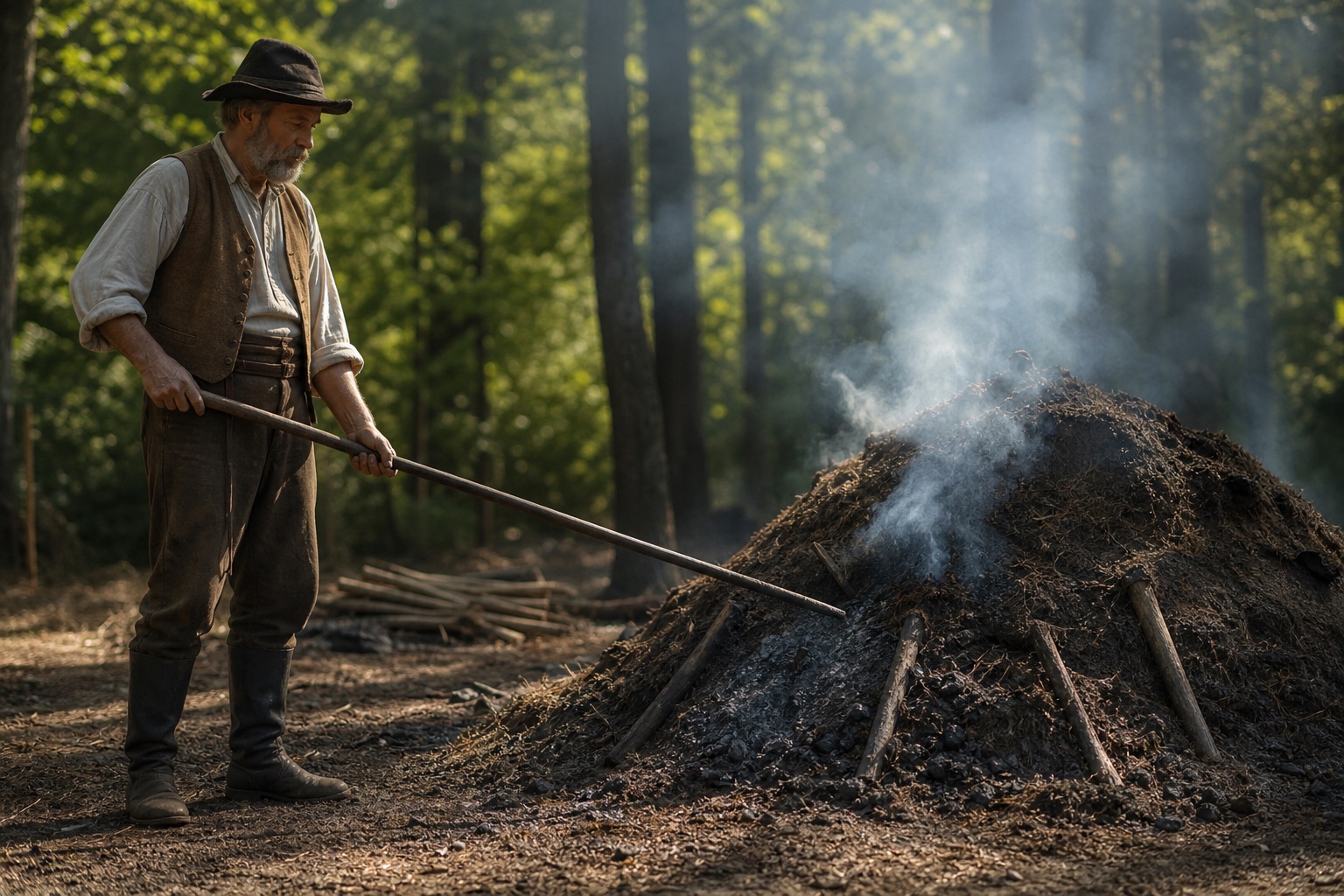
About the Charcoal-Burner profession
The charcoal-burner, the collier of the woods, was not a coal miner. He stacked cordwood from the coppice into a mound, covered it with straw, turf, and earth, and set it to smoulder rather than to flame. Too much air and the stack burnt to ash, which nobody would buy. Too little and the sticks stayed half raw. He slept in a hut beside the clamp, sometimes for several days, opening and closing vents as the smoke changed colour, and he stopped leaks in the mound with a fresh sod before a bright spot could run away. When the heap had cooled he raked out black coal and bagged it for the furnace, the powder mill, or the brazier.
Coppice woods in the Weald, the Forest of Dean, the Wyre, and a hundred smaller falls were cut on a cycle of years so that underwood, not the great timber trees, supplied him. The craft runs from medieval woodland custom into the late nineteenth century, long after Abraham Darby's coke had begun to feed furnaces. Mineral coal took the domestic grate. Coke took the ordinary blast furnace. In the nineteenth century, enclosed retorts carbonised wood in iron vessels and collected tar and acid along with a cheaper charcoal. The clamp in the coppice could not match that price. The last burners were remnants, coaling for hop kilns, braziers, and a few special trades, not for the ironworks that had once kept the woods smoking.
Day in the Life of a Charcoal-Burner
Stacking the wood
The burner and his helper corded the coppice wood and stacked it in a tight mound, thicker sticks toward the middle, with a chimney left at the core. The pile was thatched with straw or bracken and skinned with turf and earth so that air could be rationed. A loose stack was already a spoiled burn, because flame would find the gaps before the coal had formed.
Lighting the core
He lit the centre and then choked it, feeding the fire only enough air to keep a slow smoulder moving outward through the wood. The first hours decided whether the clamp would coal or simply burn. Smoke at the vents was watched for colour and smell, and a pale hungry smoke meant the mound was being given too much air.
The night watch
Once the burn was alive someone had to stay with it, including through the night, because a hole in the skin could open in an hour. The burner slept in turns in the hut, woke to walk the mound, and patched any bright spot with a wet sod or a shovel of earth. Those hours were the job as much as the stacking, and they were not itemised on the factor's ticket.
Drawing the coal
When the smoke thinned and the mound cooled, the earth was pulled back and the coal raked out before it could catch again in the open air. Dust and smalls were sieved from the lumps, and the lumps were sacked or loaded by the dozen for the carrier. Ash was a loss, and only coal that held together was paid, so a burnt-through clamp meant the cord of wood had earned almost nothing.
What came after
Wood colliers in the forest lost the iron trade to mineral coal and to charcoal made in closed retorts.
The succession pageRelated Exhibits
Agoranomos
The Agoranomos was a pivotal figure in the bustling marketplaces of ancient Greece, particularly in city-states like Athens. This role was akin to that of a modern-day market supervisor or inspector, responsible for overseeing the activities within the agora, the central public space where commerce, politics, and social interaction flourished. The Agoranomos ensured that trade was conducted fairly, that weights and measures were accurate, and that vendors adhered to the laws governing commerce. They played a crucial role in maintaining order and integrity in the marketplace, which was vital for the economic health of the city-state. In addition to regulatory duties, the Agoranomos also had the authority to impose fines on dishonest merchants and to confiscate goods that were sold under false pretenses. This position required a deep understanding of local laws and trade practices, as well as a keen sense of justice to protect both consumers and honest traders. The Agoranomos was often seen as a guardian of the public interest, ensuring that the agora remained a vibrant and trustworthy hub of activity.
Aircraft Listener
The role of an Aircraft Listener emerged in the mid-20th century, primarily during the Post-War Era, when aviation technology was rapidly advancing and air traffic was increasing significantly. Aircraft Listeners were tasked with monitoring and interpreting the sounds of aircraft engines, particularly in military contexts, where understanding the nuances of engine noise could indicate the type of aircraft, its operational status, and even potential mechanical issues. This job was crucial for military intelligence and air traffic control, as it provided valuable information about aircraft movements and capabilities without the need for visual confirmation. Listeners would often work in pairs or small teams, stationed at strategic locations such as airbases or observation posts. They utilized their acute hearing to distinguish between different aircraft types, noting variations in sound that could indicate changes in speed, altitude, or engine performance. This auditory skill was honed through extensive training and experience, as the ability to identify aircraft by sound alone was a rare and valuable talent. The job required not only a keen ear but also a deep understanding of aviation technology and the specific characteristics of various aircraft engines. Listeners would often keep detailed logs of their observations, contributing to intelligence reports and operational assessments. The role was a blend of art and science, requiring both technical knowledge and an intuitive grasp of sound dynamics.
Explore More Exhibits
Discover the full collection of past and future professions in The Jobs Museum.