
Georgian Era
Tooth-drawer
An extinct profession from Georgian Era that became obsolete due to technological advancement and societal change.
Media Gallery
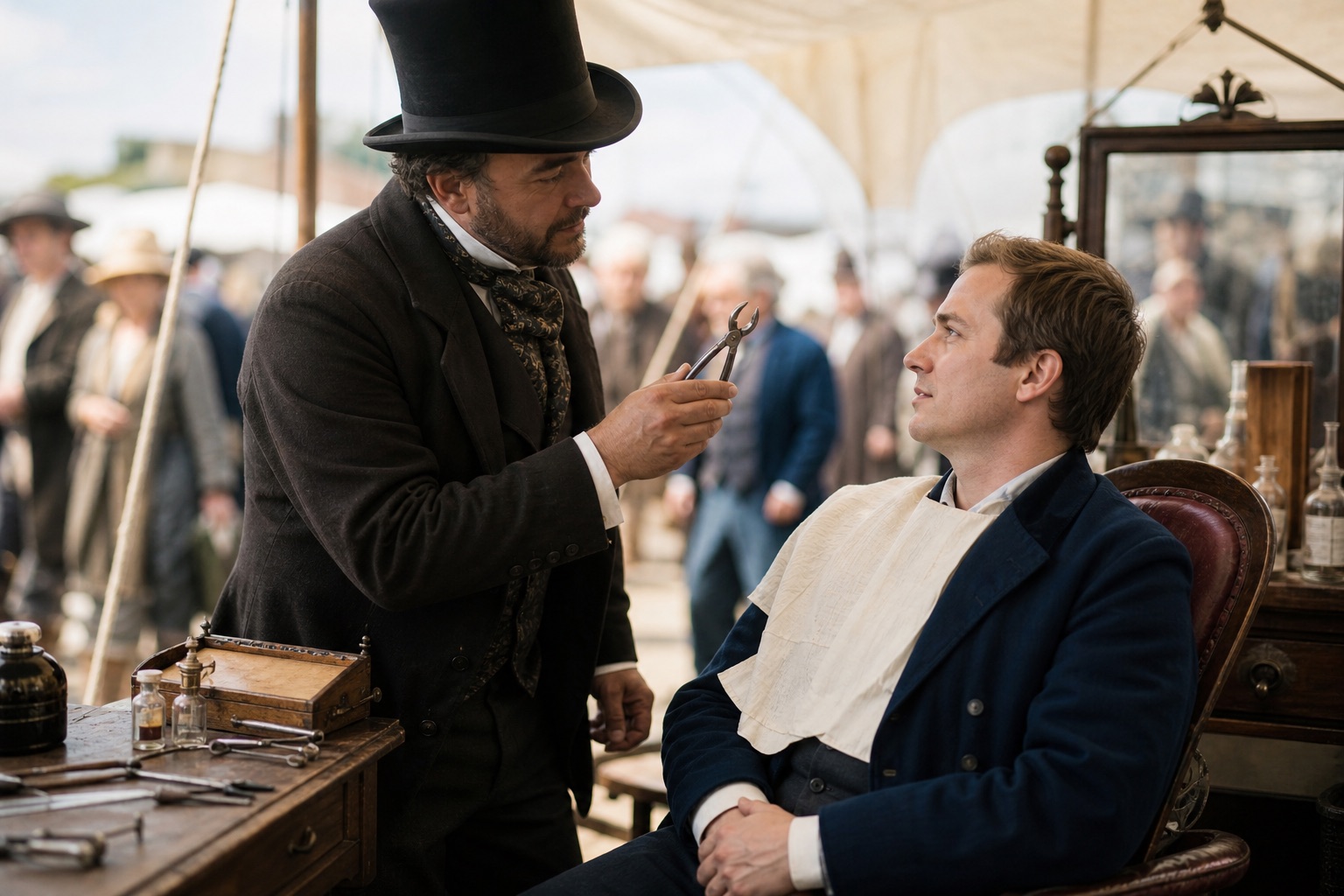
About the Tooth-drawer profession
A tooth-drawer was an itinerant extractor who worked fairs, markets, and street pitches in the seventeenth, eighteenth, and early nineteenth centuries, before dentistry was a licensed profession. He was kin to the barber-surgeon: tooth-pulling sat among the minor operations that barbers and irregular operators both claimed, while physicians kept their distance. The instruments were the pelican, an older lever, the dental key that spread in the eighteenth century, and forceps, sometimes only a string tied to the tooth. There was no anesthesia. The pull was public, because a crowd was the advertisement, and the fee was a few pence or a shilling paid at once.
The exhibit stops at the early nineteenth century, which is the form meant here: a travelling operator, not a settled dental surgeon with a room and a register. That later figure is the ending of this one. Nitrous oxide and ether gave respectable practitioners a way to promise less pain. The Dentists Act 1878 put a register under British law and began to separate the titled dentist from the fairground stool. Handbills and fair paintings are the record of the drawer. Martin van Butchell, a London operator of the late eighteenth century, is one of the few whose name survived the pitch.
Day in the Life of a Tooth-drawer
Fair and market
The drawer took a pitch where people already gathered: a fair, a market day, or a busy street. A stool, a cloth, and the instruments were enough furniture. The crowd was not an accident, and a public pull brought the next customer, which is why the work stayed in the open.
Key, pelican, forceps
The pelican levered a tooth with a pad against the gum. The dental key, common from the eighteenth century, hooked the crown and turned. Forceps improved through the period and eventually outlasted both, while a string and a sudden jerk was the poorest version of the same idea.
Cash on the stool
Payment was immediate and per tooth, often a few pence to a shilling as the handbill had promised. There was no account sent to a house and no parish contract. A day with a queue paid, and a day when fear kept people back did not, so the drawer moved on.
Surgery and the register
Settled dentists with a room, then anesthesia, then the Dentists Act 1878, took the extraction out of the fair. The register made a title that the itinerant could not honestly use. The travelling drawer belongs to the centuries before that profession existed, and the Act explains why he did not return.
What came after
The fairground extraction was replaced by a dentist in a room, with better instruments, anesthesia, and, after 1878, a register.
The succession pageRelated Exhibits
Agoranomos
The Agoranomos was a pivotal figure in the bustling marketplaces of ancient Greece, particularly in city-states like Athens. This role was akin to that of a modern-day market supervisor or inspector, responsible for overseeing the activities within the agora, the central public space where commerce, politics, and social interaction flourished. The Agoranomos ensured that trade was conducted fairly, that weights and measures were accurate, and that vendors adhered to the laws governing commerce. They played a crucial role in maintaining order and integrity in the marketplace, which was vital for the economic health of the city-state. In addition to regulatory duties, the Agoranomos also had the authority to impose fines on dishonest merchants and to confiscate goods that were sold under false pretenses. This position required a deep understanding of local laws and trade practices, as well as a keen sense of justice to protect both consumers and honest traders. The Agoranomos was often seen as a guardian of the public interest, ensuring that the agora remained a vibrant and trustworthy hub of activity.
Aircraft Listener
The role of an Aircraft Listener emerged in the mid-20th century, primarily during the Post-War Era, when aviation technology was rapidly advancing and air traffic was increasing significantly. Aircraft Listeners were tasked with monitoring and interpreting the sounds of aircraft engines, particularly in military contexts, where understanding the nuances of engine noise could indicate the type of aircraft, its operational status, and even potential mechanical issues. This job was crucial for military intelligence and air traffic control, as it provided valuable information about aircraft movements and capabilities without the need for visual confirmation. Listeners would often work in pairs or small teams, stationed at strategic locations such as airbases or observation posts. They utilized their acute hearing to distinguish between different aircraft types, noting variations in sound that could indicate changes in speed, altitude, or engine performance. This auditory skill was honed through extensive training and experience, as the ability to identify aircraft by sound alone was a rare and valuable talent. The job required not only a keen ear but also a deep understanding of aviation technology and the specific characteristics of various aircraft engines. Listeners would often keep detailed logs of their observations, contributing to intelligence reports and operational assessments. The role was a blend of art and science, requiring both technical knowledge and an intuitive grasp of sound dynamics.
Explore More Exhibits
Discover the full collection of past and future professions in The Jobs Museum.