
Victorian Era
Straw-Plaiter
An extinct profession from Victorian Era that became obsolete due to technological advancement and societal change.
Media Gallery
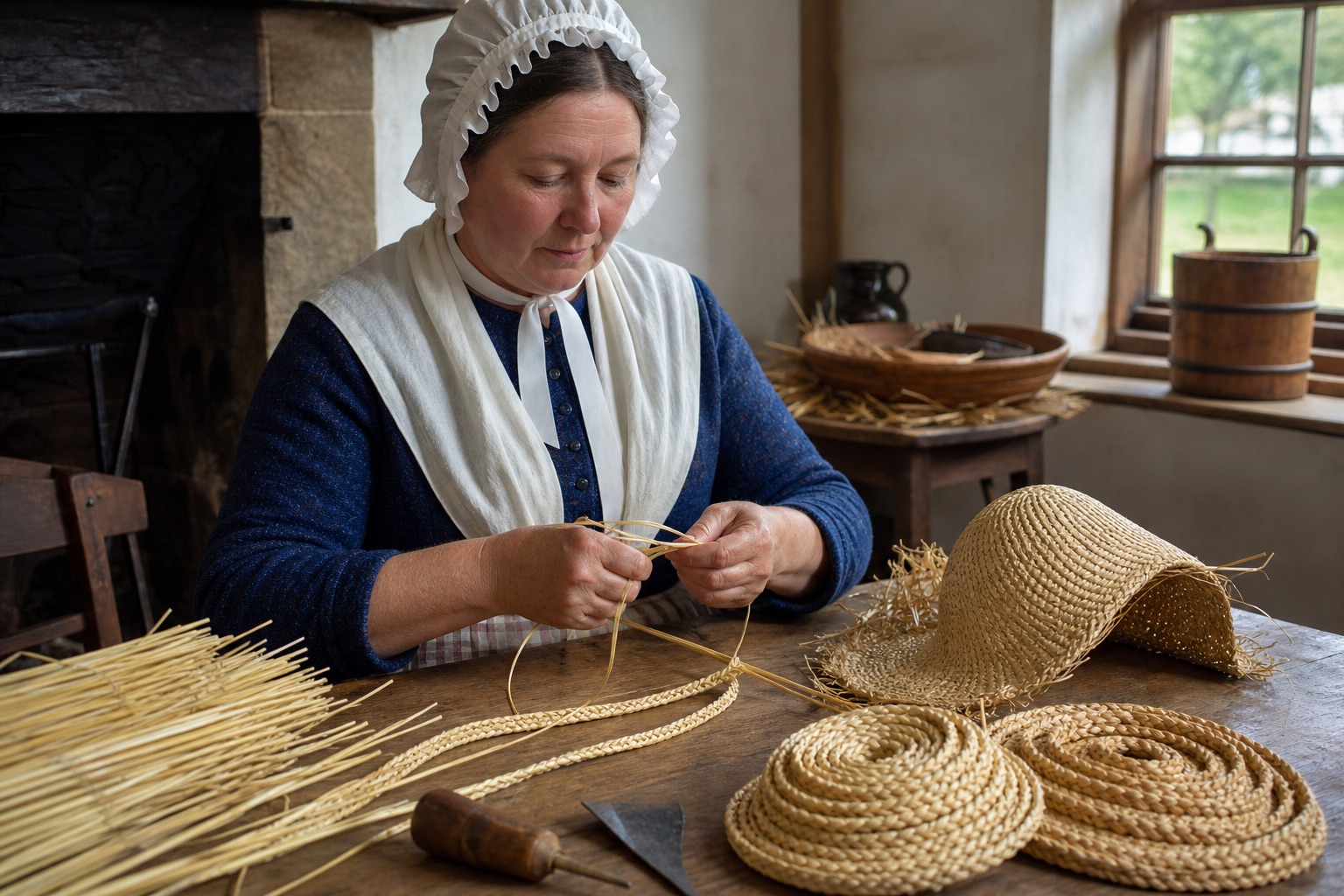
About the Straw-Plaiter profession
Straw plait was a narrow braid of split wheat straw, made in the cottages of Bedfordshire, Buckinghamshire, and Hertfordshire and sold to the hat trade of Luton and Dunstable. The plaiter damped the straws, split them, and worked a set pattern, joining a fresh straw so the edge did not lump, until she had a score of twenty yards. That score was the unit of the weekly plait market. Women and children did the work. In a village plait school a child could sit the day for pence, and a mother made her own scores in the evening for a few shillings when the buyers were kind. The hat factories turned the braid into bonnets and hats. The cottage sold them braid, not hats.
Luton's hat industry continued. The local hand plait did not. Italian straw, including the Leghorn and Tuscan kinds, had long been a finer rival for the best hats. In the late nineteenth century cheap plait from China arrived in amounts the south Midlands could not underbid. Sewing machines and factory blocking then made hats from that imported braid, or from other materials, without a village score at all. By the early twentieth century a girl in a Bedfordshire parish was no longer set to plait as her mother had been. The market had stopped paying an English hand price for the hours in the braid.
Day in the Life of a Straw-Plaiter
Damping and splitting
The morning began with straw: whole straws damped so they would not crack, then drawn through a small splitter to make the narrow splints the pattern required. Too wet and the plait stained, and too dry it split in the hand and had to be thrown aside. A child in a plait school spent part of every day on this preparation, because a tangled bundle of straw earned nothing until it was braid.
The braid itself
Plaiting was done in the fingers, a named pattern such as a seven-end, each new straw joined in so the edge stayed tight and did not show a lump. The worker could walk, mind a child, or sit in a doorway and keep the braid going, which is why the trade fitted a cottage and a schoolroom alike. An uneven edge was a lower price at market, so speed that spoiled the pattern did not pay.
Making the score
The unit was the score, twenty yards, measured and tied off before the next was started. A quick adult might finish more than one score in a good day, while a child finished less and was paid in pence rather than a woman's few shillings. Scores were bundled and kept clean, because stained straw was docked when the buyer looked at it.
Market morning
On market day the bundles went to the plait market, in Luton, Dunstable, or a nearer town, and dealers priced them by pattern and quality. The seller took the money, or the promise of it, and often straw for the next week. By the 1890s many of those buyers were comparing her score with a cheaper bundle already landed from China or Italy, and paying her accordingly.
What came after
Bedfordshire plait lost its price to imports and to hats sewn by machine.
The succession pageRelated Exhibits
Lacemaker
Pillow lace was made on a cushion. A parchment pricking carried the pattern, and the thread moved on dozens of bobbins that the worker crossed, twisted, and pinned. The Midlands trade, in Buckinghamshire, Bedfordshire, and Northamptonshire, made continuous lace, ground and motif growing as one web. Bucks point was an older pride of that country. After the Great Exhibition put Maltese lace in fashion, Bedfordshire workers also made a plaited lace to sell into that taste. Devon worked differently. At Honiton and in the villages toward Beer the lacemaker made separate sprigs, sewn onto net. From the early nineteenth century that net was usually machine-made, so a celebrated Honiton piece could sit on a ground the pillow had never worked. Women and girls did most of the hand work. Lace schools sat small children at pillows for eight or ten hours and a few pence, the mistress selling their output and keeping a margin. A woman at home might make a few shillings in a week and still work into the evening to finish a yard. John Heathcoat's bobbin-net machine of 1809, and the Leavers machine developed from it in Nottingham, put patterned lace on the market below the pillow's price. Hand lace did not stop on a given Monday. It became a poorly paid remnant beside a machine that already supplied the ordinary buyer.
Agoranomos
The Agoranomos was a pivotal figure in the bustling marketplaces of ancient Greece, particularly in city-states like Athens. This role was akin to that of a modern-day market supervisor or inspector, responsible for overseeing the activities within the agora, the central public space where commerce, politics, and social interaction flourished. The Agoranomos ensured that trade was conducted fairly, that weights and measures were accurate, and that vendors adhered to the laws governing commerce. They played a crucial role in maintaining order and integrity in the marketplace, which was vital for the economic health of the city-state. In addition to regulatory duties, the Agoranomos also had the authority to impose fines on dishonest merchants and to confiscate goods that were sold under false pretenses. This position required a deep understanding of local laws and trade practices, as well as a keen sense of justice to protect both consumers and honest traders. The Agoranomos was often seen as a guardian of the public interest, ensuring that the agora remained a vibrant and trustworthy hub of activity.
Explore More Exhibits
Discover the full collection of past and future professions in The Jobs Museum.