
Medieval Era
Illuminator
An extinct profession from Medieval Era that became obsolete due to technological advancement and societal change.
Media Gallery
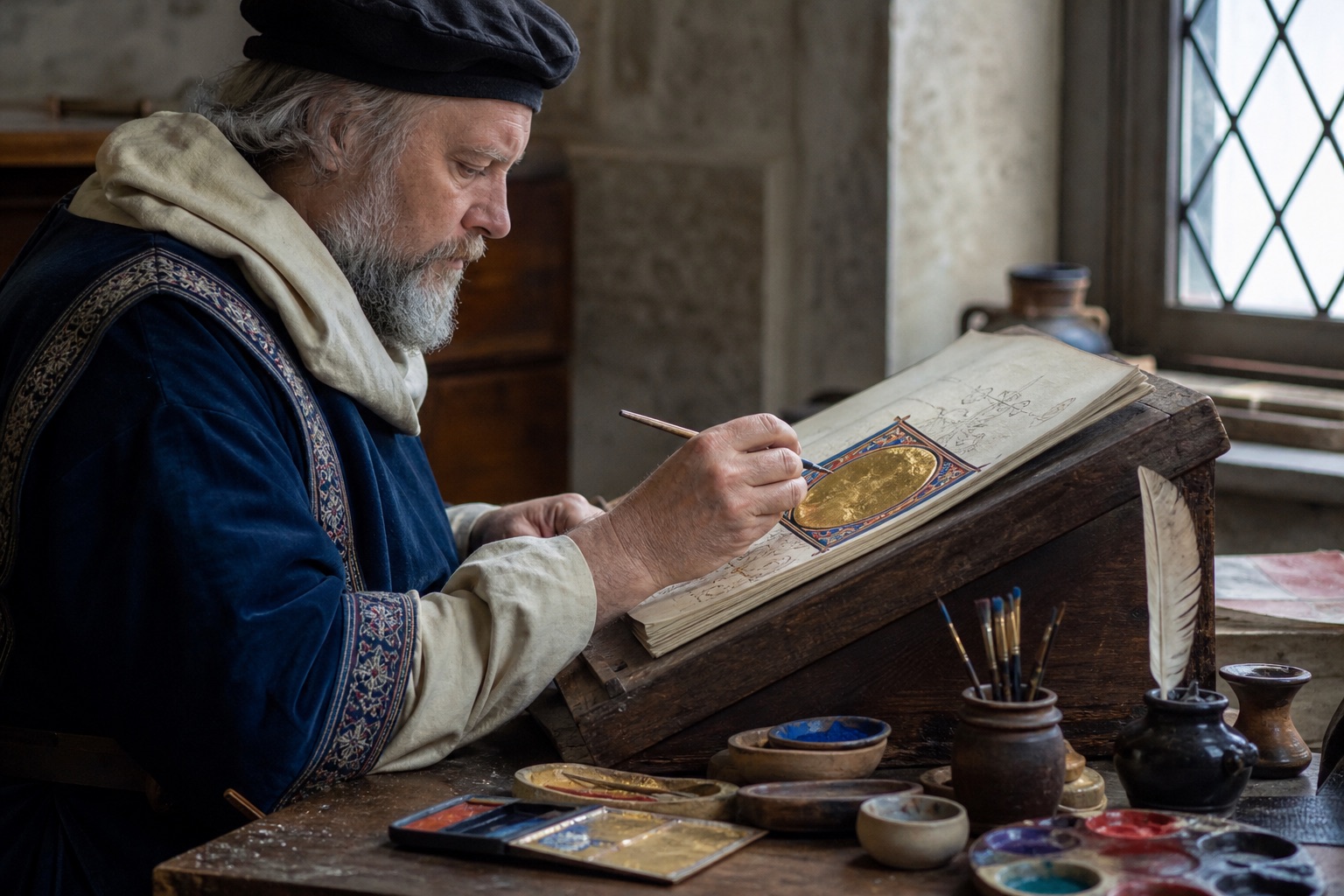
About the Illuminator profession
An illuminator painted the decorated letters, borders, and miniatures in a manuscript book, and was a different worker from the scribe who wrote the text. A quire often passed from one to the other: the scribe left blank spaces, and the illuminator filled them with an initial in gold and color or with a small picture. The materials were parchment or vellum, later paper, mineral and organic pigments, and gold leaf laid on a gesso ground and burnished. The work belonged to the medieval book, from the Romanesque scriptorium through the books of hours of the fourteenth and fifteenth centuries.
Monks and nuns did illuminate, especially in earlier centuries, and it is a mistake to stop the story there. By the later Middle Ages many illuminators were lay urban artisans, men and women in commercial workshops in Paris, Bruges, Ghent, Bologna, and London, hired by stationers who dealt with the patron. Christine de Pizan praised a Parisian illuminator named Anastasia. The Limbourg brothers worked for the Duke of Berry as professional painters, not as cloistered scribes. Printing, from the middle of the fifteenth century through the sixteenth, took the ordinary commission away. Luxury manuscripts lingered. The specialist trade of illuminating books by hand did not.
Day in the Life of a Illuminator
After the scribe
The illuminator received a quire on which the text was already written, with spaces left for initials and pictures. He or she did not usually write the book. The sequence was scribe, then painter, then binder, often under a stationer who owned the contract, and blank space was the handoff.
Initials and miniatures
A small initial might be penwork and a wash of color. A richer one took gold leaf on a raised ground, burnished, with painted foliage in the margin. A miniature was a picture in a frame, priced by size and by the gold, and the same book could contain all three.
The urban workshop
Paris, Bruges, Ghent, London, and Bologna supported lay illuminators who kept shops and apprentices like other artisans. Monastic scriptoria mattered, and they were not the whole trade. Stationers subcontracted the painting, so a journeyman might never meet the patron whose arms he was gilding.
The printed book
From the 1450s the press multiplied texts without a painter. Rubrication by hand lingered on some early printed pages, and a few rich buyers still ordered manuscripts. By the later sixteenth century a specialist illuminator was a remnant, and the ordinary book had left the burnisher behind.
What came after
Painted initials and miniatures lost the ordinary buyer to type and the woodcut.
The succession pageRelated Exhibits
Calligrapher
The art of calligraphy, often referred to as 'beautiful writing,' flourished during the Medieval Period, where skilled calligraphers played a crucial role in the preservation and dissemination of knowledge. These artisans were not merely writers; they were artists who transformed the written word into a visual spectacle. Calligraphers were responsible for creating manuscripts, religious texts, and important documents, often using intricate scripts that varied by region and purpose. Their work was characterized by the use of quills, ink, and parchment, and they often employed elaborate techniques such as gilding and illumination to enhance their creations. The calligrapher's role was not only to write but to imbue each piece with a sense of beauty and reverence, making their work essential in an era where printed materials were scarce and literacy was a privilege of the few.
Ale Conner
The role of the Ale Conner was a vital one in medieval society, particularly in England, where ale was a staple beverage. Tasked with ensuring the quality of ale produced by local brewers, the Ale Conner acted as a guardian of public health and consumer rights. This position was often held by a local official or a member of the community who had the authority to inspect and taste ale before it was sold to the public. The Ale Conner would assess the ale for its strength, flavor, and overall quality, ensuring that it met the standards set by local regulations. If the ale was found to be subpar, the Ale Conner had the power to condemn it, preventing it from being sold and protecting the community from potential harm. In addition to quality control, the Ale Conner also played a role in the regulation of prices, ensuring that brewers did not exploit consumers by charging exorbitant rates for inferior products. This position was essential in maintaining the integrity of the ale market, which was a significant part of daily life in medieval towns and villages. The Ale Conner's work was not only about quality but also about fairness in trade, reflecting the communal values of the time.
Explore More Exhibits
Discover the full collection of past and future professions in The Jobs Museum.