
Industrial Revolution
Cropper
An extinct profession from Industrial Revolution that became obsolete due to technological advancement and societal change.
Media Gallery
About the Cropper profession
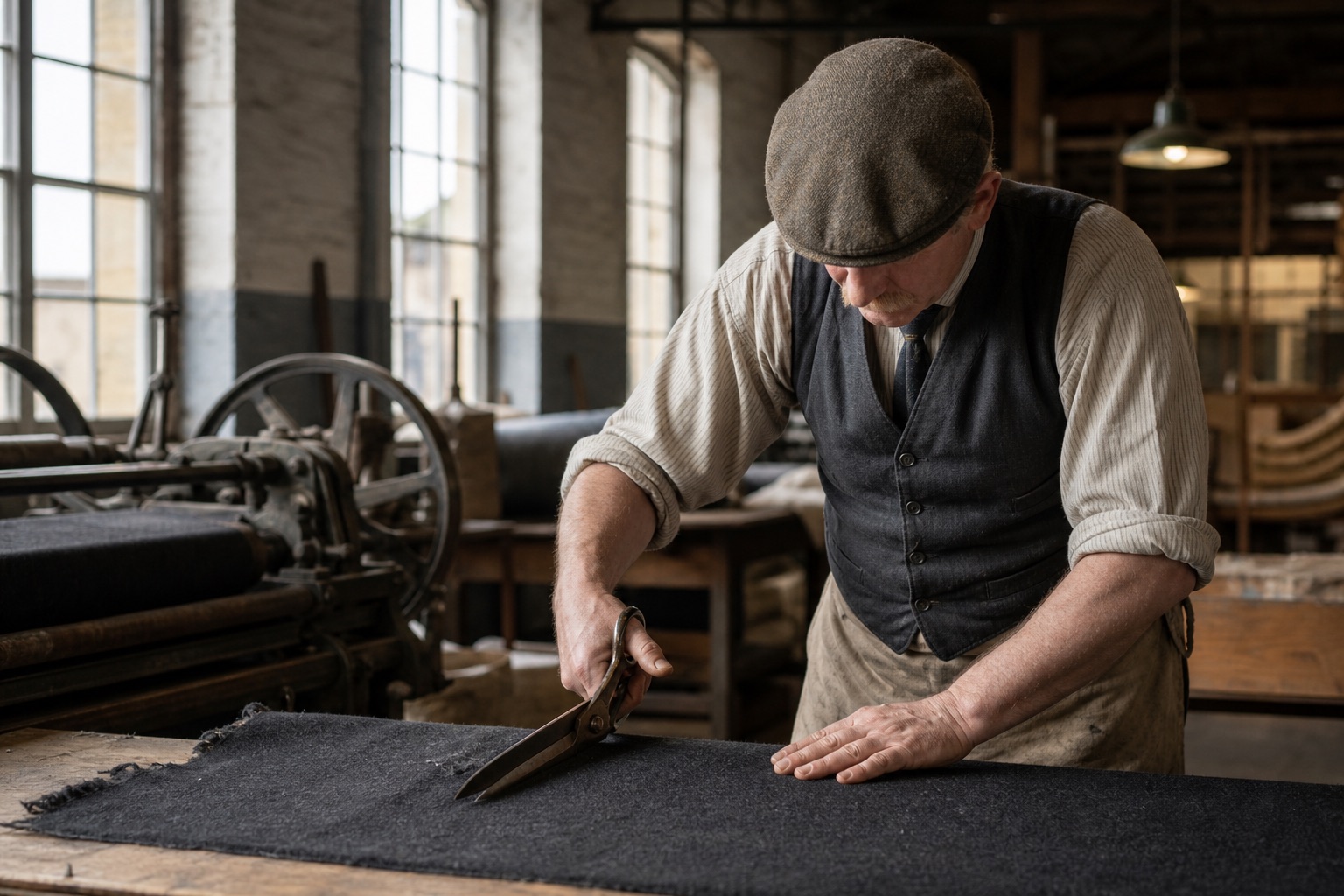
A cropper, also called a shearman, finished woollen cloth. After fulling, he raised the nap with teazle heads and then cut that nap level with shears unlike a tailor's: blades several feet long, heavy enough that the work took a man's whole strength, used flat across a shearboard. A good cropper left a face as even as a close pile, without a ridge or a hole, and West Riding clothiers paid him as one of the aristocrats of the woollen trades. Huddersfield, Leeds, and the cloth villages of the Spen Valley were his ground. The shears were the skill. The cloth remained the clothier's property, brought to the shop and taken away dressed.
Gig mills, which raised the nap on teazles fixed round a cylinder, and shearing frames, which cropped with driven blades, took the skill off the board. In 1811 and 1812 Yorkshire croppers attacked those machines, including the assault on William Cartwright's mill at Rawfolds in the Spen Valley in April 1812. The attacks belong in the story of the trade. They are not what ended it. The frames dressed cloth faster and cheaper than a man with shears, the clothiers kept installing them, and the piece rate for hand cropping disappeared. Parliament answered the violence with the Frame Breaking Act of 1812. The finishing shops answered it by cropping on the machine.
Day in the Life of a Cropper
Raising the nap
The piece came in fulled and tentered, and the first work was to raise a nap with teazle heads set in a small frame or handle. The cropper drew the teazles across the dampened cloth until the fibre stood up evenly, and he could feel a thin place before the shears ever touched it. A gig mill later did this raising by the cylinder, while on the bench it was still a slow pass of the hand.
The heavy shears
The shears were laid flat, blades several feet long, and leaded or weighted so they would bite only the nap and not the cloth. The cropper worked them in a rocking cut along the shearboard, a pass at a time, stopping if the face showed a track. This was the whole craft and the whole strain of the day: weight, repetition, and an eye that could not wander.
Second and third passes
One pass did not finish a piece, so the nap was raised again and cropped again until the face matched what the clothier had ordered. Shearings were brushed off between passes so they would not drag under the blade and mark the cloth. A hole or a ridge sent the piece back, and a ruined face was money the cropper did not get.
Folding out
When the face was even the cloth was brushed, folded, and set aside for the clothier to collect, the piece rate depending on the quality and on whether the work had been accepted. In a busy season before the frames, a steady man could keep this circuit up for a wage of a pound a week or more. After the shearing frame, the same circuit had fewer pieces, because the mill had already dressed them.
What came after
Raising the nap with hand shears was the work the gig mill and the shearing frame took, and the reason the Luddite attacks began.
The succession pageRelated Exhibits
Agoranomos
The Agoranomos was a pivotal figure in the bustling marketplaces of ancient Greece, particularly in city-states like Athens. This role was akin to that of a modern-day market supervisor or inspector, responsible for overseeing the activities within the agora, the central public space where commerce, politics, and social interaction flourished. The Agoranomos ensured that trade was conducted fairly, that weights and measures were accurate, and that vendors adhered to the laws governing commerce. They played a crucial role in maintaining order and integrity in the marketplace, which was vital for the economic health of the city-state. In addition to regulatory duties, the Agoranomos also had the authority to impose fines on dishonest merchants and to confiscate goods that were sold under false pretenses. This position required a deep understanding of local laws and trade practices, as well as a keen sense of justice to protect both consumers and honest traders. The Agoranomos was often seen as a guardian of the public interest, ensuring that the agora remained a vibrant and trustworthy hub of activity.
Aircraft Listener
The role of an Aircraft Listener emerged in the mid-20th century, primarily during the Post-War Era, when aviation technology was rapidly advancing and air traffic was increasing significantly. Aircraft Listeners were tasked with monitoring and interpreting the sounds of aircraft engines, particularly in military contexts, where understanding the nuances of engine noise could indicate the type of aircraft, its operational status, and even potential mechanical issues. This job was crucial for military intelligence and air traffic control, as it provided valuable information about aircraft movements and capabilities without the need for visual confirmation. Listeners would often work in pairs or small teams, stationed at strategic locations such as airbases or observation posts. They utilized their acute hearing to distinguish between different aircraft types, noting variations in sound that could indicate changes in speed, altitude, or engine performance. This auditory skill was honed through extensive training and experience, as the ability to identify aircraft by sound alone was a rare and valuable talent. The job required not only a keen ear but also a deep understanding of aviation technology and the specific characteristics of various aircraft engines. Listeners would often keep detailed logs of their observations, contributing to intelligence reports and operational assessments. The role was a blend of art and science, requiring both technical knowledge and an intuitive grasp of sound dynamics.
Explore More Exhibits
Discover the full collection of past and future professions in The Jobs Museum.