
Automation Age
Remote Vehicle Operator
A speculative career prediction for Automation Age based on technological trends and societal evolution.
Media Gallery
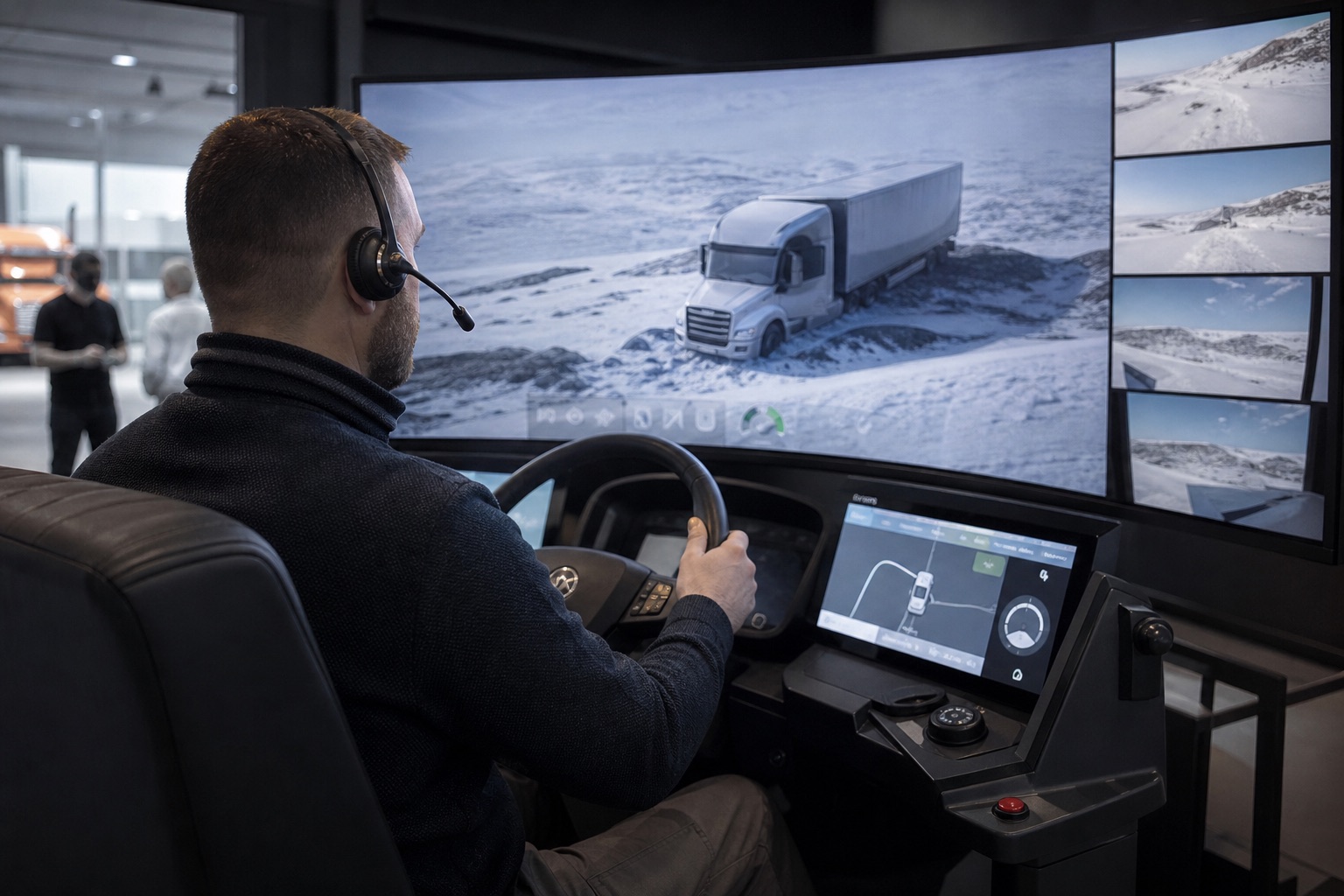
About the Remote Vehicle Operator career
The remote-vehicle operator drives, lifts, or steers a machine from somewhere else when autonomy stops, or because the law still wants a last human hand on the controls. Underground loaders have been run this way for years, by video and radio, with the operator on the surface and the bucket in the dark. Haul trucks, cranes, and some ship systems have joined that pattern. The console is cameras, a control, a radio, and a link whose delay is itself part of the hazard.
This job exists because the machine is not actually unsupervised. Dust, a person on a haul road, a face that does not match the map, a crane load that starts to swing, a ship in a tight channel: these are the moments the stack hands back. Putting the word autonomous on that arrangement gives the credit to the software and leaves the fault on the person at the screen. The plainer account is enough. A person was on the controls, at a distance, and the distance did not lighten the vehicle.
Day in the Life of a Remote Vehicle Operator
Taking the chair
The operator starts with a radio check, a camera check, and a list of which vehicles are in remote mode. Link delay is noted for each machine rather than assumed from yesterday. The first minutes are for learning the site as it is this morning, including dust, people, and work that was not on the plan.
The intervention
A truck, loader, crane, or ship system is taken when the autonomy stops or when the rules require a person on that move. The operator drives the view they actually have, at a speed the delay will allow. If the picture is not good enough to see a person or an edge, the machine stops.
People and edges
A person on foot, a light vehicle, a soft shoulder, or a load that starts to swing is a stop and then a radio call. The tonnage waiting behind the machine is real and is still not a reason to guess. The operator says, on the radio, that the motion is stopped and why.
Handback and log
Control returns to the automated system only when the path matches the conditions that system is allowed to run. Every intervention is logged with the time, the vehicle, the reason, and the duration. That log is how the next day learns which situations the stack still cannot finish.
What it grew from
It grows out of the driver and the crane operator, moved to a chair that is not in the vehicle.
Related Exhibits
Human-in-the-Loop Supervisor
In the rapidly evolving landscape of the AI Revolution, the role of the Human-in-the-Loop Supervisor emerges as a pivotal position that bridges the gap between human intuition and machine learning algorithms. As artificial intelligence systems become increasingly sophisticated, the need for human oversight to ensure ethical decision-making, contextual understanding, and nuanced judgment becomes paramount. This role is not merely about managing AI systems; it is about enhancing their capabilities through human insight, ensuring that technology serves humanity's best interests. The Human-in-the-Loop Supervisor is tasked with overseeing AI operations across various sectors, from healthcare to autonomous vehicles, ensuring that AI systems operate within ethical boundaries and align with societal values. This position requires a deep understanding of both technology and human behavior, as supervisors must interpret AI outputs, provide feedback for continuous learning, and intervene when necessary to prevent errors or biases. As AI systems learn from vast datasets, the supervisor's role is to ensure that these datasets are representative and free from harmful biases, thus safeguarding against unintended consequences. In this future job, supervisors will also play a crucial role in training AI systems, providing the necessary context and real-world knowledge that machines often lack. They will collaborate with data scientists and engineers to refine algorithms, ensuring that AI systems not only perform efficiently but also ethically. The Human-in-the-Loop Supervisor will be at the forefront of a new era of responsible AI deployment, advocating for transparency, accountability, and inclusivity in technology development.
Robotics Fleet Supervisor
In the Automation Age, the role of the Robotics Fleet Supervisor emerges as a pivotal position in the management of autonomous robotic systems. As industries increasingly rely on fleets of robots for tasks ranging from logistics and manufacturing to agriculture and healthcare, the need for skilled supervisors to oversee these fleets becomes paramount. The Robotics Fleet Supervisor is responsible for ensuring that these robotic units operate efficiently, safely, and in harmony with human workers. This role combines technical expertise with leadership skills, as supervisors must coordinate the activities of diverse robotic systems while also addressing the needs of human operators and stakeholders. The job requires a deep understanding of robotics technology, data analytics, and operational management, as well as the ability to adapt to rapidly changing environments and technologies. As society embraces automation, the Robotics Fleet Supervisor will play a crucial role in shaping the future of work, ensuring that the integration of robots enhances productivity while maintaining ethical standards and safety protocols.
Explore More Exhibits
Discover the full collection of past and future professions in The Jobs Museum.