
Mid Twentieth Century
Brakeman
An extinct profession from Mid Twentieth Century that became obsolete due to technological advancement and societal change.
Media Gallery
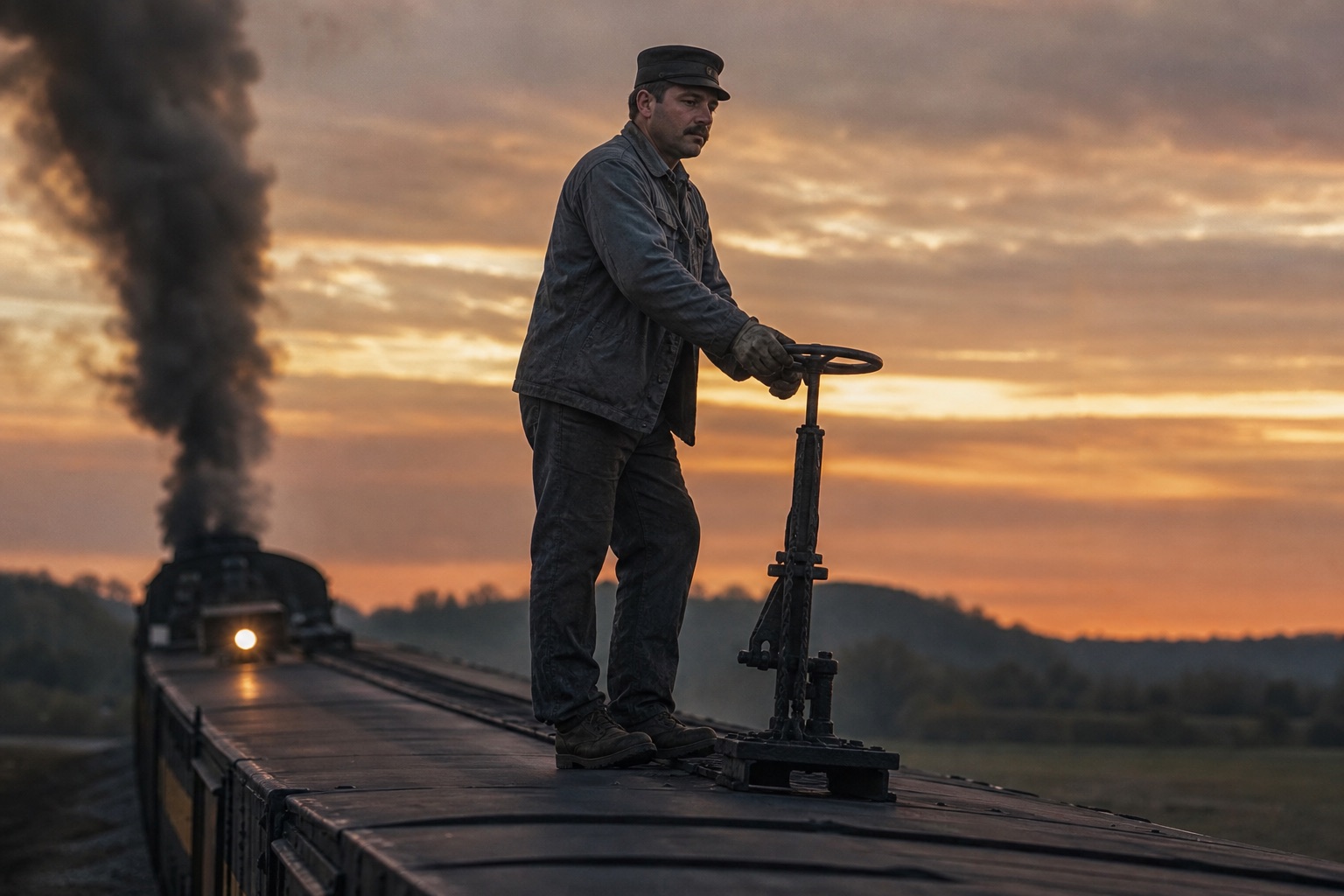
About the Brakeman profession
The brakeman in this exhibit is the American railroad man who coupled cars and set brakes from the roof and from the ground, before air brakes and during the long years when they were still spreading. With link and pin he went in between the cars. With a hand brake he climbed to the running board and wound wheels while the train moved. A lantern and a brake club were ordinary kit, and the caboose was his base once the train was on the road. The Westinghouse air brake and the automatic knuckle coupler, pressed by federal safety law in the 1890s, reduced that roof walk without retiring the craft.
Local freights and yards still needed him on the ground for decades after the roofs grew quieter. Radio and diesel road practice ended the classic form of the job. A later conductor carrying a radio was not a man on car tops in the weather. The danger of the older method was severe enough to write safety law, and it can be stated honestly without a list of injuries. This label is United States practice: roof, pin, and ground.
Day in the Life of a Brakeman
Making the train
In the yard he coupled cars, checked that brakes and couplings were what the crew expected, and took his place for the departure. Link-and-pin work put him between the cars; a knuckle coupler changed the hardware and not the fact that the train had to be made up. The conductor gave the order of the cars.
On the move
Once rolling, he passed signals along the train and, in the years before air was universal, went to the roofs to set or release hand brakes. Weather decided how bad the running board was. The engineer saw lanterns, not faces, and a missed signal was a missed stop.
At the station
A stop meant more coupling, a switch to line, or brakes to hold cars on a grade while the train did its work. He coordinated with the conductor and the other brakeman if the crew carried two. The ground was busy precisely when the public thought the train was merely waiting.
Into the yard
At the far end he helped break the train up or turn it over, then reported with the crew. Pay was the trip or the day under the agreement then in force. The next call might be a different tonnage and the same roofs, pins, or ground work, depending on the decade.
What came after
Westinghouse brakes took men off the car roofs. Radio and smaller diesel crews took what remained of the classic job.
The succession pageRelated Exhibits
Locomotive Fireman
The locomotive fireman was the second person on a steam engine, the one who fed the fire and watched the boiler while the engineer ran the train. On a coal burner that meant a shovel, a firebox door, and a footplate that punished a lazy fire with falling steam. On an oil burner the feed was a valve and a flame, and the watch on water and pressure remained. The water glass, the injector, and the gauge were his instruments together with the shovel. He was half the engine crew, not a passenger and not a shed cleaner. This exhibit is that steam fireman. American roads dieselized through the 1940s and 1950s and had largely finished with main-line steam by the early 1960s. British Rail ran its last main-line steam in 1968. Some agreements kept a second person on diesel crews afterward, and that helper did not feed a fire or mind a boiler. The label stops where the fire stops. Yard switchers and branch engines used the same watch on the glass.
Pullman Porter
A Pullman porter was the attendant on a Pullman sleeping car in the United States. He made up berths, kept the linen and the car, handled luggage, woke passengers, and stayed with the trip for as long as the schedule ran. The company hired Black men for the post by policy, and the work became one of the best-known service jobs in Black America: skilled, public, and tightly ruled. Tips were not a charming extra. They were a large part of pay because the wage was kept low, and the men who did the work named that arrangement as a grievance. Philip Randolph and the Brotherhood of Sleeping Car Porters, founded in 1925 and recognized in 1937, made dignity and the wage a contract. Maids on some cars, often Black women, were a separate grade, and this label does not fold them into the porter's title. Overnight trains then thinned. After Pullman's operating business was separated from manufacturing, the cars passed toward the railroads and were gone from most roads by the late 1960s. The exhibit speaks of the porter in plain speech, without a borrowed dialect.
Explore More Exhibits
Discover the full collection of past and future professions in The Jobs Museum.