
Energy Transition Era
Battery Passport Auditor
A speculative career prediction for Energy Transition Era based on technological trends and societal evolution.
Media Gallery
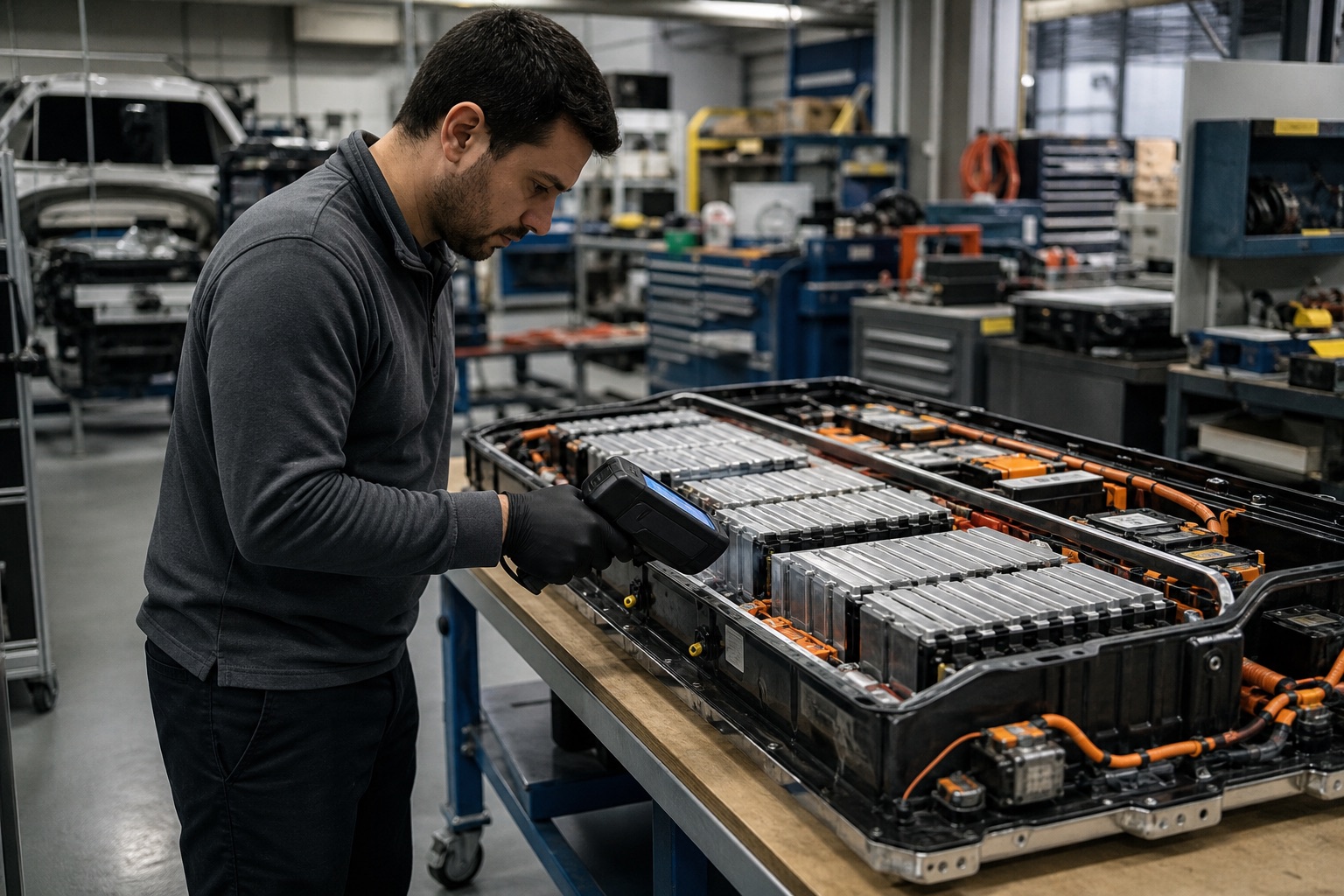
About the Battery Passport Auditor career
The battery-passport auditor checks a digital record against a physical battery and against the paperwork that claims to explain it. The European Union battery regulation gives that record a legal shape: where the materials came from, how much recycled content is claimed, what carbon figure is attached, and which battery is actually in the crate. The auditor reads the passport, then the label, the mass, the format, and the supplier declarations, and asks whether those accounts describe one object.
The usual failure is a clean code on a cell whose cobalt, lithium, nickel, or carbon claim does not survive the file underneath. Recycled content is a measurement with a method. Origin includes mines and refiners that are inconvenient to document. A carbon figure changes with the boundary someone chose to draw around the factory. The auditor writes the mismatch where it is. A pass means the sample and the papers agreed on the points that were checked.
Day in the Life of a Battery Passport Auditor
The battery in hand
The auditor starts with the physical unit: label, serial, mass, format, and the code that should open the passport. A code that points at a different model is already a finding. Notes and photographs are made before the crate is unpacked any further.
The passport
The digital record is read for origin, recycled content, the carbon figure, and the method named for each of those. Missing fields are written as missing. A smooth paragraph with no method is not treated as a completed answer.
The papers underneath
Supplier declarations, assays, and shipping documents are sampled against the passport's numbers. The auditor looks for a carbon boundary that leaves out mining, for recycled content that is only a goal, and for a certificate used on more than one batch. Questions go back to the party who signed, with a date.
The finding
The day ends with a pass, a qualified pass, or a nonconformity, each tied to a specific claim and a specific battery. The object's identity stays on the finding so a later reader can see what was checked. Praise for the manufacturer does not stand in for a result.
What it grew from
It grows out of the customs examiner and the assay office, applied to a battery and the claims attached to it.
Related Exhibits
AI-Powered Eldercare Companion Designer
In the not-so-distant future, as the global population ages and the demand for personalized care increases, the role of the AI-Powered Eldercare Companion Designer emerges as a vital profession. This innovative job combines the fields of artificial intelligence, healthcare, and human-centered design to create intelligent companions that assist the elderly in their daily lives. These companions, equipped with advanced AI algorithms, are designed to provide emotional support, monitor health conditions, and facilitate social interactions, all while adapting to the unique needs and preferences of each individual. The designer's role is not only to develop the technology but also to ensure that these companions foster meaningful connections, enhance quality of life, and promote independence among seniors. As society grapples with the challenges of an aging population, this profession stands at the intersection of compassion and technology, paving the way for a more inclusive future.
Circular Economy Strategist
In the Climate Adaptation Era, the role of a Circular Economy Strategist emerges as a pivotal force in reshaping industries and communities towards sustainability. This innovative profession is dedicated to designing and implementing systems that minimize waste, maximize resource efficiency, and promote the continual use of materials. Circular Economy Strategists work at the intersection of environmental science, economics, and social responsibility, crafting strategies that not only benefit businesses but also contribute to the health of our planet. They are the architects of a new economic model that prioritizes regeneration over depletion, ensuring that products are designed for longevity, reuse, and recycling. As advocates for sustainable practices, they engage with stakeholders across various sectors, from manufacturing to retail, to foster a culture of sustainability that permeates every level of the supply chain.
Explore More Exhibits
Discover the full collection of past and future professions in The Jobs Museum.