
Late Twentieth Century
Video Rental Clerk
An extinct profession from Late Twentieth Century that became obsolete due to technological advancement and societal change.
Media Gallery
About the Video Rental Clerk profession
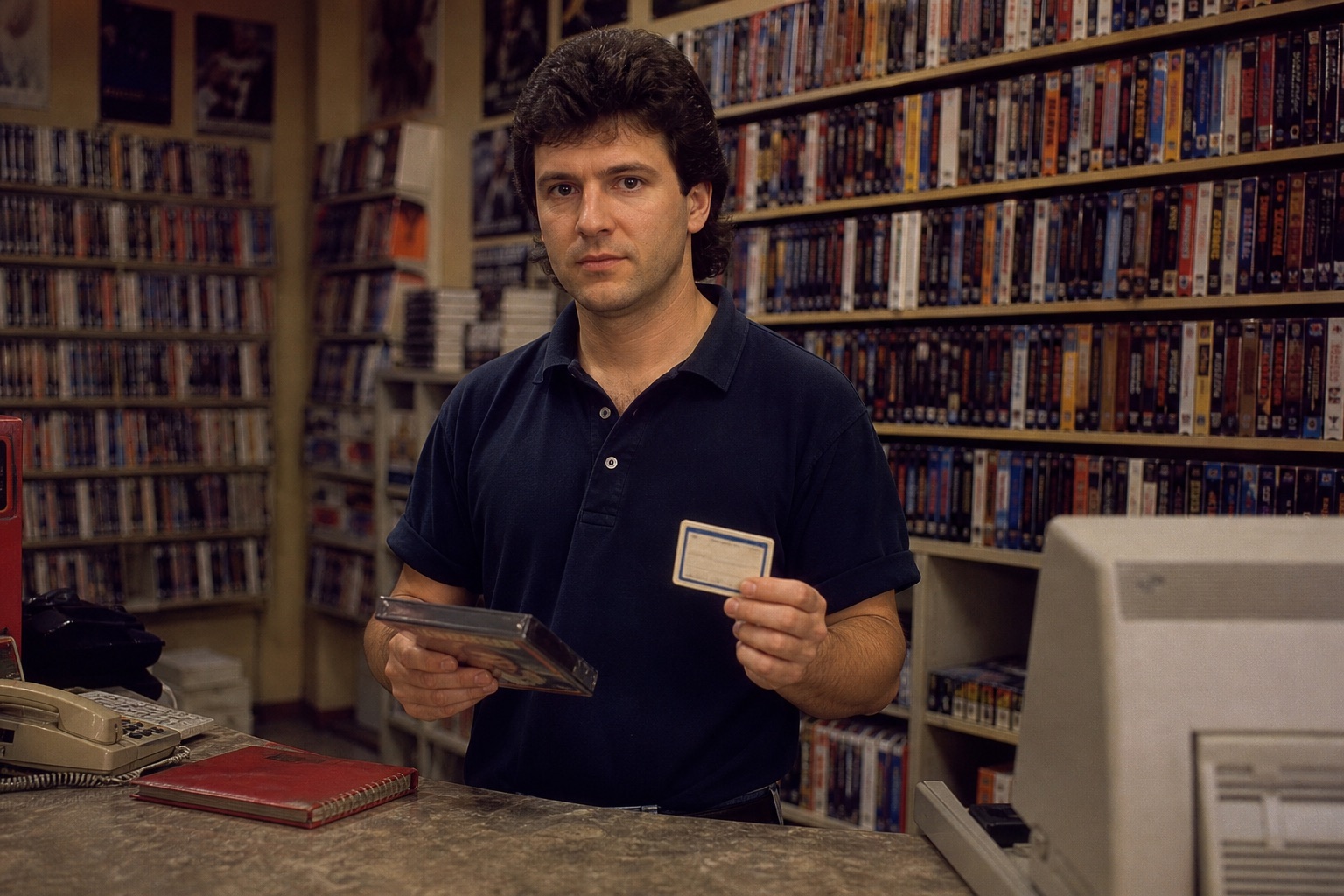
A video rental clerk stood the counter of a shop that rented movies, first on VHS and then on DVD, in independent stores and in chains such as Blockbuster. A membership card had to be on the account before a tape or a disc left the shop. The new-release wall, close to the door and priced for a short rental, held the titles people had come for; older stock filled the cheaper aisles behind it. Late fees, a charge for each day past the due date, were the argument at the register and the store's money, not the clerk's. On VHS the counter also cared whether the cassette had been rewound.
The trade runs from the late 1980s through the 2000s. DVD-by-mail and then streaming emptied the wall and ended the counter. Independents often kept the actual tape behind the desk and put an empty box on the shelf; chains later put the live case on the floor in a lock. Either way the clerk's work was the card, the due date, and the case. This exhibit stays inside that shop.
Day in the Life of a Video Rental Clerk
The wall
Opening meant checking the new-release wall, the drop box, and the returns that had piled up overnight. Empty boxes or locked cases had to match what was actually in stock. The expensive titles went back on that front wall before the first customer.
The card
A rental started with the membership card, a lookup, and a check for unpaid late fees. No card, or a card in arrears, and the tape stayed in the shop. The clerk named the due date out loud, because that date would be the next argument.
Checkout
New releases scanned at the higher rate, catalog titles at the cheaper one, and the case went into a bag. On VHS the clerk might remind the member to rewind. A reservation for a title still on the wall was a promise written on the account, not a handshake.
After close
The drop box was emptied, late returns assessed, and the wall rebuilt for the next day. Rewinding, where the store still did it, filled the last hour. The fees recorded that night belonged to the company, and the clerk clocked out on an hourly retail rate.
What came after
The counter, the membership card, and the late fee were replaced by discs in the mail and then by a login.
The succession pageRelated Exhibits
Cash Girl
A cash girl was a department-store junior, often a girl or a young woman, who carried the customer's money and the written bill to a cashier and brought the receipt and the change back. The counter itself had no register yet. She waited where the sale was made, took the cash and the slip, walked the floor to the desk, and returned without mixing one purchase with another in a crowded aisle. The work was ordinary and public, a pair of errands repeated for every sale. This record keeps that walk concrete and calm. The practice belongs to the late nineteenth century in the United States and in Britain, in dry-goods houses and the new department stores. Cable systems such as Lamson's cash railway, pneumatic tubes to a central desk, and the cash register on the counter each removed a reason to send a junior across the floor. She was not the buyer and not the cashier. She was the distance between them, and when that distance was mechanized the walk ended.
Pneumatic Tube Attendant
A pneumatic-tube attendant staffed the terminals of a store or office system that shot small carriers through tubes of air. In a department store the carrier brought a sale's cash and bill to a central cashier, and the attendant sent the change and the receipt back to the counter. In an office the same rush of air carried papers between floors, and the attendant opened, sorted, and returned them. The work was the mouth of the tube: a lever, a carrier, a drawer. This is the late nineteenth and early twentieth century. It is not the hospital tube, which still runs and is another job entirely. Retail ended the attendant when the tubes and the central cashier's desk were ripped out and the money stayed on the selling floor. Office lines lingered in a few buildings and are not the center of this label. The earlier cash girl had walked what the carrier now flew; the register on the counter would later make even the flight unnecessary. The person with the pile of carriers is the exhibit.
Explore More Exhibits
Discover the full collection of past and future professions in The Jobs Museum.