
Early Twentieth Century
Pneumatic Tube Attendant
An extinct profession from Early Twentieth Century that became obsolete due to technological advancement and societal change.
Media Gallery
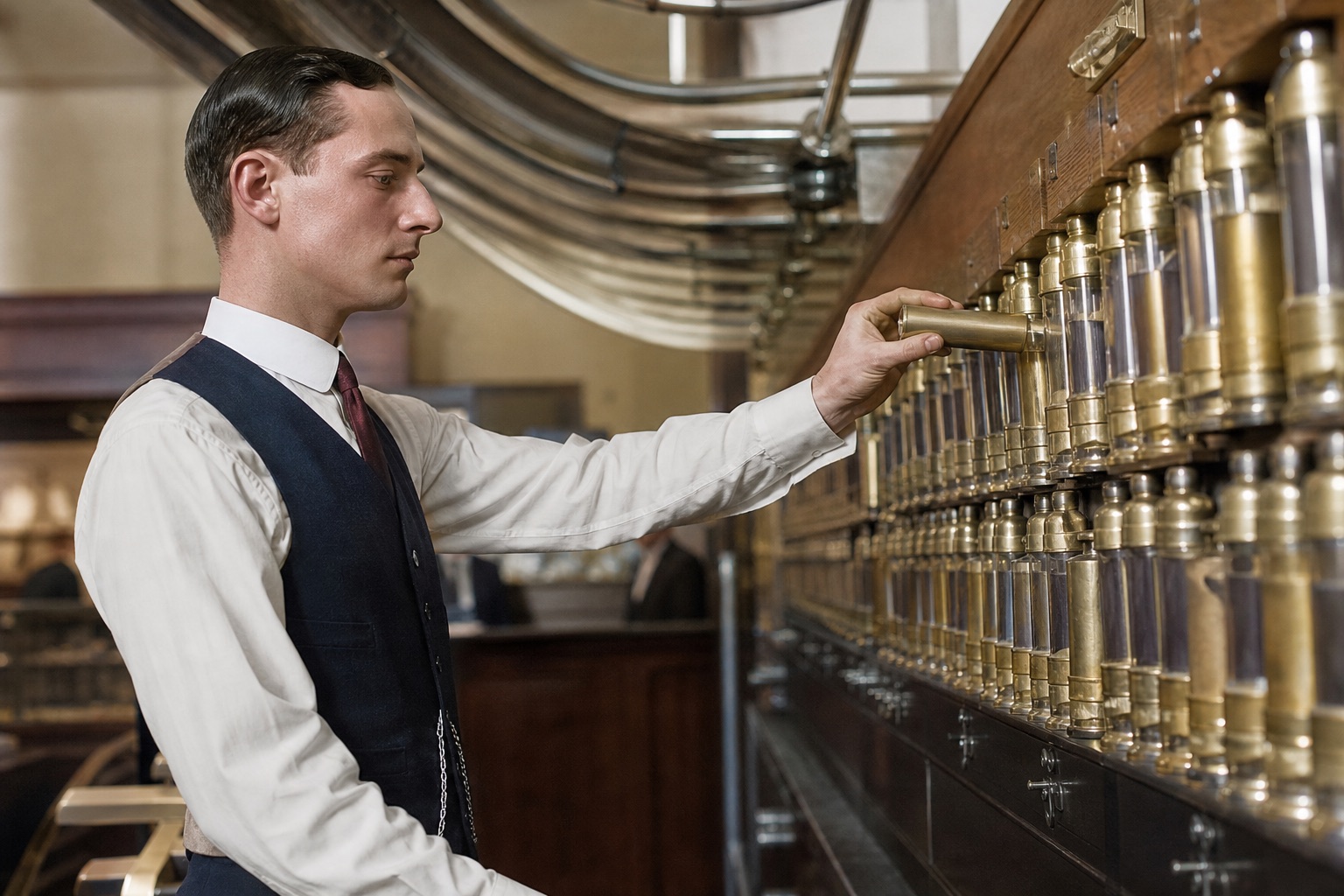
About the Pneumatic Tube Attendant profession
A pneumatic-tube attendant staffed the terminals of a store or office system that shot small carriers through tubes of air. In a department store the carrier brought a sale's cash and bill to a central cashier, and the attendant sent the change and the receipt back to the counter. In an office the same rush of air carried papers between floors, and the attendant opened, sorted, and returned them. The work was the mouth of the tube: a lever, a carrier, a drawer. This is the late nineteenth and early twentieth century. It is not the hospital tube, which still runs and is another job entirely.
Retail ended the attendant when the tubes and the central cashier's desk were ripped out and the money stayed on the selling floor. Office lines lingered in a few buildings and are not the center of this label. The earlier cash girl had walked what the carrier now flew; the register on the counter would later make even the flight unnecessary. The person with the pile of carriers is the exhibit.
Day in the Life of a Pneumatic Tube Attendant
Opening the desk
The attendant opened the central station, checked that carriers were at hand, and tried the line before the floor sent real money. A stuck morning tube was cleared before the rush. The drawer was counted in the cashier's way, not in the attendant's private notebook.
A carrier in
A carrier arrived with a thud, was opened, and the bill and cash were checked against each other. Change and a receipt went into the same carrier or the next. The counter was waiting, so the motion had to be quick and still exact.
Sending it back
The carrier was latched and the lever thrown for the station that had sent it. A wrong station was a lost sale and an angry counter. Office work, where the tube carried papers instead of cash, used the same hands and a different judgment about what was inside.
Shutting the line
At closing the last carriers were returned, the drawer balanced with the cashier, and the mouths covered or left as the building required. The tubes were quiet. The attendant's day was indoor and repetitive, measured in arrivals rather than in a route.
What came after
Store tubes and the central cashier were ripped out once the counter could finish the sale. Hospital tubes are a different, living system.
The succession pageRelated Exhibits
Cash Girl
A cash girl was a department-store junior, often a girl or a young woman, who carried the customer's money and the written bill to a cashier and brought the receipt and the change back. The counter itself had no register yet. She waited where the sale was made, took the cash and the slip, walked the floor to the desk, and returned without mixing one purchase with another in a crowded aisle. The work was ordinary and public, a pair of errands repeated for every sale. This record keeps that walk concrete and calm. The practice belongs to the late nineteenth century in the United States and in Britain, in dry-goods houses and the new department stores. Cable systems such as Lamson's cash railway, pneumatic tubes to a central desk, and the cash register on the counter each removed a reason to send a junior across the floor. She was not the buyer and not the cashier. She was the distance between them, and when that distance was mechanized the walk ended.
Comptometer Operator
A comptometer operator ran a Felt comptometer, the key-driven adding machine Dorr E. Felt brought out in 1887. Unlike a crank adder, it let several keys in a column go down together, so a trained hand could enter a number in one stroke. Banks, billing offices, railroads, and insurance rooms hired people, mostly women, to add and extend figures for hours at that keyboard. Operator schools taught the touch and certified speed. The product was a total the bookkeeper could trust, not a printed page of prose. The machine's long life makes the job look Victorian at the start, and the honest center of the exhibit is the twentieth-century office, ending when electronic calculators and computers took the columns in the 1960s and 1970s. A comptometer bureau might sell the labor by the batch. An in-house operator sat beside the ledgers she fed. Either way the skill was in the hands, and it did not survive the cheap electronic key.
Explore More Exhibits
Discover the full collection of past and future professions in The Jobs Museum.