
Victorian Era
Tosher
An extinct profession from Victorian Era that became obsolete due to technological advancement and societal change.
Media Gallery
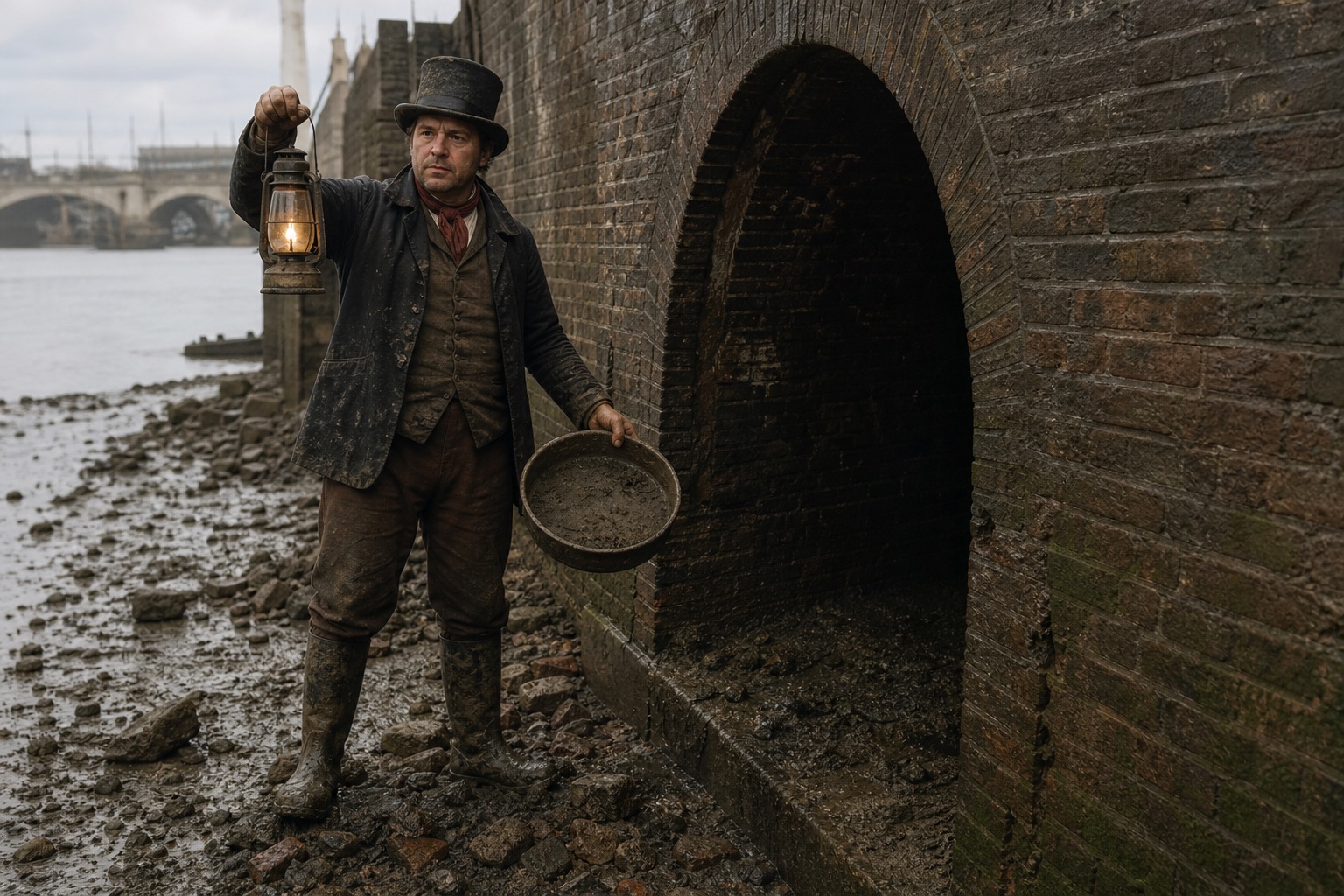
About the Tosher profession
A tosher scavenged the older sewers of London for coins, metal, and other objects that had washed in from the streets. Henry Mayhew recorded the men in London Labour and the London Poor as sewer-hunters who entered the brick tunnels at low tide, usually in a small gang, with a lantern and a bag. They raked the invert, the curved floor where heavy objects settled, and sold what they brought out to dealers. The work was illegal. The sewers belonged to the commissioners, and a tosher was a trespasser, not a parish employee. Tosh was the scrap itself. The word names both the find and the man.
The workplace was sewage. That is stated here because it was the fact of the job, not as a joke and not as a shudder for the reader. The men Mayhew interviewed described a calculated round: in on the ebb, out before the water returned, avoiding the flushers and the foremen who would turn them away. Joseph Bazalgette's intercepting sewers for the Metropolitan Board of Works, begun in 1859 and built through the 1860s and 1870s, replaced the old creek outlets these gangs used. Employed flushers maintained the new system. Freelance toshing did not survive that rebuilding.
Day in the Life of a Tosher
Low tide
Toshers entered when the water was low enough to walk, often where an old sewer opened toward the Thames. A rising tide was the clock that ended the shift. They did not control the gates or the flow, and the day was as long as the ebb allowed and no longer.
Coin and metal
The search was for anything heavy enough to settle: coins, nails, scrap brass and iron, sometimes cutlery or a lost tool. Organic waste was the medium, not the prize. What went into the bag was metal and money, to be washed and sold, and the rest was left where it lay.
Trespass
The sewers were not open to scavengers. Commissioners and, later, the Board of Works employed their own men, and a tosher who met them could be turned out or prosecuted as a trespasser. Gangs worked quietly and preferred stretches they knew, because illegality was a condition of the trade, not a rumor added later.
Bazalgette's rebuild
From 1859 Joseph Bazalgette built the intercepting system that carried London's sewage away from the old foreshore outlets. Employed flushers maintained the new sewers. The freelance hunter of the abandoned-looking tunnel lost both the ground and the excuse, and by the mid-1870s the trade Mayhew described was no longer a living London occupation.
What came after
Freelance searching of sewers was replaced by employed flushers in Bazalgette's system, and by a law that had always forbidden the old trade.
The succession pageRelated Exhibits
Pure-finder
A pure-finder collected dog dung from the streets, mews, and kennels of Victorian London and sold it to tanneries under the trade name pure. Tanners used it as a bate. After hides had been limed and unhaired, a bate of dung softened them and made them take the later tannins. Dog dung was preferred for this step, and the yards of Bermondsey were the market. The finder walked a beat, gathered the material into a pail or a sack, and sold it by quantity and condition. Dry, saleable stock fetched more than a wet or spoiled pail. This was a poor street trade, recorded in detail by Henry Mayhew in London Labour and the London Poor. The work was frank about its material because the material was the product. Finders handled dung as stock, and tanners bought it as an ingredient. The trade faded when chemical bates and then chrome tanning removed the yard's need for dung. It was not banned by a single famous Act. It became unsaleable. By the end of the nineteenth century and the start of the twentieth, a finder with a pail no longer had the old queue of buyers at Bermondsey.
Coal Whipper
Coal reached London in colliers and left them in baskets. A coal whipper stood in a gang and hoisted those baskets out of the hold with a whip, a rope through a pulley, worked by the men's weight as they jumped down from a staging. It was the standard way of unloading a coal ship in the port before hydraulic cranes and tips. The gang was hired by the ship, paid by the ton, and often controlled by a publican who took his cut before the men saw theirs. Parliament noticed. The Coal Whippers Act of 1843 set up a register office so that gangs were called in turn and the publican's hold on the work was broken. The act did not save the trade. Steam cranes, and then the hydraulic coal tips that emptied a wagon straight into a barge, did the jumping for them.
Explore More Exhibits
Discover the full collection of past and future professions in The Jobs Museum.