
Industrial Revolution
Matchstick Maker
An extinct profession from Industrial Revolution that became obsolete due to technological advancement and societal change.
Media Gallery
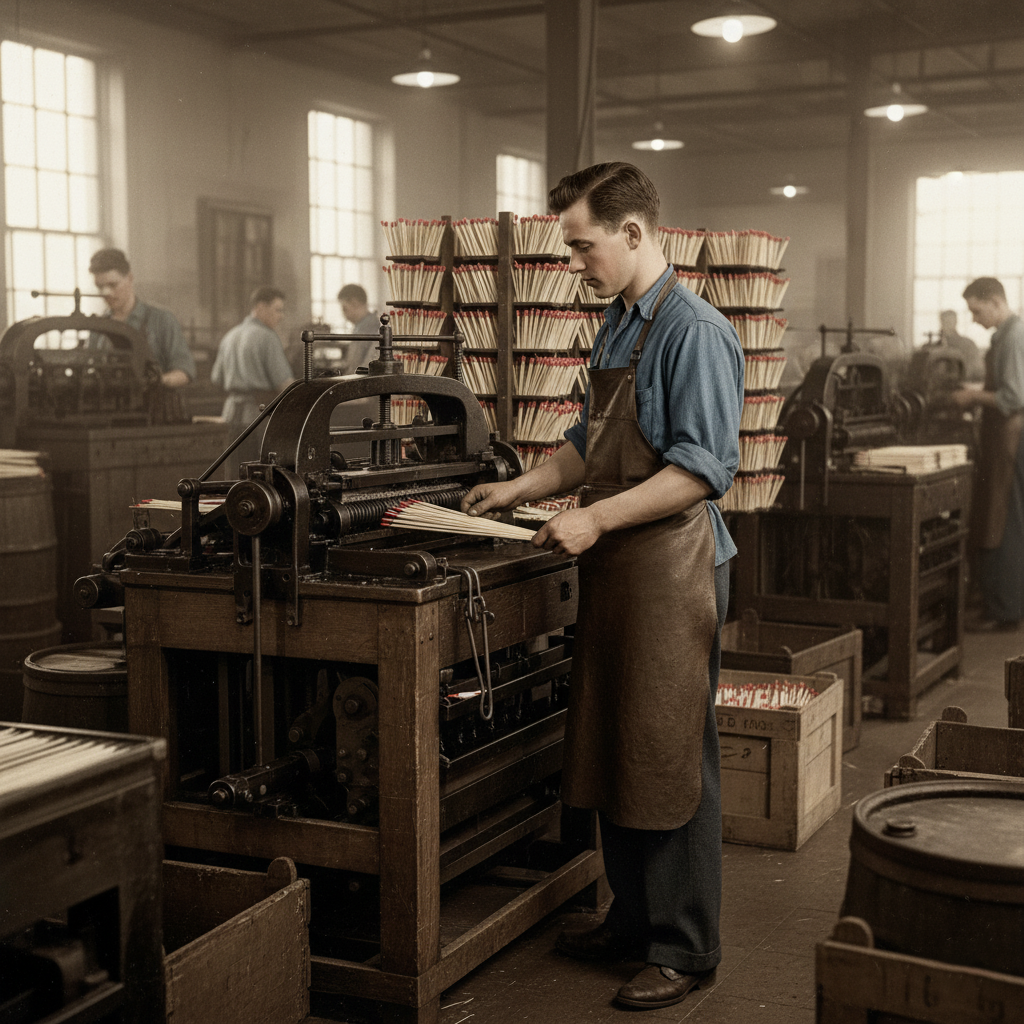
About the Matchstick Maker Profession
In the bustling factories of the Industrial Revolution, the matchstick maker played a crucial role in the production of one of the era's most essential commodities: matches. These small, slender sticks, tipped with a flammable substance, revolutionized the way people ignited fires, making them a staple in households and businesses alike. The matchstick maker was responsible for crafting these vital tools, often working in dimly lit workshops filled with the scent of sulfur and wood.
The process of match production was labor-intensive and required a keen eye for detail. Workers would begin by cutting thin strips of wood, typically from readily available softwoods like aspen or pine. These strips were then meticulously dipped into a mixture of chemicals, including potassium chlorate, sulfur, and glass powder, to create the striking head of the match. The matchsticks were then dried, packaged, and prepared for distribution.
The job was not without its hazards; the chemicals used in match production were often toxic, leading to health issues such as 'phossy jaw,' a painful condition caused by exposure to phosphorus. Despite these dangers, matchstick makers were essential to the growing demand for convenience in lighting fires, which was a significant aspect of daily life during the Industrial Revolution.
Day in the Life of a Matchstick Maker
Early Morning: Preparation and Setup
As dawn breaks, the matchstick maker arrives at the factory, greeted by the familiar scent of wood and chemicals. The first task of the day involves preparing the workspace, ensuring that all tools are in place and the wood strips are ready for cutting. The rhythmic sound of saws fills the air as workers begin to cut the wood into uniform lengths, a crucial step in ensuring the quality of the matches.
Mid-Morning: Dipping and Drying
Once the wood strips are cut, the matchstick maker moves to the dipping station. Here, they carefully dip the ends of the matchsticks into a mixture of chemicals, a process that requires precision and speed. Each match must be coated evenly to ensure it ignites properly. After dipping, the matchsticks are laid out on drying racks, where they will sit for several hours to allow the chemicals to set.
Afternoon: Quality Control and Packaging
After the drying process, the matchsticks are inspected for quality. Any that do not meet the standards are discarded. The remaining matches are then packaged into boxes, ready for shipment. This task requires attention to detail, as the packaging must be secure to prevent damage during transport.
Late Afternoon: Clean-Up and Maintenance
As the day winds down, the matchstick maker cleans the workspace, ensuring that all tools are properly stored and that the area is free of hazardous materials. This is a vital step in maintaining safety in the factory, especially given the toxic nature of some of the chemicals used in production.
Evening: Reflection and Community
After a long day, the matchstick maker often gathers with fellow workers to share stories and discuss the challenges of their trade. Despite the dangers and difficulties, there is a sense of camaraderie among the workers, united by their shared experiences in the match-making industry.
Related Exhibits
Stereoscopist
The role of a stereoscopist emerged in the mid-19th century, coinciding with the rise of the stereoscope, a device that allowed viewers to experience three-dimensional images. Stereoscopists were skilled artisans and technicians who specialized in creating stereoscopic images, which were pairs of photographs taken from slightly different angles to simulate depth perception when viewed through a stereoscope. This job was not only a technical craft but also an artistic endeavor, as stereoscopists had to carefully compose scenes, select appropriate lighting, and ensure that the images conveyed a sense of realism and depth. Stereoscopists often worked in studios or as part of larger photographic firms, where they would collaborate with photographers and artists. They were responsible for processing the images, mounting them on cards, and sometimes even hand-coloring them to enhance their visual appeal. The popularity of stereoscopic images surged during the Victorian Era, as they provided a novel form of entertainment and education, allowing people to experience distant landscapes, historical events, and even exotic cultures from the comfort of their homes. As the demand for stereoscopic images grew, so did the need for skilled stereoscopists who could produce high-quality work. They played a crucial role in the dissemination of visual culture, contributing to the development of photography as an art form and a means of communication.
Soda Jerk
The soda jerk was a quintessential figure in American culture from the late 19th century through the mid-20th century, particularly in the United States. This role was primarily associated with soda fountains, which were popular gathering spots in drugstores and diners. The soda jerk was responsible for preparing and serving a variety of carbonated beverages, ice cream sodas, and other sweet treats, often with a flair that entertained patrons. The term 'jerk' refers to the quick motion of pulling the soda fountain lever to dispense the fizzy drink, a skill that required both speed and precision. Soda jerks were not just servers; they were also social facilitators, engaging with customers and creating a lively atmosphere. They often wore distinctive uniforms, which included a white apron and a paper hat, and were known for their friendly demeanor and knowledge of the menu. The soda jerk's role was integral to the experience of visiting a soda fountain, where patrons could enjoy a refreshing drink while socializing with friends or family. The soda jerk's repertoire included classic concoctions such as root beer floats, banana splits, and phosphates, which were flavored syrups mixed with carbonated water. The job required a good understanding of flavors and the ability to create visually appealing presentations. In addition to beverages, soda jerks often served light snacks, such as sandwiches and pastries, making them a vital part of the local dining scene.
Explore More Exhibits
Discover the full collection of past and future professions in The Jobs Museum.