
Victorian Era
Map Colourist
An extinct profession from Victorian Era that became obsolete due to technological advancement and societal change.
Media Gallery
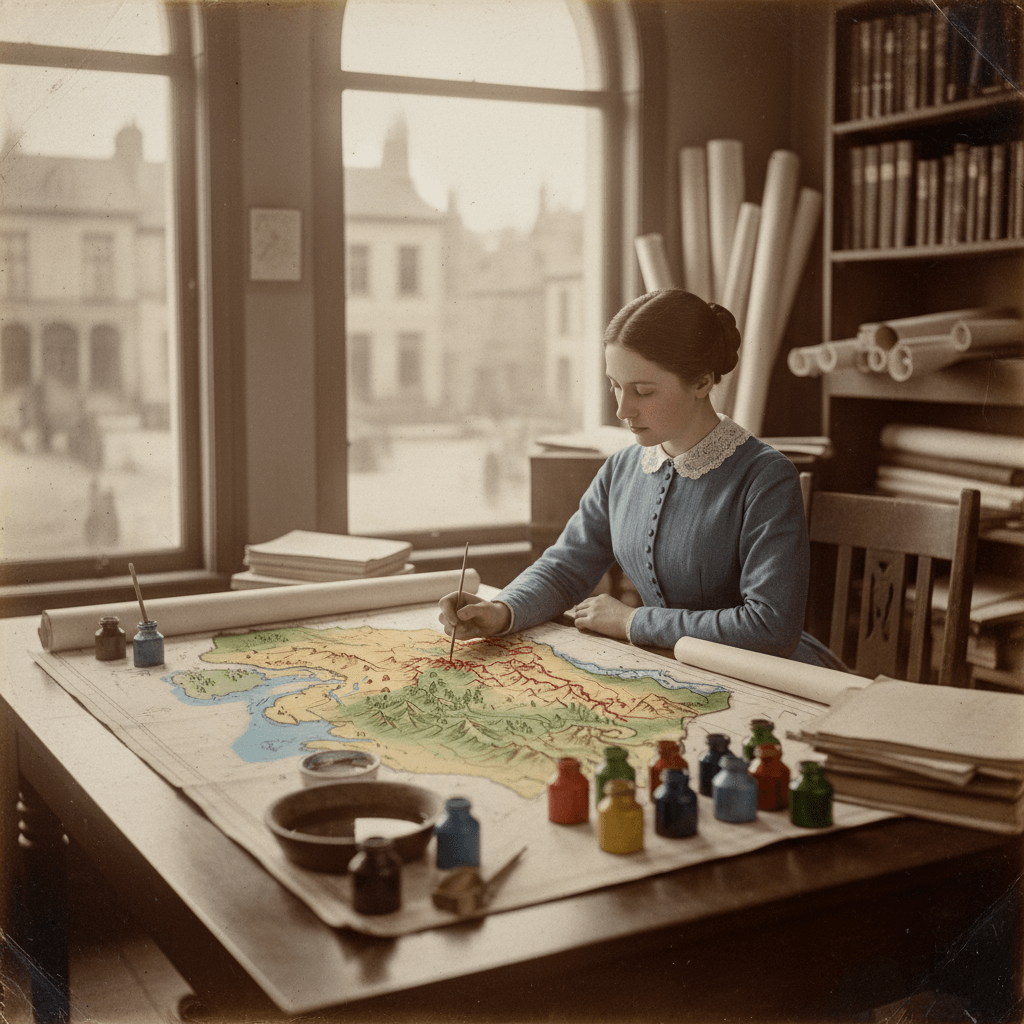
About the Map Colourist Profession
The role of a Map Colourist was integral to the production of maps during the Victorian Era, a time when cartography was both an art and a science. Map Colourists were responsible for the meticulous task of hand-painting maps, adding vibrant colors to delineate various geographical features, political boundaries, and land use. Each color had a specific meaning; for instance, blue often represented water bodies, green indicated forests, and brown was used for mountains. The work required not only artistic skill but also a deep understanding of geography and the significance of different regions.
Map Colourists worked in printing houses or cartographic firms, often alongside surveyors and engravers. They would receive printed maps, typically in black and white, and then apply their artistic talents to bring these maps to life. The process was labor-intensive, requiring precision and patience, as even the slightest mistake could lead to misinterpretation of the map's information. The final product was a beautifully colored map that was both functional and aesthetically pleasing, often used for educational purposes, navigation, and decoration.
As the demand for maps grew with the expansion of the British Empire and the rise of global exploration, the role of the Map Colourist became increasingly important. However, this job was not without its challenges, as the work environment could be cramped and poorly lit, leading to eye strain and fatigue. Despite these conditions, the Map Colourist took pride in their craft, knowing that their work contributed to the understanding of the world around them.
Day in the Life of a Map Colourist
Morning: Preparing the Workspace
The day began early, often before the sun had fully risen. The Map Colourist would arrive at the printing house, where the air was filled with the scent of ink and paper. After settling into their designated workspace, they would gather their tools: fine brushes, a palette of vibrant inks, and a selection of maps awaiting their artistic touch. The first task was to review the maps, noting the areas that required color and the specific hues needed for each geographical feature.
Mid-Morning: Mixing Inks
Once the maps were organized, the Colourist would spend time mixing inks to achieve the perfect shades. This process required a keen eye for color and an understanding of how different pigments interacted. The Colourist would often test their mixtures on scrap paper to ensure accuracy before applying them to the maps.
Afternoon: Painting the Maps
With the inks prepared, the Colourist would begin the painstaking process of painting. Using fine brushes, they would carefully apply color to the designated areas, ensuring that lines were crisp and colors did not bleed into one another. This task required immense concentration and a steady hand, as even a small mistake could compromise the map's clarity. The Colourist would often work in silence, occasionally pausing to step back and assess their progress.
Late Afternoon: Quality Control
As the day drew to a close, the Colourist would conduct a final review of their work. This involved checking for any missed areas or inconsistencies in color. Once satisfied, they would prepare the maps for the next stage of production, which might involve additional printing or engraving. The Colourist would then clean their brushes and tidy their workspace, readying it for another day of creativity and precision.
Related Exhibits
Ice Delivery Man
The Ice Delivery Man was a vital figure in the late 19th and early 20th centuries, responsible for transporting large blocks of ice from ice houses to homes and businesses. Before the advent of modern refrigeration, ice was essential for preserving food, cooling drinks, and providing comfort during the sweltering summer months. Ice delivery men would often rise before dawn, preparing for a long day of labor that involved hauling heavy blocks of ice, sometimes weighing up to 300 pounds, using specialized tools and horse-drawn wagons. They navigated through city streets, delivering ice to households, restaurants, and markets, often shouting 'Ice!' to announce their arrival. The job required not only physical strength but also knowledge of customer preferences, as many clients had specific requests for the size and quantity of ice needed. The ice delivery man was a familiar sight in urban areas, contributing to the daily rhythm of life and commerce.
Armourer
The role of the armourer was pivotal in the medieval period, a time when warfare and personal protection were paramount. Armourers were skilled craftsmen responsible for creating, repairing, and maintaining the protective gear worn by soldiers and knights. Their work encompassed a variety of tasks, including forging metal plates, shaping chainmail, and crafting helmets, shields, and other defensive equipment. The craftsmanship of an armourer was not only functional but also often artistic, with intricate designs and embellishments that reflected the status and wealth of the wearer. The armourer’s workshop was a hub of activity, filled with the sounds of hammering metal, the glow of the forge, and the smell of heated iron. Each piece of armour was custom-fitted to the individual, ensuring both protection and mobility in battle. As warfare evolved, so too did the demands on armourers, who had to adapt their techniques and designs to meet the changing needs of their clients.
Explore More Exhibits
Discover the full collection of past and future professions in The Jobs Museum.