Medieval Period
Barber Surgeon
An extinct profession from Medieval Period that became obsolete due to technological advancement and societal change.
Media Gallery
Image

Medieval Period
An extinct profession from Medieval Period that became obsolete due to technological advancement and societal change.
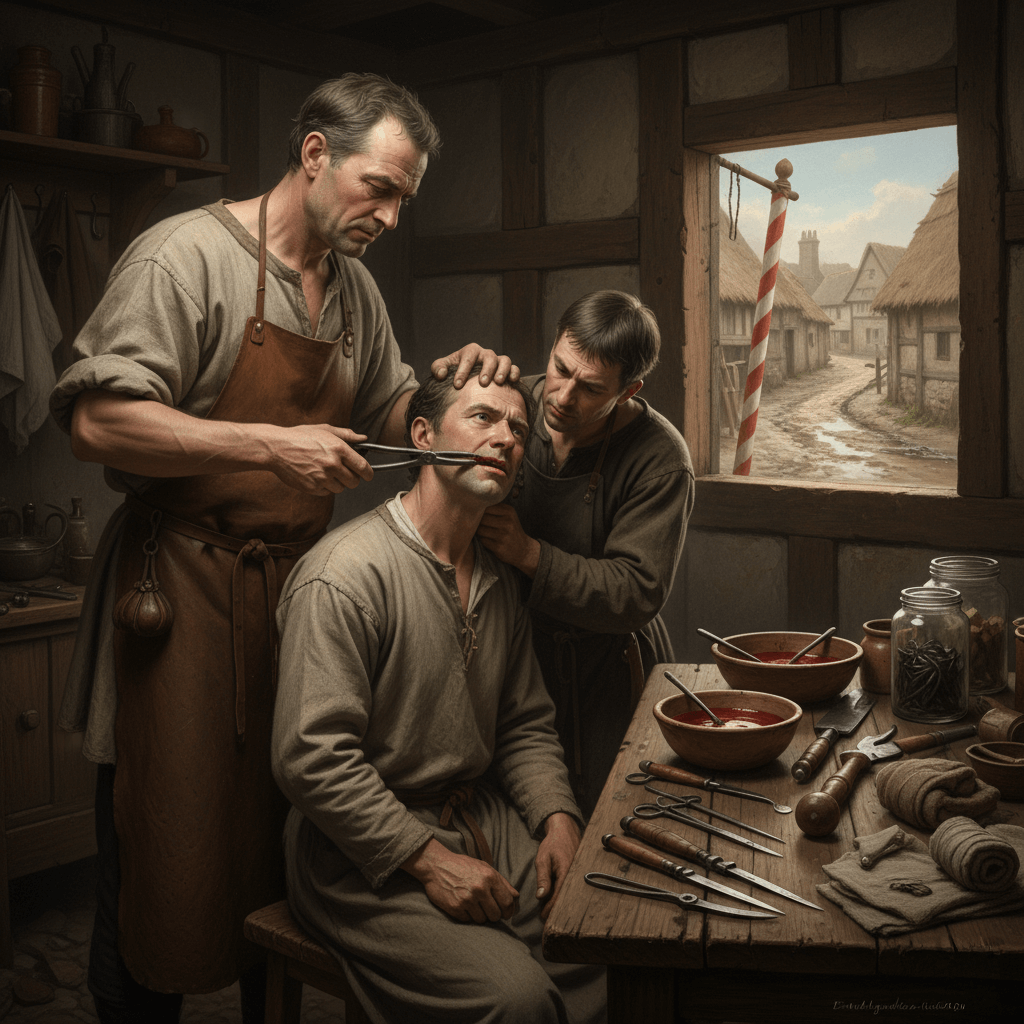
The barber surgeon was a unique figure in medieval society, serving as both a barber and a surgeon. This dual role emerged in the 12th century and persisted into the 17th century, reflecting the limited medical knowledge and the social structure of the time. Barber surgeons were responsible for a variety of tasks, including hair cutting, shaving, and performing surgical procedures such as bloodletting, tooth extraction, and even amputations. They were often the first point of contact for medical care in their communities, providing essential services in an era when formal medical training was scarce. The barber's pole, a symbol of their trade, features red and white stripes, representing blood and bandages, a nod to their surgical duties.
Barber surgeons operated in a time when the boundaries between medicine and personal grooming were blurred. They were often found in small shops or stalls, where they would set up their equipment and await customers. The role required a blend of practical skills, a steady hand, and a certain level of anatomical knowledge, albeit rudimentary by modern standards. Despite their contributions, barber surgeons were often viewed with suspicion by the more educated physicians, who considered their practices to be unrefined and lacking in scientific rigor.
As the Renaissance ushered in a new era of medical understanding and the establishment of formal medical schools, the role of the barber surgeon began to decline. The rise of trained physicians and surgeons, who had undergone extensive education and training, rendered the barber surgeon's services increasingly obsolete. By the 18th century, the profession had largely disappeared, replaced by specialized medical practitioners who could offer more effective and safer treatments.
The day begins early for the barber surgeon, as the sun rises over the bustling medieval town. After a quick breakfast, he heads to his shop, a modest space filled with the tools of his trade. He carefully cleans and sharpens his razors, scalpels, and other instruments, preparing for a day of both grooming and medical care. The barber surgeon hangs the iconic barber pole outside his shop, signaling to passersby that he is open for business.
As customers begin to trickle in, the barber surgeon starts with haircuts and shaves. He engages in friendly banter with his clients, discussing local news and gossip while skillfully wielding his straight razor. Each shave is a meticulous process, requiring precision and care to avoid nicks and cuts. The barber surgeon takes pride in his work, knowing that a well-groomed appearance is important to his clientele.
After the morning rush, the barber surgeon prepares for the more serious aspect of his profession. He sets up a small area in his shop for surgical procedures, laying out his tools and ensuring everything is clean. Patients arrive for various ailments, from toothaches to wounds needing stitching. The barber surgeon must remain calm and focused, as he performs bloodletting or tooth extractions, often without anesthesia. His steady hands and knowledge of anatomy are crucial, as he navigates the delicate balance between providing relief and causing pain.
As the day progresses, the barber surgeon may be called upon to perform more serious procedures, such as bloodletting or even amputations. He prepares his patient, explaining the process and reassuring them as best he can. With a combination of skill and bravery, he carries out the procedure, often relying on the support of an assistant to hold the patient steady. The atmosphere is tense, but the barber surgeon's experience helps him manage the situation.
As the sun sets, the barber surgeon cleans his tools and reflects on the day's work. He may have treated several patients, each with their own stories and ailments. After closing up shop, he heads home, exhausted but fulfilled, knowing he has played a vital role in his community's health and well-being.
The life of a barber surgeon is one of duality, balancing the art of grooming with the science of healing, a testament to the complexities of medieval medicine.
The role of a Map Colourist was integral to the production of maps during the Victorian Era, a time when cartography was both an art and a science. Map Colourists were responsible for the meticulous task of hand-painting maps, adding vibrant colors to delineate various geographical features, political boundaries, and land use. Each color had a specific meaning; for instance, blue often represented water bodies, green indicated forests, and brown was used for mountains. The work required not only artistic skill but also a deep understanding of geography and the significance of different regions. Map Colourists worked in printing houses or cartographic firms, often alongside surveyors and engravers. They would receive printed maps, typically in black and white, and then apply their artistic talents to bring these maps to life. The process was labor-intensive, requiring precision and patience, as even the slightest mistake could lead to misinterpretation of the map's information. The final product was a beautifully colored map that was both functional and aesthetically pleasing, often used for educational purposes, navigation, and decoration. As the demand for maps grew with the expansion of the British Empire and the rise of global exploration, the role of the Map Colourist became increasingly important. However, this job was not without its challenges, as the work environment could be cramped and poorly lit, leading to eye strain and fatigue. Despite these conditions, the Map Colourist took pride in their craft, knowing that their work contributed to the understanding of the world around them.
The art of calligraphy, often referred to as 'beautiful writing,' flourished during the Medieval Period, where skilled calligraphers played a crucial role in the preservation and dissemination of knowledge. These artisans were not merely writers; they were artists who transformed the written word into a visual spectacle. Calligraphers were responsible for creating manuscripts, religious texts, and important documents, often using intricate scripts that varied by region and purpose. Their work was characterized by the use of quills, ink, and parchment, and they often employed elaborate techniques such as gilding and illumination to enhance their creations. The calligrapher's role was not only to write but to imbue each piece with a sense of beauty and reverence, making their work essential in an era where printed materials were scarce and literacy was a privilege of the few.
Discover the full collection of past and future professions in The Jobs Museum.