
Industrial Revolution
Knife Grinder
An extinct profession from Industrial Revolution that became obsolete due to technological advancement and societal change.
Media Gallery
About the Knife Grinder Profession
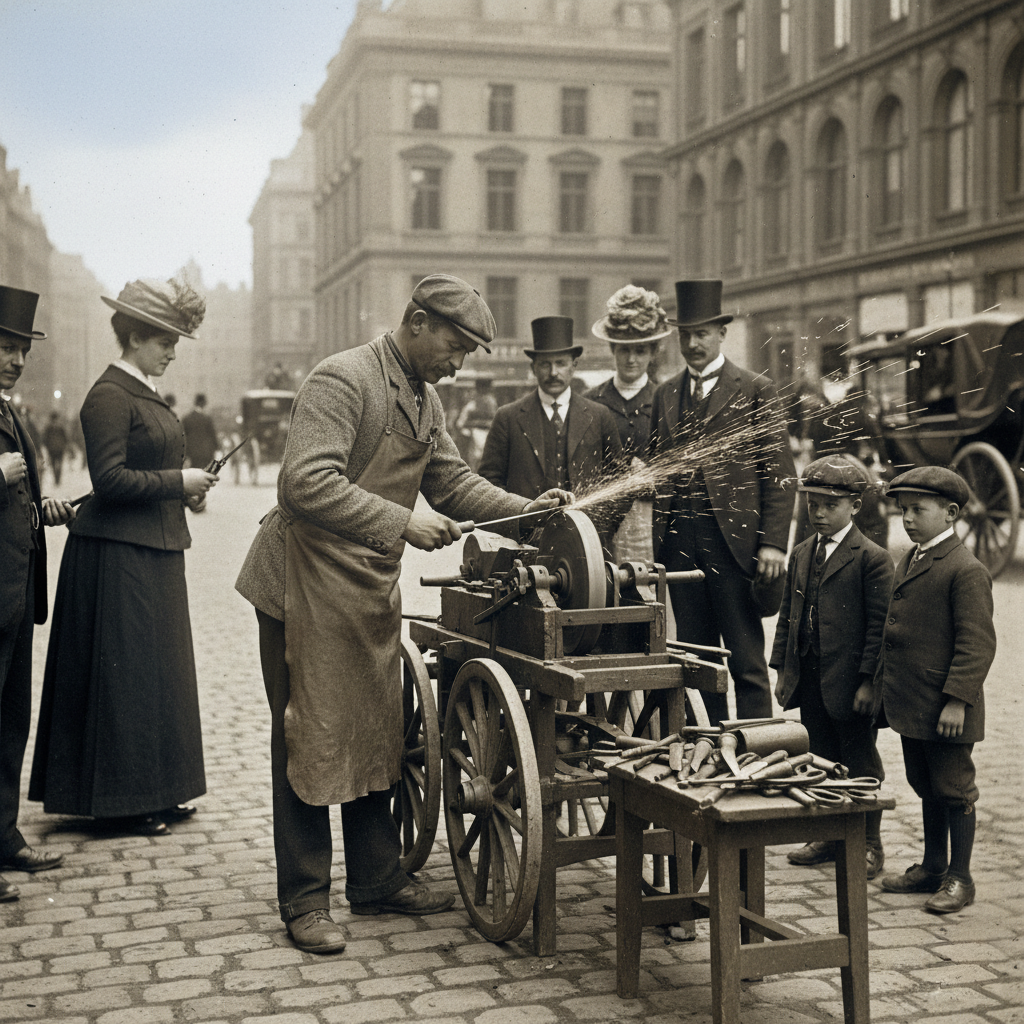
The knife grinder was a skilled tradesperson responsible for sharpening and honing blades, from kitchen knives to industrial cutting tools. This occupation flourished during the Industrial Revolution, a period marked by rapid technological advancement and a growing demand for precision tools in both domestic and industrial settings. Knife grinders often worked in small workshops or as itinerant tradespeople, traveling from town to town with their grinding wheels and tools, providing essential services to local communities. The sound of the grinding wheel, a rhythmic and reassuring noise, was a familiar part of daily life, as these craftsmen ensured that the tools of the trade remained sharp and effective.
The process of knife grinding involved several steps. First, the grinder would assess the blade's condition, determining the level of wear and the type of sharpening needed. Using a foot-powered grinding wheel, the grinder would carefully sharpen the blade, maintaining the correct angle to ensure optimal cutting performance. After sharpening, the blade would often be polished to a fine finish, sometimes using a leather strop to achieve a razor-sharp edge. Knife grinders were not only skilled in their craft but also had a deep understanding of the various types of steel and the specific needs of different tools, making them invaluable to both domestic households and industrial operations.
Day in the Life of a Knife Grinder
Early Morning: Setting Up the Shop
As dawn breaks, the knife grinder arrives at his workshop, a modest space filled with the scent of metal and oil. He begins by preparing his tools, ensuring that his grinding wheel is clean and ready for the day's work. The grinder checks his inventory of knives and tools left by customers, ready to be sharpened.
Mid-Morning: The First Customers
By mid-morning, the shop is bustling with activity. Local chefs and housewives arrive with their dull knives, eager to have them sharpened. The grinder greets each customer, discussing their specific needs and the types of knives they bring. He carefully inspects each blade, noting any chips or damage that may require special attention.
Afternoon: Grinding and Polishing
As the sun reaches its zenith, the grinder begins the labor-intensive process of sharpening. He steps onto the foot pedal of his grinding wheel, which spins with a steady hum. With practiced precision, he angles each knife against the wheel, sparks flying as metal meets stone. After sharpening, he moves to the polishing station, using a leather strop to give the blades a fine edge. The rhythmic sound of grinding fills the air, a testament to his skill and dedication.
Late Afternoon: Traveling Sales
In the late afternoon, the grinder packs up his tools and prepares to hit the road. Many knife grinders were itinerant, traveling to nearby towns to offer their services. He loads his cart with the grinding wheel and a selection of tools, ready to set up shop in a new location. As he travels, he calls out to locals, advertising his services and ensuring that the tradition of sharp blades continues.
Evening: Closing Up
As the day winds down, the grinder returns to his workshop, exhausted but satisfied. He cleans his tools, prepares for the next day, and reflects on the importance of his work. Each knife he sharpens is a tool that will help someone prepare a meal, create art, or perform a task, and he takes pride in being a vital part of that process.
Related Exhibits
Pinsetter
In the bustling alleys of mid-20th century bowling alleys, the role of the pinsetter was a vital yet often overlooked occupation. Pinsetters were responsible for resetting the bowling pins after each frame, ensuring that the game could continue smoothly. This job required a keen eye and quick reflexes, as the pinsetter had to swiftly and accurately place the pins back in their designated spots while dodging the heavy bowling balls that rolled down the lane. The pinsetter's work environment was often loud and filled with the sounds of laughter, clattering pins, and the thud of bowling balls. They worked in dimly lit back rooms, often hidden from the view of the bowlers, where they operated a series of levers and pulleys to reset the pins. The job was physically demanding, requiring the pinsetter to be agile and strong enough to handle the heavy equipment used to lift and position the pins. As bowling grew in popularity during the 1950s and 1960s, the demand for pinsetters increased, making it a common sight in bowling alleys across America. However, the advent of automatic pinsetting machines in the late 1960s marked the beginning of the end for this once-essential role. These machines could reset pins faster and more efficiently than any human, leading to the gradual decline of the pinsetter profession.
Ostrich Feather Plucker
The role of the ostrich feather plucker emerged in the late 19th century, coinciding with the rise of the fashion industry and the extravagant tastes of the Victorian elite. Ostrich feathers, prized for their softness, length, and striking appearance, became a symbol of luxury and status. The feathers were used in a variety of fashionable items, including hats, boas, and elaborate costumes. Pluckers were responsible for harvesting these feathers, a delicate task that required both skill and care to ensure the birds remained healthy and the feathers were of the highest quality. Ostrich farms, primarily located in South Africa, became the epicenter of this industry. Workers would carefully pluck feathers from live ostriches, a process that was typically done once a year during the molting season when the birds naturally shed their feathers. The feathers were then sorted, cleaned, and prepared for shipment to fashion houses around the world. The demand for these luxurious feathers surged, leading to a booming industry that provided employment for many, particularly women, who often worked in harsh conditions for meager pay. As fashion trends evolved and the use of synthetic materials became more prevalent, the demand for natural ostrich feathers began to decline. Additionally, the ethical concerns surrounding the treatment of ostriches and the rise of animal rights movements contributed to the job's obsolescence. By the early 20th century, the ostrich feather plucker had largely disappeared from the workforce, replaced by more humane and sustainable alternatives in the fashion industry.
Explore More Exhibits
Discover the full collection of past and future professions in The Jobs Museum.