
Victorian Era
Funeral mute
An extinct profession from Victorian Era that became obsolete due to technological advancement and societal change.
Media Gallery
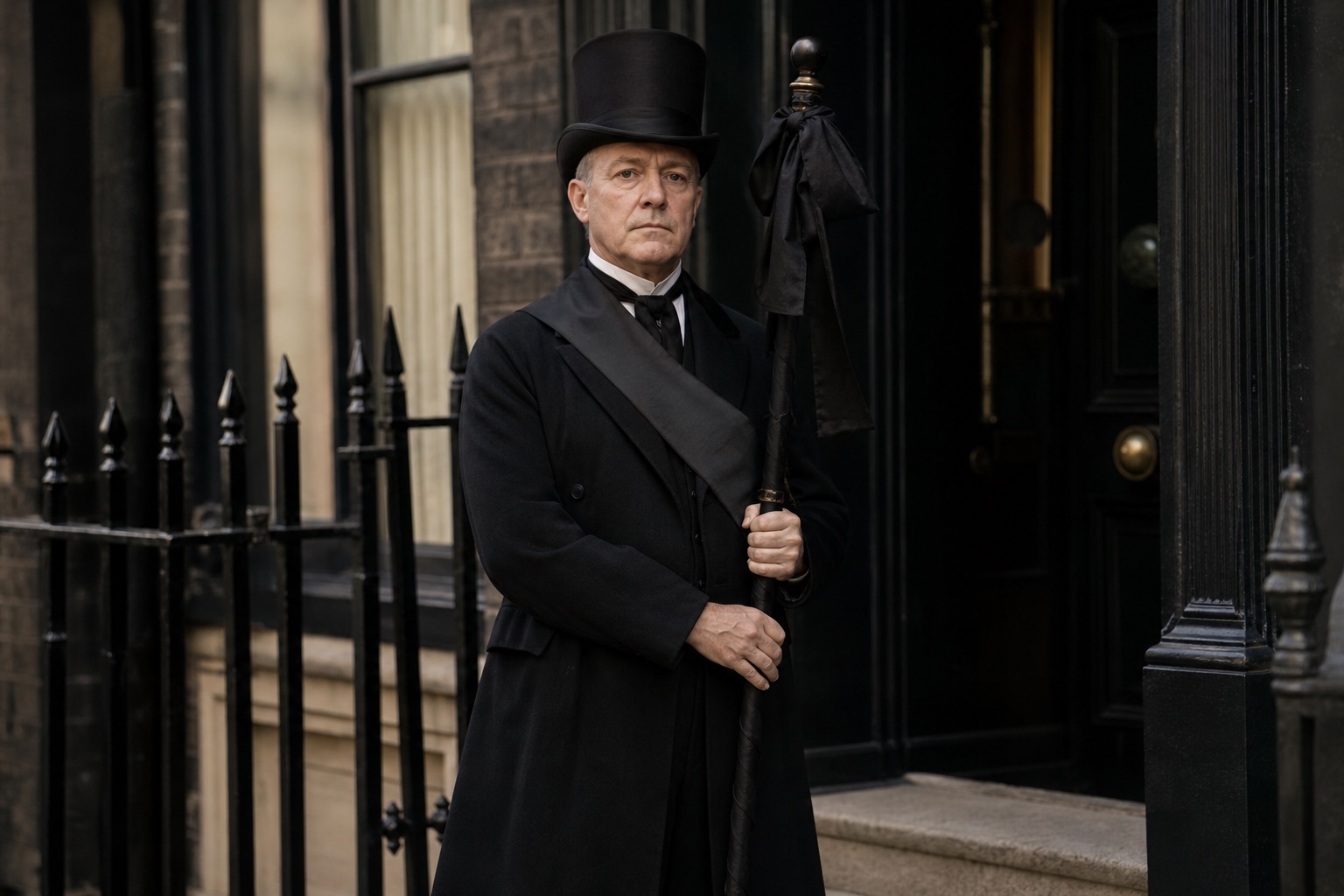
About the Funeral mute profession
A funeral mute was a hired mourner in full black who walked at the head of a Victorian funeral with a wand or a staff. Undertakers kept such men, or engaged them for the day, as part of the pageant sold to families who wanted the procession to look grave. Mute meant silent attendant. It did not mean a person unable to speak. In pairs they went ahead of the hearse from the house door toward the church or the cemetery and stood while the service asked for stillness. A tall hat with a long crepe weeper, black gloves, and the wand were the kit that made the role readable from the pavement.
The trade belonged to the commercial funeral of the nineteenth century, especially in London and in towns that copied London furnishers. Dickens placed a mute in the shop of the undertaker Sowerberry in Oliver Twist, and the figure became a stock image of hired grief. Reformers from the 1870s attacked the cost of feathers, mutes, and velvet. Simpler funerals, the motor hearse, and the decline of the pageant funeral in the early twentieth century removed the reason to hire a man to walk in silence. The mute faded because the bill changed. No statute abolished the wand.
Day in the Life of a Funeral mute
Black and the wand
The mute dressed entirely in black, with a weeper on the hat and a wand or staff in the hand. The clothes were sometimes his and sometimes the undertaker's stock, returned after the day. From across a street the wand and the black were the office.
Silence for hire
He did not speak to the crowd and did not greet acquaintances along the route. The silence was the product being sold, a show of gravity at the front of the line. When the funeral ended he could talk again, because the hire was for the hours of the procession only.
The pageant
Mutes belonged with feathers, velvet, and mutes counted in pairs on a furnisher's price list. Two mutes said one thing about a family's means, and four said more. The conductor ran the day, and the mute was there to be counted and seen.
Simpler processions
From the late Victorian years, and faster after 1900, families cut the display. A motor hearse and a short walk to a cemetery chapel had no place for a hired silent man. The mute disappeared from the bill because the pageant did, while undertaking itself continued.
What came after
Hired silence at the head of a funeral was dropped as processions shortened and families stopped paying for mutes.
The succession pageRelated Exhibits
Cash Girl
A cash girl was a department-store junior, often a girl or a young woman, who carried the customer's money and the written bill to a cashier and brought the receipt and the change back. The counter itself had no register yet. She waited where the sale was made, took the cash and the slip, walked the floor to the desk, and returned without mixing one purchase with another in a crowded aisle. The work was ordinary and public, a pair of errands repeated for every sale. This record keeps that walk concrete and calm. The practice belongs to the late nineteenth century in the United States and in Britain, in dry-goods houses and the new department stores. Cable systems such as Lamson's cash railway, pneumatic tubes to a central desk, and the cash register on the counter each removed a reason to send a junior across the floor. She was not the buyer and not the cashier. She was the distance between them, and when that distance was mechanized the walk ended.
Moirologist
The moirologist, a term derived from the Greek word 'moirologia' meaning 'to lament,' was a specialized profession that emerged during the Victorian Era, particularly in the 19th century. These individuals were skilled mourners, often hired to express grief at funerals and memorial services. Their role was to provide a public display of sorrow, which was considered an essential part of the mourning process in a society that placed great emphasis on the rituals surrounding death. Moirologists were often women, who would don black attire and engage in elaborate displays of mourning, including weeping, wailing, and reciting elegies or poems that honored the deceased. Their presence was thought to enhance the emotional atmosphere of the funeral, allowing the bereaved family to feel supported in their grief. In addition to their emotional labor, moirologists were also expected to have a deep understanding of the customs and traditions surrounding death, including the appropriate attire, behavior, and rituals that were expected in various social contexts. They often worked alongside funeral directors and were an integral part of the mourning culture of the time, which was characterized by elaborate funerals and a public display of grief.
Explore More Exhibits
Discover the full collection of past and future professions in The Jobs Museum.