
Industrial Revolution
Newspaper Typesetter
An extinct profession from Industrial Revolution that became obsolete due to technological advancement and societal change.
Media Gallery
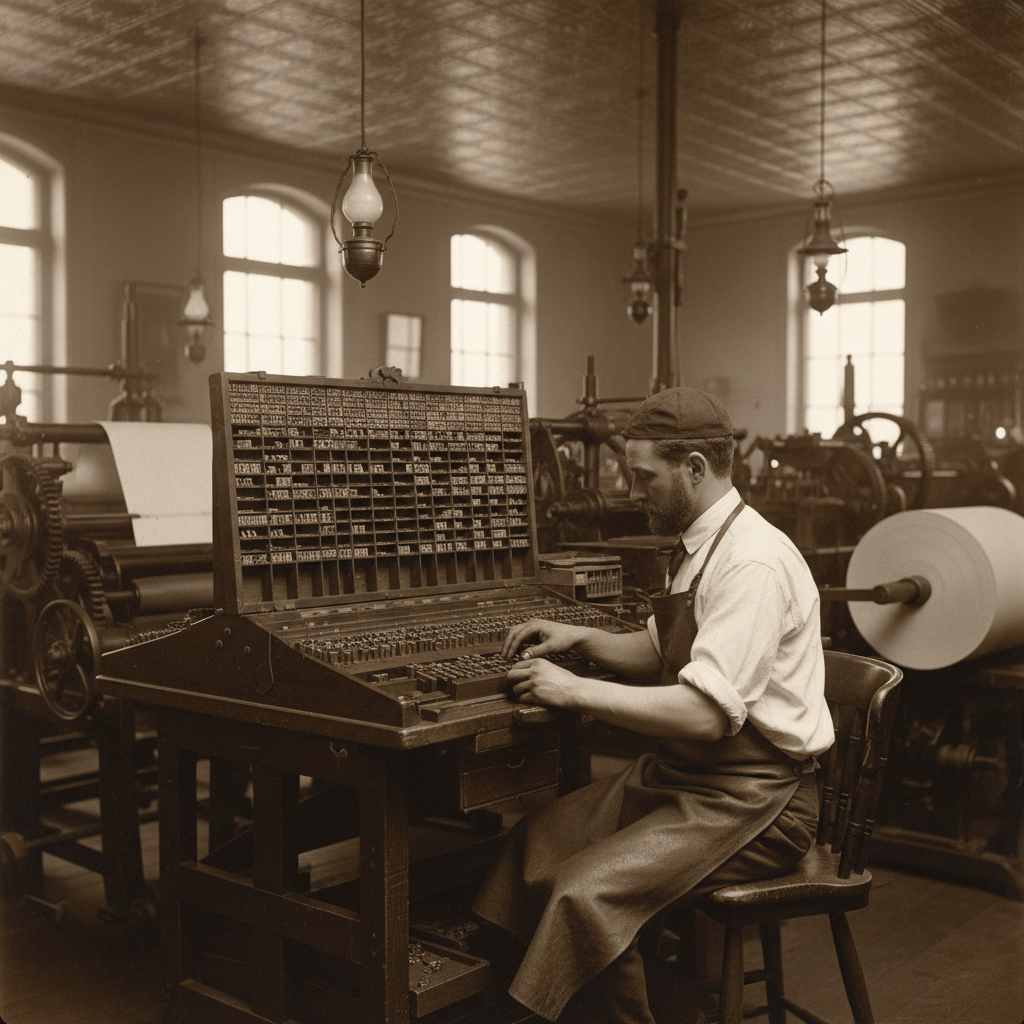
About the Newspaper Typesetter Profession
The role of a newspaper typesetter was pivotal in the production of printed media during the Industrial Revolution and well into the 20th century. Typesetters were responsible for arranging the text and images that would be printed in newspapers, ensuring that each page was visually appealing and legible. This intricate process involved selecting individual metal type pieces, known as 'sorts', and arranging them into words and sentences on a composing stick. Once the text was set, it was locked into place in a chase, ready for the printing press. Typesetters worked in a noisy, bustling environment, often alongside other skilled tradespeople, such as printers and proofreaders, in a print shop. The job required not only technical skill but also a keen eye for detail and a strong understanding of typography and layout.
Day in the Life of a Newspaper Typesetter
Early Morning: Preparing for the Day
As dawn breaks, the typesetter arrives at the print shop, greeted by the familiar sounds of machinery and the smell of ink. The first task is to review the day’s newspaper layout, which has been planned by the editors. The typesetter gathers the necessary typefaces and sizes, preparing the composing stick and ensuring that the workspace is organized and efficient.
Mid-Morning: Setting the Type
With the layout in hand, the typesetter begins the meticulous process of setting type. Using a type case, they select individual letters and symbols, carefully placing them in the composing stick. This requires not only speed but also precision, as a single mistake can lead to costly errors in the final print. The typesetter must also consider the overall design, balancing text with images and ensuring that headlines stand out.
Afternoon: Proofreading and Adjustments
Once a section of the newspaper is typeset, it is time for proofreading. The typesetter collaborates with proofreaders to check for typos, spacing issues, and alignment. Corrections are made by adjusting the type or re-setting sections as needed. This collaborative effort is crucial to maintaining the newspaper’s reputation for accuracy and quality.
Late Afternoon: Preparing for Printing
As the day progresses, the typesetter locks the completed type into a chase, preparing it for the printing press. This involves securing the type and ensuring that it is ready for the inking process. The typesetter may also assist in mixing ink and preparing the press for operation, working closely with printers to ensure a smooth transition from typesetting to printing.
Evening: Final Checks and Clean-Up
As the day winds down, the typesetter conducts final checks on the printed pages, ensuring that everything meets the publication’s standards. After the day’s work is complete, the typesetter cleans the workspace, returning unused type to the cases and preparing for the next day’s production. The satisfaction of seeing the finished newspaper, with their work prominently displayed, is a rewarding end to a busy day.
Related Exhibits
Phrenologist
Phrenology, a now-discredited field of study, emerged in the early 19th century as a popular method for assessing personality traits and intellectual capabilities based on the shape and contours of the skull. Phrenologists believed that the brain was the organ of the mind, and that specific areas of the brain corresponded to different character traits. By examining the bumps and indentations on a person's skull, phrenologists claimed they could determine an individual's character, tendencies, and even potential for success in various fields. Phrenologists often set up practices in urban centers, where they would offer consultations to clients seeking insights into their personalities or those of their children. They would use a combination of observation, intuition, and rudimentary anatomical knowledge to assess the skull's shape, often employing plaster casts or models to illustrate their findings. The practice was not only popular among the general public but also found its way into educational and occupational settings, influencing hiring practices and social interactions. Despite its initial popularity, phrenology faced increasing skepticism from the scientific community as the 19th century progressed. Critics pointed out the lack of empirical evidence supporting its claims and the ethical implications of using skull shape to judge character. By the late 19th century, advances in psychology and neuroscience began to overshadow phrenology, leading to its decline and eventual obsolescence.
Switchboard Operator
In the bustling world of the late 19th and early 20th centuries, the role of the switchboard operator emerged as a vital cog in the machinery of communication. These skilled individuals were the unsung heroes of the telephone network, connecting calls and facilitating conversations that bridged distances and brought people together. With the advent of the telephone, the need for a human intermediary became apparent, and thus, the switchboard operator took center stage in the realm of telecommunications. Switchboard operators worked in large, often crowded rooms filled with rows of switchboards, each adorned with a myriad of plugs and wires. Their primary responsibility was to connect callers by manually plugging and unplugging telephone lines into the appropriate jacks on the switchboard. This intricate dance of wires required not only dexterity but also a keen ear for voices and an ability to quickly assess and respond to the needs of callers. Operators were often the first point of contact for individuals seeking to connect with friends, family, or businesses, making their role both crucial and highly regarded. The job was not without its challenges. Operators had to manage multiple calls simultaneously, often dealing with a cacophony of voices and requests. They were trained to handle emergencies, providing vital assistance during crises, such as connecting calls to hospitals or fire departments. The work environment was typically fast-paced and required a high level of concentration, as even a small mistake could lead to misdirected calls or delays in communication. As technology advanced, the role of the switchboard operator began to wane. The introduction of automated switching systems in the mid-20th century marked the beginning of the end for this once-essential occupation. These systems could connect calls without human intervention, leading to a decline in demand for operators. By the 1980s, the role had largely disappeared, replaced by automated systems that could handle the volume of calls with greater efficiency and reliability.
Explore More Exhibits
Discover the full collection of past and future professions in The Jobs Museum.