
Industrial Revolution
Lector
An extinct profession from Industrial Revolution that became obsolete due to technological advancement and societal change.
Media Gallery
About the Lector Profession
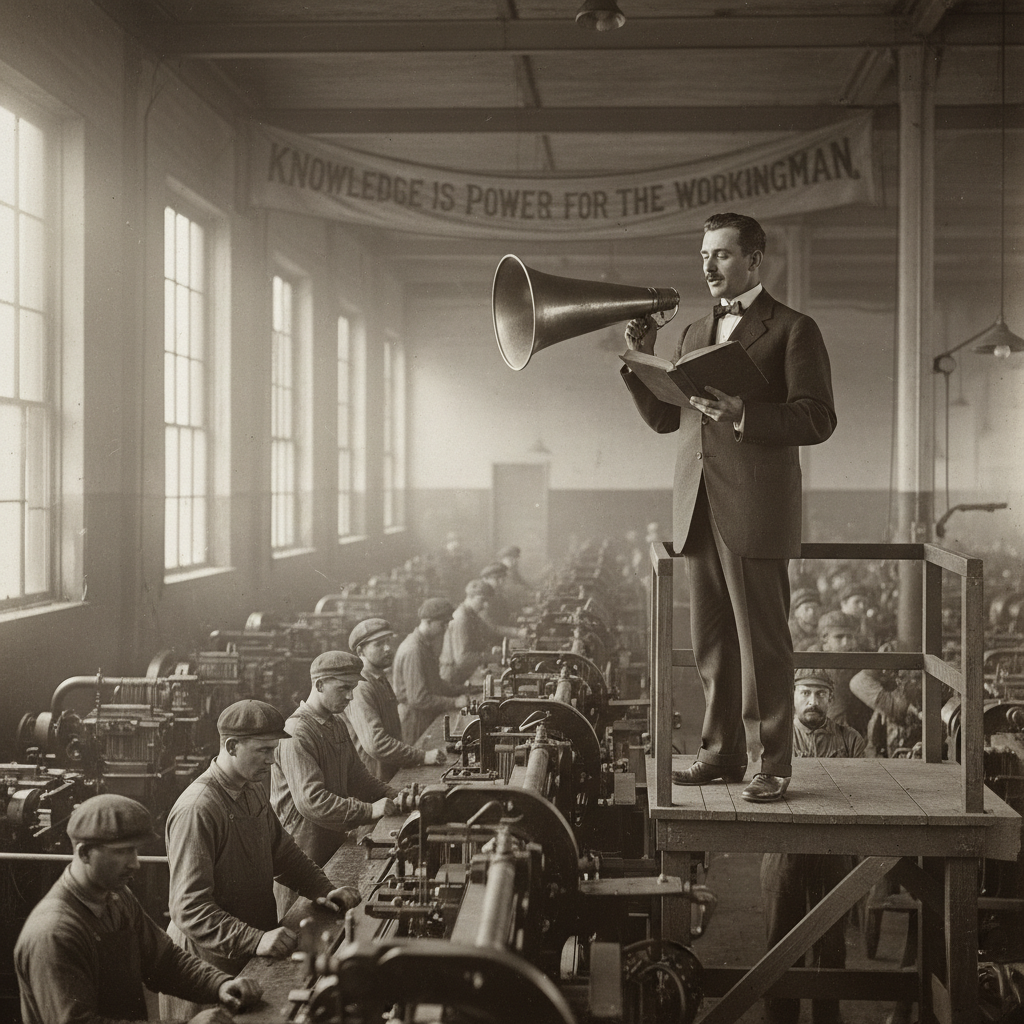
The lector was a unique and fascinating occupation that emerged during the Industrial Revolution, particularly in the late 19th and early 20th centuries. This role was primarily found in cigar factories, where workers would spend long hours engaged in repetitive tasks. To alleviate the monotony and foster a sense of community, a lector would read aloud to the workers, providing them with entertainment, education, and a connection to the outside world. The readings often included literature, newspapers, and political essays, allowing workers to stay informed and engaged with current events while they toiled away. The lector was not merely a reader; they were a storyteller, a commentator, and sometimes even a social activist, using their platform to inspire and provoke thought among the laborers. This role was vital in creating a shared cultural experience among workers, fostering camaraderie and solidarity in an otherwise isolating environment.
Day in the Life of a Lector
Morning: Setting the Stage
The day for a lector typically began early in the morning, arriving at the cigar factory before the workers. They would prepare their reading materials, often selecting a mix of literature, news articles, and political pamphlets to engage the diverse interests of the laborers. The lector would set up a small area in the factory, ensuring that their voice could carry over the sounds of rolling tobacco and machinery.
Mid-Morning: The First Reading
As the factory bell rang, signaling the start of the workday, the lector would begin their first reading session. Workers would gather around, some pausing their tasks to listen intently, while others continued to roll cigars with one ear tuned to the lector's voice. The lector would read with passion, using inflection and emotion to bring the text to life, often pausing to discuss the content or encourage workers to share their thoughts.
Afternoon: Engaging Discussions
After a break for lunch, the lector would resume their readings, often shifting to more politically charged material, especially during times of labor unrest. This was a crucial part of their role, as they would not only entertain but also educate workers about their rights and the broader social issues affecting their lives. The lector would facilitate discussions, encouraging workers to think critically about the world around them.
Evening: Wrapping Up
As the workday came to a close, the lector would finish with a lighter reading, perhaps a humorous story or a piece of poetry, leaving the workers with a sense of camaraderie and upliftment. After the final reading, the lector would often engage in informal conversations with the workers, solidifying their role as a beloved figure within the factory community.
Related Exhibits
Lanista
The lanista was a pivotal figure in the world of ancient Roman gladiatorial games, serving as a trainer and manager of gladiators. These individuals were responsible for the selection, training, and overall management of gladiators, who were often slaves or prisoners of war forced to fight in brutal spectacles for public entertainment. The lanista operated a ludi, or gladiatorial school, where they would oversee the rigorous training of their fighters, teaching them combat techniques, discipline, and the art of survival in the arena. The lanista's role was not only to prepare gladiators physically but also to cultivate their mental fortitude, as the psychological demands of combat were immense. They were often seen as both a mentor and a taskmaster, instilling a sense of loyalty and camaraderie among their fighters while also ensuring they were ready to face the deadly challenges of the arena. The lanista's influence extended beyond training; they were also involved in the business side of gladiatorial combat, negotiating contracts, managing finances, and sometimes even betting on the outcomes of fights. This multifaceted role made the lanista a significant player in the social and economic fabric of Roman entertainment culture.
Human Computer
The role of a Human Computer emerged in the early 20th century, primarily during the 1930s to the 1950s, as a response to the growing need for complex calculations in fields such as astronomy, engineering, and military applications. Human Computers were predominantly women who performed mathematical calculations by hand, often using pencil and paper, and later, mechanical calculators. They worked in teams, meticulously calculating trajectories for rockets, analyzing astronomical data, and solving intricate mathematical problems that were essential for scientific advancements. Their work was critical in the development of early computers, as they laid the groundwork for the algorithms and processes that would later be automated. These women, often referred to as "computers," were not only skilled mathematicians but also adept at problem-solving and critical thinking. They operated in environments that ranged from university laboratories to government research facilities, where they collaborated closely with scientists and engineers. The atmosphere was often intense, with deadlines looming and the pressure to produce accurate results being paramount. The Human Computer's role was not just about numbers; it was about precision, attention to detail, and the ability to work under pressure. They were the unsung heroes behind many scientific breakthroughs, including the early space missions and the development of radar technology during World War II. Their contributions were vital, yet often overlooked in the historical narrative of computing and mathematics.
Explore More Exhibits
Discover the full collection of past and future professions in The Jobs Museum.