
20th Century
Human Computer
An extinct profession from 20th Century that became obsolete due to technological advancement and societal change.
Media Gallery
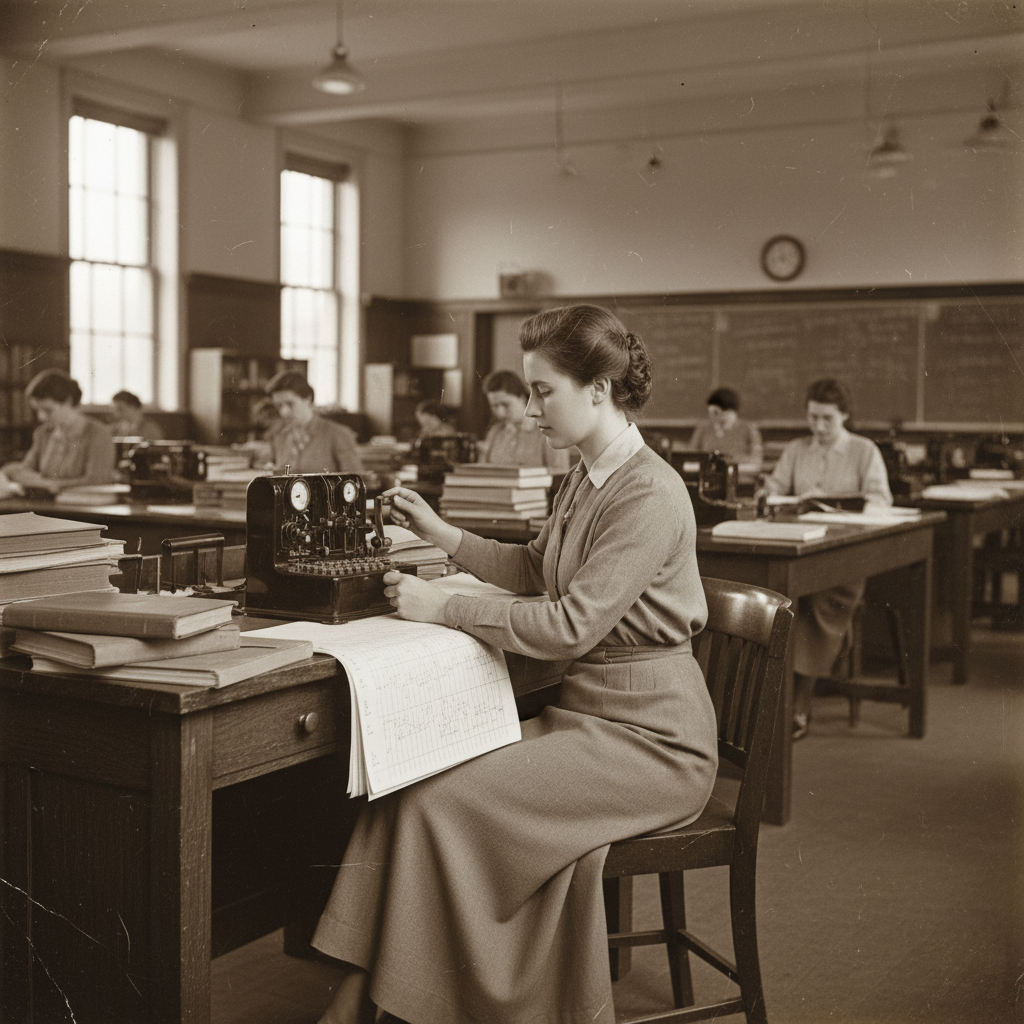
About the Human Computer Profession
The role of a Human Computer emerged in the early 20th century, primarily during the 1930s to the 1950s, as a response to the growing need for complex calculations in fields such as astronomy, engineering, and military applications. Human Computers were predominantly women who performed mathematical calculations by hand, often using pencil and paper, and later, mechanical calculators. They worked in teams, meticulously calculating trajectories for rockets, analyzing astronomical data, and solving intricate mathematical problems that were essential for scientific advancements. Their work was critical in the development of early computers, as they laid the groundwork for the algorithms and processes that would later be automated.
These women, often referred to as "computers," were not only skilled mathematicians but also adept at problem-solving and critical thinking. They operated in environments that ranged from university laboratories to government research facilities, where they collaborated closely with scientists and engineers. The atmosphere was often intense, with deadlines looming and the pressure to produce accurate results being paramount.
The Human Computer's role was not just about numbers; it was about precision, attention to detail, and the ability to work under pressure. They were the unsung heroes behind many scientific breakthroughs, including the early space missions and the development of radar technology during World War II. Their contributions were vital, yet often overlooked in the historical narrative of computing and mathematics.
Day in the Life of a Human Computer
Morning: The Calculating Begins
The day typically began early, with Human Computers arriving at their desks in a bustling research facility. After a quick briefing with their supervisors, they would gather their tools: pencils, erasers, and mechanical calculators. The first task of the day often involved reviewing the previous day's calculations, ensuring accuracy and making necessary corrections.
Mid-Morning: Team Collaboration
As the morning progressed, the Human Computers would often work in teams, discussing complex problems and sharing insights. They would gather around large tables covered in sheets of paper filled with numbers and equations. Collaboration was key, as they would double-check each other's work, ensuring that every calculation was precise.
Afternoon: Intensive Calculation
The afternoon was often the most intense part of the day. With deadlines approaching, the Human Computers would dive deep into their calculations, sometimes working on multiple problems simultaneously. The atmosphere was charged with focus, as the sound of pencils scratching against paper filled the room. They would often take short breaks to clear their minds, but the pressure to deliver accurate results was ever-present.
Late Afternoon: Reporting Results
As the day wound down, the Human Computers would compile their results into reports for the scientists and engineers they supported. This involved not only presenting the numbers but also explaining the methodologies used in their calculations. The ability to communicate complex mathematical concepts clearly was essential, as it ensured that their work could be effectively utilized in ongoing projects.
Evening: Continuous Learning
After hours, many Human Computers would engage in further study, keeping up with advancements in mathematics and technology. This commitment to continuous learning was crucial, as the field was rapidly evolving, and staying ahead meant adapting to new methods and tools.
Related Exhibits
Breaker Boy
The role of a Breaker Boy emerged during the Industrial Revolution, particularly in the coal mining regions of the United States, where the demand for coal surged to fuel the burgeoning industries. Breaker Boys were young boys, often between the ages of 8 and 12, who worked in coal breaker facilities. Their primary responsibility was to separate impurities from coal, a crucial step in preparing the coal for market. This labor-intensive job involved sitting on a high platform above a conveyor belt, where they would pick out rocks, slate, and other debris from the coal as it passed by. The work was not only monotonous but also hazardous, as the boys were exposed to coal dust and the risk of injury from the machinery. Breaker Boys typically worked long hours, often from dawn until dusk, in poorly ventilated and unsafe conditions, earning a meager wage that reflected the exploitative labor practices of the time. The job was emblematic of the harsh realities faced by child laborers during the Industrial Revolution, highlighting the intersection of economic necessity and social injustice.
Ostrich Feather Plucker
The role of the ostrich feather plucker emerged in the late 19th century, coinciding with the rise of the fashion industry and the extravagant tastes of the Victorian elite. Ostrich feathers, prized for their softness, length, and striking appearance, became a symbol of luxury and status. The feathers were used in a variety of fashionable items, including hats, boas, and elaborate costumes. Pluckers were responsible for harvesting these feathers, a delicate task that required both skill and care to ensure the birds remained healthy and the feathers were of the highest quality. Ostrich farms, primarily located in South Africa, became the epicenter of this industry. Workers would carefully pluck feathers from live ostriches, a process that was typically done once a year during the molting season when the birds naturally shed their feathers. The feathers were then sorted, cleaned, and prepared for shipment to fashion houses around the world. The demand for these luxurious feathers surged, leading to a booming industry that provided employment for many, particularly women, who often worked in harsh conditions for meager pay. As fashion trends evolved and the use of synthetic materials became more prevalent, the demand for natural ostrich feathers began to decline. Additionally, the ethical concerns surrounding the treatment of ostriches and the rise of animal rights movements contributed to the job's obsolescence. By the early 20th century, the ostrich feather plucker had largely disappeared from the workforce, replaced by more humane and sustainable alternatives in the fashion industry.
Explore More Exhibits
Discover the full collection of past and future professions in The Jobs Museum.