
Victorian Era
Doll Eye Setter
An extinct profession from Victorian Era that became obsolete due to technological advancement and societal change.
Media Gallery
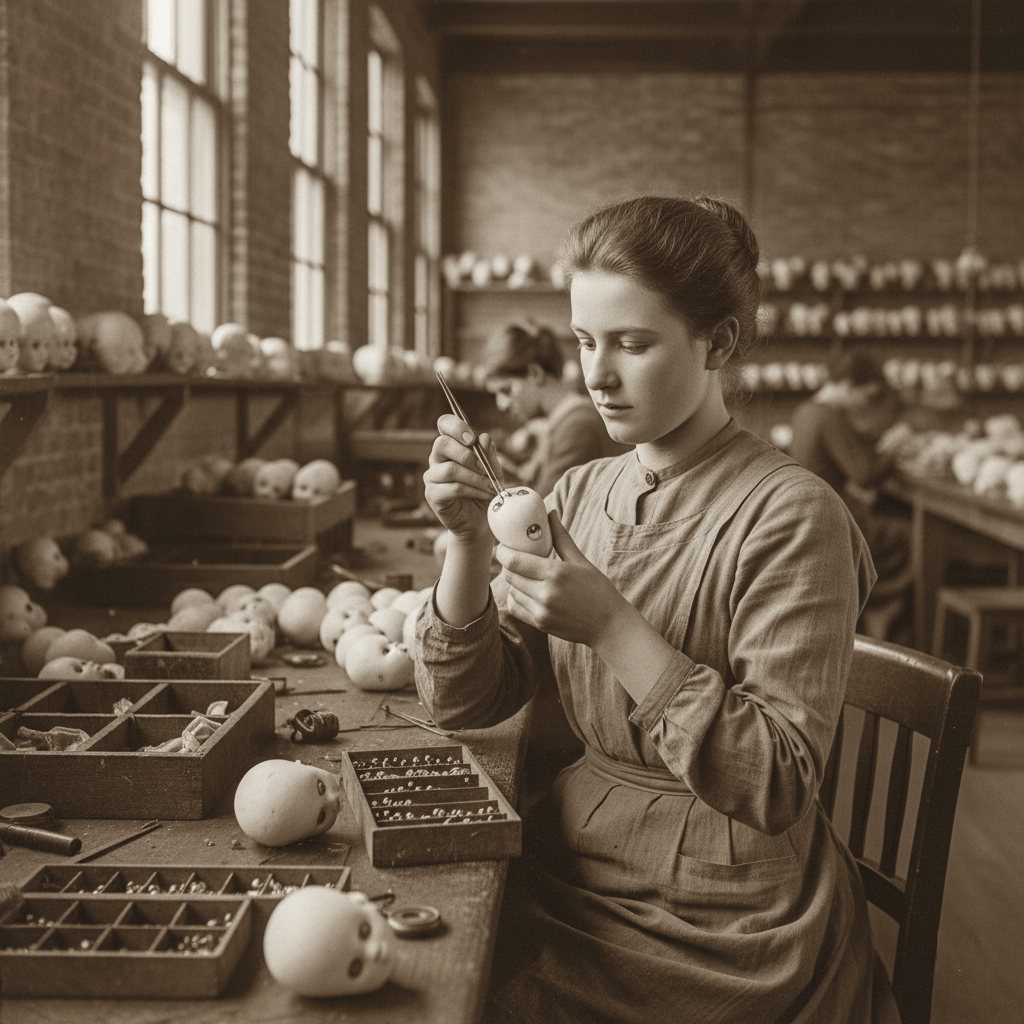
About the Doll Eye Setter Profession
The role of a Doll Eye Setter was a specialized craft within the toy-making industry, particularly prominent during the Victorian Era (1837-1901). This occupation involved the meticulous task of inserting glass or plastic eyes into dolls, ensuring that each doll had a lifelike appearance. Doll Eye Setters worked primarily in factories or workshops, where they would receive unassembled dolls from doll makers. The eyes, often made of glass, were crafted in various sizes and colors to match the intended design of the doll. The setter would carefully position the eyes, often using a small tool to secure them in place, ensuring they were aligned perfectly to create an expressive gaze. This attention to detail was crucial, as the eyes were considered the windows to the doll's personality, enhancing its appeal to children and collectors alike.
The job required not only dexterity and precision but also an artistic eye for detail, as the placement of the eyes could significantly affect the doll's overall aesthetic. Doll Eye Setters often worked long hours, sometimes in poorly lit conditions, which could strain their eyesight. The work was repetitive, yet it required a steady hand and a keen sense of proportion to ensure that each doll was visually appealing.
As the demand for dolls surged during the Victorian Era, fueled by the rise of the middle class and the popularity of children's toys, the role of the Doll Eye Setter became increasingly important. However, as the 20th century approached, advancements in manufacturing processes, such as the introduction of mass production techniques and the use of plastic eyes that could be molded directly into the doll's head, rendered the specialized skills of the Doll Eye Setter obsolete. The shift towards automation and the decline of handcrafted toys led to the gradual disappearance of this once-essential occupation.
Day in the Life of a Doll Eye Setter
Morning: Preparation and Setup
The day began early in the workshop, where the Doll Eye Setter would arrive to find a workspace filled with unassembled dolls and a variety of glass and plastic eyes. After donning protective eyewear to shield against glass shards, the setter would organize their tools, which included a small pair of tweezers, a needle, and a specialized eye-setting tool. The first task was to inspect the dolls for any defects and to select the appropriate eyes for each doll based on size and color.
Mid-Morning: Eye Insertion
Once the dolls were prepared, the setter would begin the delicate process of inserting the eyes. Using tweezers, they would carefully pick up a glass eye and position it into the doll's head, ensuring it was aligned correctly. This required a steady hand and a keen eye for detail, as even a slight misalignment could detract from the doll's appearance. The setter would often work on several dolls at once, moving from one to the next, ensuring efficiency while maintaining quality.
Afternoon: Quality Control and Finishing Touches
After the eyes were set, the Doll Eye Setter would conduct a quality check, examining each doll to ensure that the eyes were secure and properly positioned. Any dolls that did not meet the quality standards would be set aside for rework. Once the quality control was complete, the setter would apply finishing touches, such as adding eyelashes or painting the eyelids, to enhance the doll's lifelike appearance.
Late Afternoon: Clean-Up and Inventory
As the day wound down, the Doll Eye Setter would clean their workspace, carefully disposing of any broken glass and organizing tools for the next day. They would also take inventory of the completed dolls, preparing them for shipment to toy stores or distributors. This final task was crucial, as it ensured that the dolls would reach their destinations in perfect condition, ready to delight children and collectors alike.
Related Exhibits
Slubber Doffer
The slubber doffer was a crucial figure in the textile industry during the Industrial Revolution, primarily responsible for the maintenance and operation of spinning machines. These workers played a vital role in ensuring that the production of yarn and thread ran smoothly in the bustling textile mills of the 18th and 19th centuries. The term 'slubber doffer' specifically referred to those who removed the full bobbins of spun yarn from the spinning frames and replaced them with empty ones, a task that required both physical dexterity and a keen understanding of the machinery involved. The slubber doffer's work was often performed in a noisy, fast-paced environment, where the clatter of machines filled the air, and the smell of raw cotton and wool was ever-present. The job was typically held by young boys and girls, often as young as eight or nine, who were employed in the mills due to their small stature, which allowed them to navigate the cramped spaces between the machines. The slubber doffer's day was filled with the repetitive yet essential task of ensuring that the spinning process continued without interruption, a job that was physically demanding and required a high level of attention to detail. Despite the harsh working conditions, slubber doffers were an integral part of the textile production process, contributing to the rapid growth of the textile industry, which was a cornerstone of the Industrial Revolution. Their labor was essential in meeting the increasing demand for textiles, which fueled both domestic and international markets.
Lamplighter
In the dimly lit streets of the Victorian Era, where gas lamps flickered to life at dusk, the lamplighter emerged as a vital figure in urban life. Tasked with the responsibility of illuminating the night, lamplighters were the unsung heroes of the city, ensuring that the streets were safe and navigable after sunset. With a long pole equipped with a flame, they would traverse their designated routes, igniting the gas lamps that lined the thoroughfares, alleyways, and public squares. Each lamp was a small beacon of light, a symbol of progress in an age that was rapidly industrializing and urbanizing. The lamplighter's work was not merely about lighting lamps; it was a ritual that involved careful attention to detail. They would check each lamp for proper function, ensuring that the gas supply was adequate and that the glass was clean and intact. In addition to lighting the lamps, they were also responsible for extinguishing them at dawn, marking the transition from night to day. This job required a keen sense of time, as the lamplighter had to complete their rounds before the city fully awoke. As cities grew and the demand for street lighting increased, lamplighters became a common sight, often working in pairs or teams to cover larger areas. Their presence was a reassurance to the public, a reminder that the city was alive even in the darkest hours. However, the lamplighter's role was not without its challenges; they braved the elements, working in rain, snow, and the chill of winter nights, often climbing ladders to reach the higher lamps. The lamplighter was a figure of community, often known by name and face, fostering a sense of familiarity and safety among the residents. They were also a part of the social fabric, as their rounds often coincided with the evening strolls of townsfolk, creating a shared experience of urban life.
Explore More Exhibits
Discover the full collection of past and future professions in The Jobs Museum.