
Company
ActiveOpenAI
San Francisco · Since 2015
Still operating. Founded as a nonprofit, it later added a commercial subsidiary, and the legal structure has been rebuilt more than once.
A later timeline chapter projects a role for this organization. That chapter is a projection. This page is about the institution as it exists, or as it existed.
OpenAI was founded in 2015 as a nonprofit research lab, with a stated aim of building artificial intelligence that would not be captured by a single firm. In 2019 it created a capped-profit subsidiary so it could raise the money the work actually costs. The structure has been rebuilt since, more than once.
The 2020 language model, and the public chat tool released in 2022, changed the lab into a vendor. Companies that do not employ researchers began buying access, because a fluent draft had become something a customer expected.
A small staff, a wide consequence
OpenAI employs researchers, engineers, and a growing enterprise sales and policy staff. It does not employ the people whose jobs the tool touches. Those people work in the firms that subscribe. The occupation is split: a small, expensive lab, and a large number of clerks, writers, and programmers elsewhere who now start the day with a generated draft they have to check. The checking is the job that grew. The lab does not list it.
A present company inside a projection
OpenAI is a real company with an office and a payroll. Chapters that describe how firms like it will reorganize the office in 2030 are projections. They are not a history of this company past today. The legal form, nonprofit or commercial or something built to be both, is less stable than the fact of the product. The page records both.
The work it organized
- Research scientist
- Applied engineer
- Policy staff
- Enterprise seller
In the exhibits
Jobs associated with this organization.
 Projected · AI RevolutionHuman-AI Creative DirectorIn the not-so-distant future, the role of the Human-AI Creative Director emerges as a pivotal position at the intersection of human creativity and artificial intelligence. As industries increasingly integrate AI into their creative processes, this role becomes essential in guiding and harmonizing the collaboration between human artists and AI systems. The Human-AI Creative Director is responsible for overseeing projects that leverage AI tools to enhance artistic expression, ensuring that the final outputs resonate with human emotions and cultural relevance. This position not only requires a deep understanding of both creative practices and AI technologies but also a visionary approach to how these two realms can coexist and elevate one another. The Human-AI Creative Director will curate experiences that challenge traditional notions of authorship and creativity, pushing the boundaries of what is possible in art, design, and media.
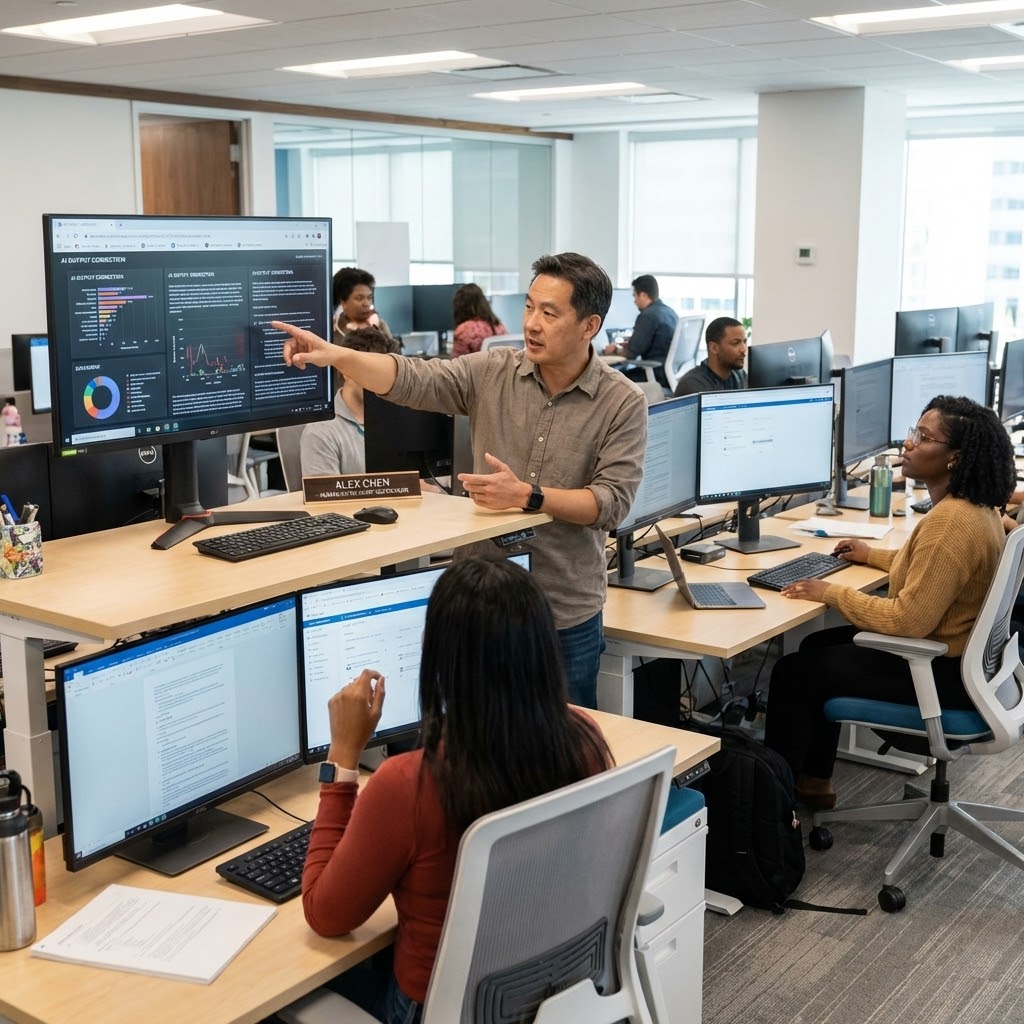 Projected · AI RevolutionHuman-in-the-Loop SupervisorIn the rapidly evolving landscape of the AI Revolution, the role of the Human-in-the-Loop Supervisor emerges as a pivotal position that bridges the gap between human intuition and machine learning algorithms. As artificial intelligence systems become increasingly sophisticated, the need for human oversight to ensure ethical decision-making, contextual understanding, and nuanced judgment becomes paramount. This role is not merely about managing AI systems; it is about enhancing their capabilities through human insight, ensuring that technology serves humanity's best interests.
The Human-in-the-Loop Supervisor is tasked with overseeing AI operations across various sectors, from healthcare to autonomous vehicles, ensuring that AI systems operate within ethical boundaries and align with societal values. This position requires a deep understanding of both technology and human behavior, as supervisors must interpret AI outputs, provide feedback for continuous learning, and intervene when necessary to prevent errors or biases. As AI systems learn from vast datasets, the supervisor's role is to ensure that these datasets are representative and free from harmful biases, thus safeguarding against unintended consequences.
In this future job, supervisors will also play a crucial role in training AI systems, providing the necessary context and real-world knowledge that machines often lack. They will collaborate with data scientists and engineers to refine algorithms, ensuring that AI systems not only perform efficiently but also ethically. The Human-in-the-Loop Supervisor will be at the forefront of a new era of responsible AI deployment, advocating for transparency, accountability, and inclusivity in technology development.